What’s Your Feelings Style? › The Cheerleader and the Clue Leaver
One of you keeps it upbeat, the other hints at how they feel
The Cheerleader and the Clue Leaver
One says the good things out loud. The other leaves clues about the hard ones, and a clue can get lost in the cheer.
A free quiz: pick what you’d really do in 12 everyday moments. About 3 minutes.
Where it works
There’s warmth both ways, and neither pushes a hard feeling on the other before they’re ready.
Where it trips
A hint can be easy to miss next to so much good news, and it may get answered with more cheer.
Where it shows up
- A compliment
- One says it big and out loud. The other may answer with a joke, and keep the words for days.
- Missing someone
- One texts “miss you!” The other may mention it’s been a while, and hope that’s enough to say it.
- A letdown
- One looks for the bright side right away. The other’s sigh may be asking for a minute first.
How each can be misread
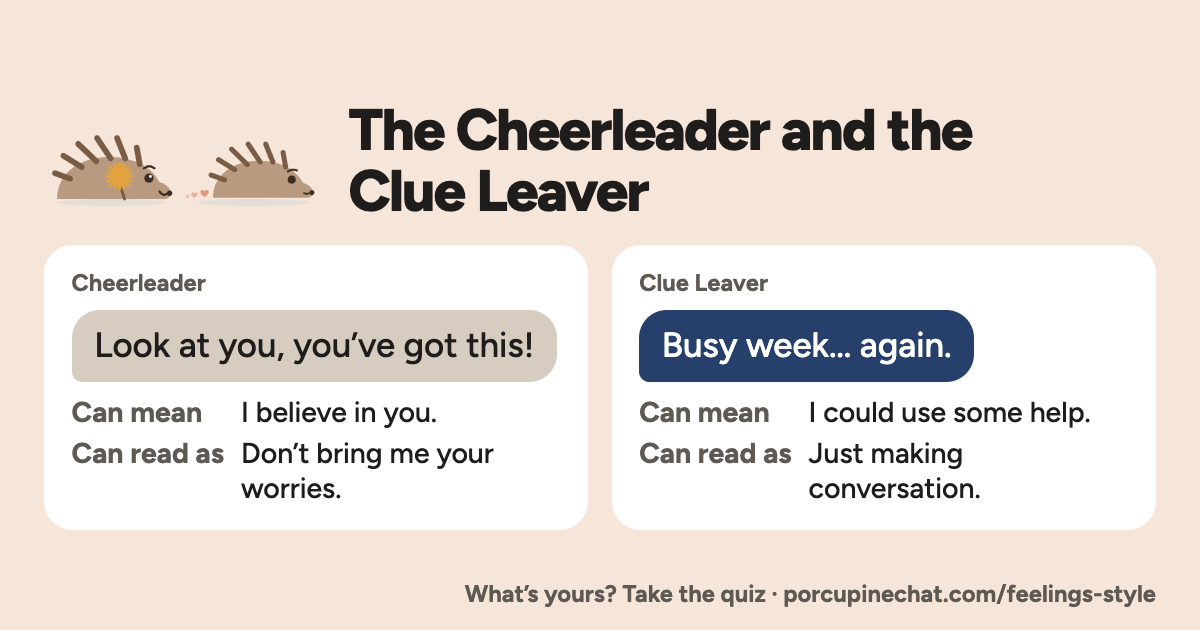
CheerleaderLook at you, you’ve got this!
- Can mean
- I believe in you.
- Can read as
- Don’t bring me your worries.
Clue LeaverBusy week… again.
- Can mean
- I could use some help.
- Can read as
- Just making conversation.
How it can go
One of them has a big presentation Friday and has been up late all week.
Clue LeaverUp late again… this deck never ends.
CheerleaderYou’re going to crush it! So proud of you.
Clue LeaverHa. Thanks.
PorcupineThe late nights may be a clue about feeling stretched thin. The cheer may be real support. What’s missing is a plain ask for help before Friday.
Why it helps: Check before assumingQuills down: the same moment, another way
CheerleaderThat sounds like a lot. How are you really doing with it?
Clue LeaverI’m stressed about Friday. Could you listen to my run-through tonight?
CheerleaderYes. After dinner, and I’ll time you.
One thing each can try
The Cheerleader
When something sounds like a clue, ask about it before you cheer.
That sounds like a lot. How are you really doing with it?
Why it helps: Check before assumingThe Clue Leaver
Say what you’d like, not only what’s happening.
I’m stressed about Friday. Could you listen to my run-through tonight?
Why it helps: Honest and hearableFinding the word
A feeling is easier to answer when it has a name. “Upset” could mean a lot of things; “left out” or “let down” gives the other person something they can answer.
Find the word: Feelings FinderAsk each other
Pick an easy moment, when you both have time to listen.
When I cheer you on, does it ever feel like I missed something?
How can I tell you something’s off so it doesn’t get lost?
Is there a sign I should watch for when you’re having a hard time?
Is it hard to hear my worries when you want to cheer me up?
Common questions
Do a Cheerleader and a Clue Leaver get along?
Often, yes. Warmth goes both ways, and neither pushes a hard feeling before the other is ready. The tricky part is that a quiet clue can get lost next to so much good news.
Why does a Clue Leaver hint instead of saying it?
A hint can feel safer than a plain sentence: it leaves room to take it back, and room for the other person to notice. When nobody picks it up, it can feel like they don’t care, even when they just missed it.
Know a pair like this?
What’s Your Feelings Style?
Pick what you’d really do in twelve everyday moments, and see which feelings you say, hint at, let come out as something else or keep in, and one thing to try.
Find your feelings styleMore on these styles
- The CheerleaderThe good ones out loud, the hard ones kept in.
- The Clue LeaverYou leave clues and hope they notice.
- The five feelings stylesFive ways people let a feeling out, or keep it in.
The quiz is for fun and conversation. It isn’t a scientific test, therapy, counseling or professional advice. The styles are Porcupine’s own, and they describe what people do with a feeling, not who they are. Afraid of how someone might react? Put your safety first, and talk to someone you trust.
Updated