What’s Your Feelings Style? › The Cheerleader and the Translator
One of you keeps it upbeat, the other turns hurt into sarcasm
The Cheerleader and the Translator
One says the good things out loud. The other’s hard feelings come out sharper, and the cheer can get the sharp end.
A free quiz: pick what you’d really do in 12 everyday moments. About 3 minutes.
Where it works
The cheerful side keeps things warm, and the sharper side doesn’t let a problem slide for long.
Where it trips
A sharp line can land hard on someone who keeps their hurt in, and the cheer may smooth over what the edge was about.
Where it shows up
- After a speech
- One says “you were amazing up there!” The other may answer “I was a wreck,” and still be glad to hear it.
- Running late
- One says “no worries!” The other may say “nice of you to show up,” and be glad they came.
- A flat tire
- One says “no big deal, these things happen!” The other kicks the tire and grumbles. Both may be stressed.
How each can be misread
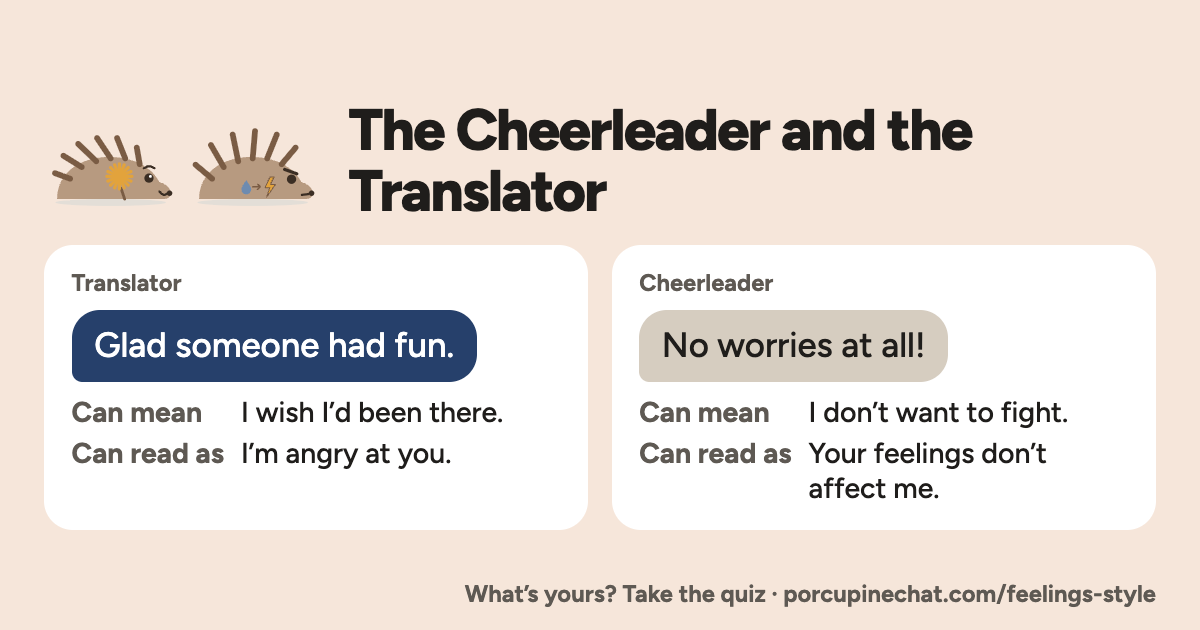
TranslatorGlad someone had fun.
- Can mean
- I wish I’d been there.
- Can read as
- I’m angry at you.
CheerleaderNo worries at all!
- Can mean
- I don’t want to fight.
- Can read as
- Your feelings don’t affect me.
How it can go
One of them just got back from a weekend away. The other worked all weekend.
CheerleaderThe cabin was amazing! You’d have loved it.
TranslatorMust be nice to have weekends.
CheerleaderNo worries! Next time for sure.
PorcupineThe edge may be about missing out, or feeling stuck. “No worries” may skip right past it, so “I missed you” never gets said.
Why it helps: Check before assumingQuills down: the same moment, another way
CheerleaderThat sounded like a hard week. Are you okay?
TranslatorSorry. I’m jealous, and I missed you.
CheerleaderI missed you too. Let’s plan the next one together.
One thing each can try
The Cheerleader
When something comes out sharp, ask what’s under it.
That sounded like a hard week. Are you okay?
Why it helps: Say what’s underneathThe Translator
Name the feeling under the edge.
Sorry. I’m jealous, and I missed you.
Why it helps: Say what’s underneathFinding the word
A feeling is easier to answer when it has a name. “Upset” could mean a lot of things; “left out” or “let down” gives the other person something they can answer.
Find the word: Feelings FinderAsk each other
Pick an easy moment, when you both have time to listen.
When you sound sharp, what’s the best thing I can ask?
When you say “no worries,” is there ever a worry?
Does my cheering ever make it harder to say you’re upset?
When I’m sharp with you, how does it land?
Common questions
Do a Cheerleader and a Translator get along?
They can: one keeps things warm, and the other makes sure a problem gets noticed. It gets bumpy when a sharp line meets a cheerful answer, and the feeling under both goes unsaid.
Why does a Translator sound sarcastic when they’re hurt?
For some people, hurt or worry comes out sharper than they feel it. The edge is what gets heard, but there may be something softer under it, like missing someone or feeling left out.
Know a pair like this?
What’s Your Feelings Style?
Pick what you’d really do in twelve everyday moments, and see which feelings you say, hint at, let come out as something else or keep in, and one thing to try.
Find your feelings styleMore on these styles
- The CheerleaderThe good ones out loud, the hard ones kept in.
- The TranslatorThe softer feelings come out sharper: hurt as sarcasm, worry as snapping.
- The five feelings stylesFive ways people let a feeling out, or keep it in.
The quiz is for fun and conversation. It isn’t a scientific test, therapy, counseling or professional advice. The styles are Porcupine’s own, and they describe what people do with a feeling, not who they are. Afraid of how someone might react? Put your safety first, and talk to someone you trust.
Updated