What’s Your Feelings Style? › The Translator
The Translator
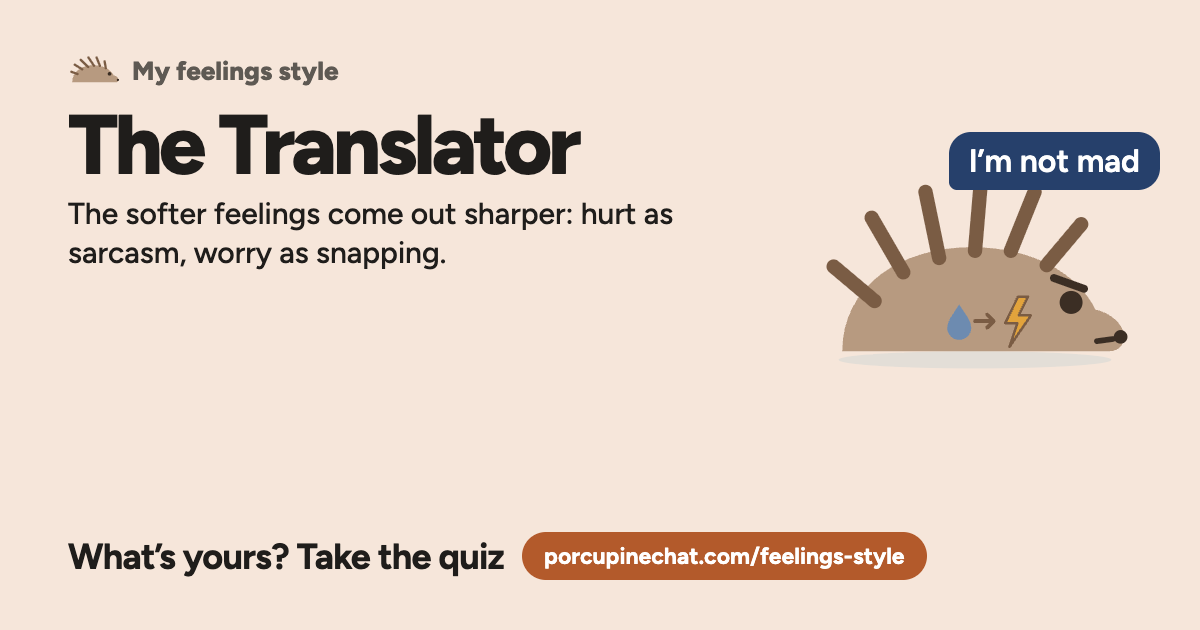
The softer feelings come out sharper: hurt as sarcasm, worry as snapping.
With the Translator, a softer feeling comes out as something sharper, so people hear the edge before the feeling.
Find your feelings styleA free quiz: pick what you’d really do in 12 everyday moments. About 3 minutes.
What the Translator looks like
Three everyday moments, handled the Translator way. Every style’s page uses the same three, so you can compare.
With a friend · Your friends throw you a small surprise party.
Joke: “Who told you I wanted attention?”
With family · A parent forgets to ask about your big week.
Text them: “Guess my week wasn’t interesting enough.”
At work · Your manager hands your project to someone else without asking you.
Tell your manager: “Sure, give it away. Not like I care.”
How the Translator lands
What the Translator does well
You don’t let things slide, and people know when something’s wrong.
Where the Translator trips
They hear the sharp part and answer that, so the hurt or worry underneath never gets answered.
One thing to try
Porcupine · a tipWhen you notice the edge, name what’s under it.
Instead ofWow, love waking up at six. Every day.
TryI’m frustrated about the alarm. Can we talk?
The Translator with each style
Where each pairing works, where it trips, and one thing each can try.
If someone does it like this
A sharp line may have something softer under it. You don’t have to answer the edge.
Answer what’s under it
Hurt can come out as sarcasm, and worry as snapping. Ask about that part.
You don’t have to match it
A calm question can bring the real feeling out.
Being scared is different
Saying how you feel is fine. Insults, threats or anything that scares you is something else, and no style explains it away.
If they sayOh, so now you have time for me?
Porcupine · a tipSkip the edge, and answer what may be under it.
You could saySounds like you’ve missed me. I’ve missed you too.
Common questions
What is a Translator with feelings?
With the Translator, a softer feeling comes out as something sharper, so people hear the edge before the feeling. Hurt can sound like sarcasm, and worry like snapping. People know something’s wrong, but they may answer the edge, not the feeling.
Why does hurt come out as sarcasm?
For some people, the sharp version feels easier to say than the soft one. Naming what’s underneath gives the other person something they can answer.
How do I stop being sarcastic when I’m upset?
Notice the edge, then say the feeling under it: “That came out sharp. I’m actually hurt.”
Am I a Translator?
If your softer feelings tend to come out sharper, maybe. The quiz gives you twelve everyday moments, each with a feeling in it, and shows which ones you tend to say, hint at, let come out as something else or keep in, in about three minutes.
Know someone this sounds like?
What’s Your Feelings Style?
Pick what you’d really do in twelve everyday moments, and see which feelings you say, hint at, let come out as something else or keep in, and one thing to try.
Find your feelings styleMore from Porcupine
All five styles
- The Open BookYou say it as it comes, the good and the hard.
- The TranslatorThe softer feelings come out sharper: hurt as sarcasm, worry as snapping.
- The CheerleaderThe good ones out loud, the hard ones kept in.
- The VaultMost of it stays inside.
- The Clue LeaverYou leave clues and hope they notice.
The quiz is for fun and conversation. It isn’t a scientific test, therapy, counseling or professional advice. The styles are Porcupine’s own, and they describe what people do with a feeling, not who they are. Afraid of how someone might react? Put your safety first, and talk to someone you trust.
Updated