What’s Your Conflict Style? › The Case Maker and the Untangler
Conflict styles, together
The Case Maker and the Untangler
Both go toward the problem. One wants the facts of it, and the other wants what’s under it.
A free quiz: pick what you’d really do in 12 everyday moments. About 3 minutes.
Where it works
Neither one walks away. Both speak up, stay with it and want it sorted out.
Where it trips
“What happened?” and “What’s really going on?” are different questions. Each can feel the other is skipping the part that matters, and it can run very late.
How each can be misread
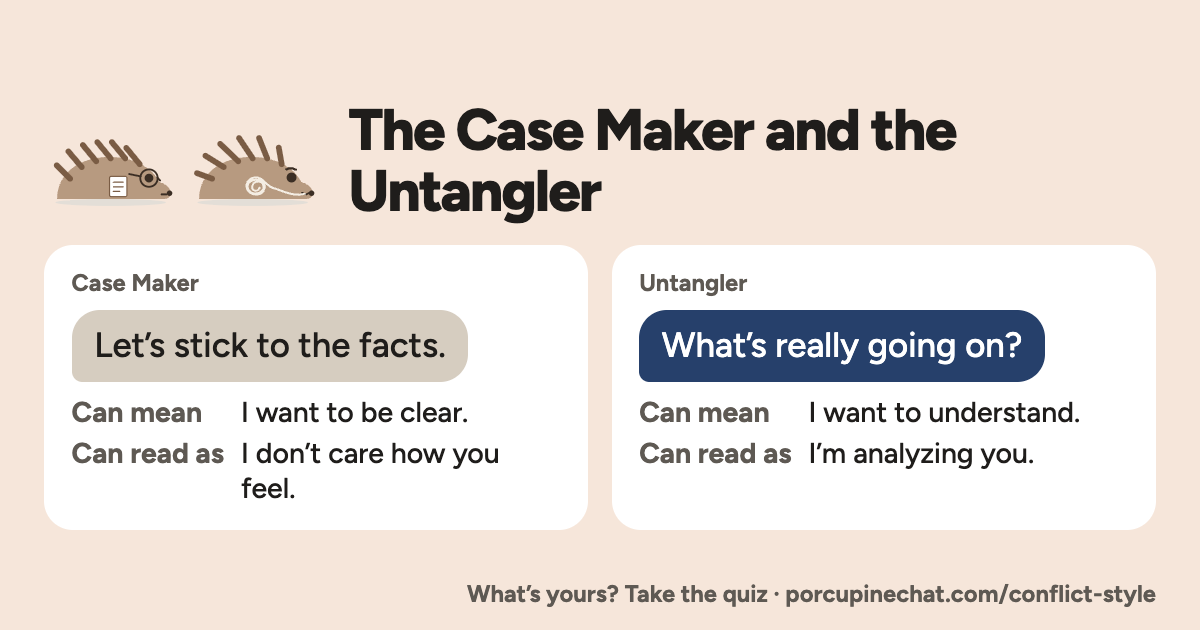
Case MakerLet’s stick to the facts.
- Can mean
- I want to be clear.
- Can read as
- I don’t care how you feel.
UntanglerWhat’s really going on?
- Can mean
- I want to understand.
- Can read as
- I’m analyzing you.
How it can go
A mix-up over the calendar
UntanglerI don’t think this is about the calendar. What’s really going on?
Case MakerIt’s about the calendar. Let’s stick to the facts.
UntanglerBut how did that feel?
PorcupineIt may be about the calendar, or it may be about more than that. Both could be true, and they may be answering different questions.
Why it helps: Check before assuming › Free tool · What does this text mean?Got a message like this?Paste it in to see a few ways it could be read, and what you could say back. We don’t save it.Check a textOne thing each can try
The Case Maker
Say one thing about how it felt, even briefly.
The facts matter to me because I felt blamed.
Why it helps: Say what’s underneath ›The Untangler
Take the facts seriously first.
You’re right about the calendar. Can I also ask how it felt?
Why it helps: Understand before answering ›After a fight
Style is only half of it. Two people can want different things afterward: one wants to talk tonight, and the other needs a day. Neither is wrong. Say it out loud: “Here’s what I need after a fight. What do you need?”
Know a pair like this?
What’s Your Conflict Style?
Pick what you’d really do in twelve everyday moments, and see your style, how you come back from it and one thing to try.
Find your conflict styleMore on these styles
- The Case MakerYou have your facts straight, and you came prepared.
- The UntanglerYou can’t rest until you get to the bottom of it.
- The seven conflict stylesSeven ways people handle a disagreement, and five ways they come back from it.
No style is the best one: each works sometimes and trips sometimes, and yours may change with the person and the day. The quiz is for fun and conversation. It isn’t a scientific test, and it isn’t therapy, counseling or professional advice. Porcupine made up these styles and ways back, drawing loosely on common ideas about conflict, and nobody has tested them. They describe what people do in a disagreement, not who they are or how a relationship is going. If you’re afraid of how someone might react, a page like this isn’t enough: put your safety first and talk to someone you trust (Safety first).