What’s Your Conflict Style? › The Case Maker
Conflict styles
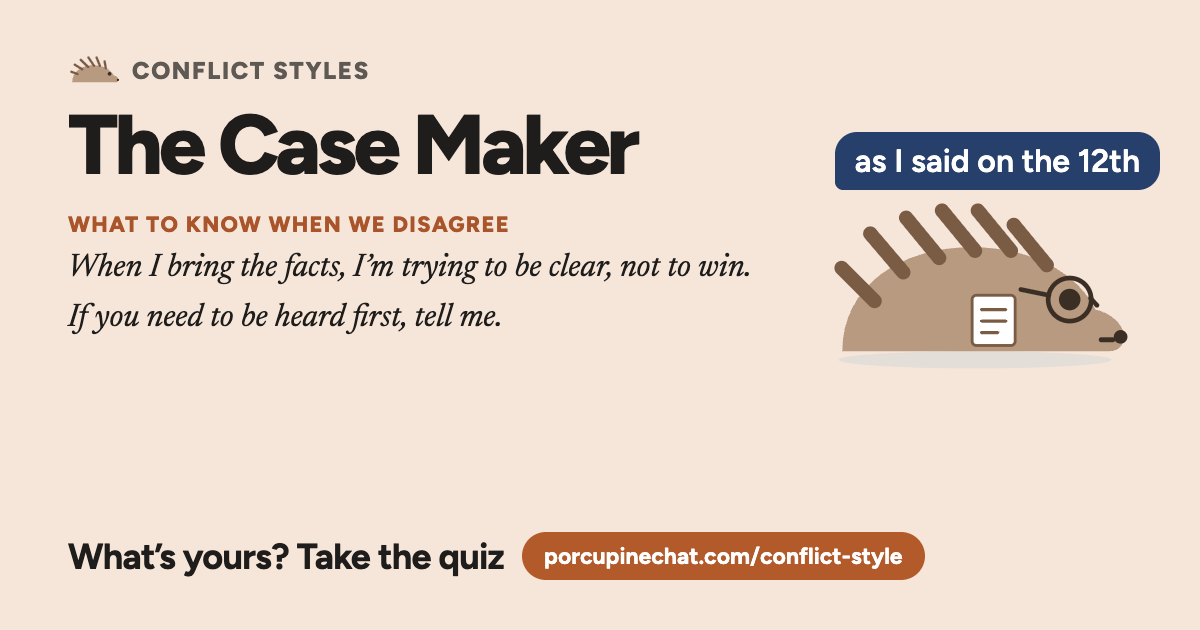
The Case Maker
You have your facts straight, and you came prepared.
The Case Maker comes to a disagreement prepared: the facts, the dates, and a clear reason for each point.
Find your conflict styleA free quiz: pick what you’d really do in 12 everyday moments. About 3 minutes.
What it looks like
Three everyday moments, handled the Case Maker way. Every style’s page uses the same three, so you can compare.
With a friend · They borrowed your car and brought it back with the tank empty.
Send a photo of the gauge, and remind them what you agreed.
With family · A parent rearranges your kitchen on every visit.
Point out the three times you’ve asked them not to.
At work · A coworker keeps leaving you off the emails about your project.
Forward the emails you missed, with the dates, and ask why.
How it lands
What it does well
You stand up for what matters, and you’re clear about why.
Where it trips
You can win the point and still leave them feeling unheard.
One thing to try
Porcupine · a tipBefore your next point, say theirs back to them.
Instead ofActually, here’s why that’s wrong.
TrySo you felt left out of the decision. Did I get that right?
A guide that may help: How to disagree with your boss respectfully ›
With other styles
With people who make more room
The Firecracker · The Untangler
What they give up may be easy to miss.
Try: Ask: “What would you want, if it were up to you?”
With people who speak up less
The Peacekeeper · The Quiet One · The Deal Maker
It may feel settled to you before it does to them.
Try: Leave a gap, and ask: “What do you think? I really want to know.”
The Case Maker with each style
Where each pairing works, where it trips, and one thing each can try.
If someone handles it like this
A list of facts can feel like being cross-examined. It may just be how they try to be clear.
Answer the fact first
If they’re right about the date, say so. It clears the way for the rest.
Then say how it was for you
“You’re right about Tuesday, and I still felt left out” gives your point somewhere to go.
Ask to be heard first
It’s fair to say: “Before the details, can I tell you how this felt?”
If they sayAs I said last week, we agreed on the 3rd.
Porcupine · a tipSay what’s true in it, then what you’d like them to hear.
You could sayYou’re right, we did. I’d still like you to hear why it was hard.
Common questions
What is a Case Maker in a conflict?
Arguing from the record: “As I said on the 12th,” with the dates and details ready. It’s clear and prepared, and it can feel like a courtroom from the other side.
Is the Case Maker a competing conflict style?
Close. “Competing” is the usual name for standing firm on your own side. Porcupine made up the Case Maker, and its name puts the weight on facts and reasons.
Why do I win the argument and still feel bad?
Being right can settle the point and leave the feeling where it was. If they feel unheard, the disagreement isn’t over, even when the facts are in.
How do I stop arguing like a lawyer?
Before your next point, say theirs back to them: “So you felt left out of the decision. Did I get that right?” Then make your point.
Am I a Case Maker?
If you tend to come with your facts straight, maybe. The quiz gives you twelve everyday moments and shows what you tend to do when something’s wrong and how you come back from it, in about three minutes.
Know someone this sounds like?
What’s Your Conflict Style?
Pick what you’d really do in twelve everyday moments, and see your style, how you come back from it and one thing to try.
Find your conflict styleMore from Porcupine
All seven styles
- The FirecrackerQuick to light, quick to fizzle out.
- The UntanglerYou can’t rest until you get to the bottom of it.
- The PeacekeeperYou’ll give a lot to keep things good between you.
- The Quiet OneWhen it gets hard, you go quiet.
- The Case MakerYou have your facts straight, and you came prepared.
- The Deal MakerYou’d rather both get something than argue all night.
- The ChameleonNo one style stood out, and your choices moved around.
The five ways back
A way back is what you need after a fight. It goes with any of the seven styles.
- Talk It ThroughYou need to go back over it until you both understand.
- Sorry FirstYou’re the first to say sorry.
- Give It TimeYou need space before you can come back to it.
- Back to NormalA joke, a coffee, and it’s over.
- Fix ItYou want to know what’s different next time.
No style is the best one: each works sometimes and trips sometimes, and yours may change with the person and the day. The quiz is for fun and conversation. It isn’t a scientific test, and it isn’t therapy, counseling or professional advice. Porcupine made up these styles and ways back, drawing loosely on common ideas about conflict, and nobody has tested them. They describe what people do in a disagreement, not who they are or how a relationship is going. If you’re afraid of how someone might react, a page like this isn’t enough: put your safety first and talk to someone you trust (Safety first).