What’s Your Conflict Style? › Two Peacekeepers
Conflict styles, together
Two Peacekeepers
Two people keeping the peace. It’s kind, it’s calm, and what each one wants may never come up.
A free quiz: pick what you’d really do in 12 everyday moments. About 3 minutes.
Where it works
Both notice what the other needs, and small things get let go. Very little turns into a fight.
Where it trips
When both give way, the decision can land on something neither one wanted. What each gives up can build up on both sides, with nobody saying so.
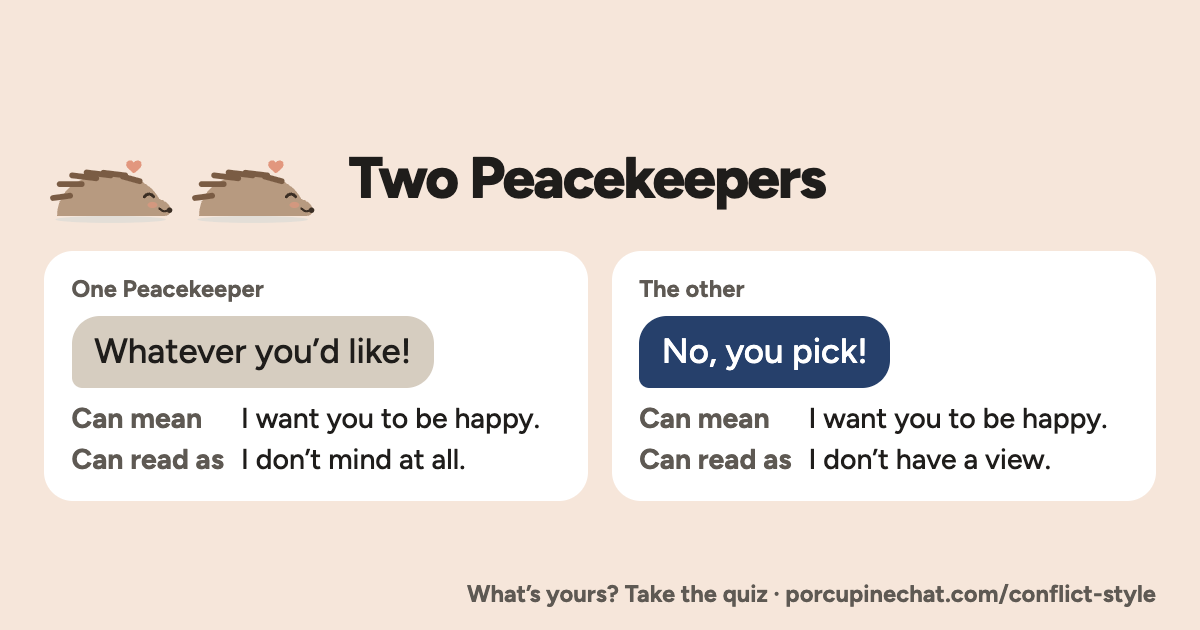
How each can be misread
One PeacekeeperWhatever you’d like!
- Can mean
- I want you to be happy.
- Can read as
- I don’t mind at all.
The otherNo, you pick!
- Can mean
- I want you to be happy.
- Can read as
- I don’t have a view.
How it can go
Picking a place to eat
One PeacekeeperWhatever you’d like!
The otherNo, you pick!
One PeacekeeperHonestly, anything’s fine.
PorcupineThey may both want the same place, or two different ones. Both are being kind, and neither has said what they’d like.
Why it helps: Check before assuming › Free tool · Is this text passive-aggressive?Got a message like this?Paste it in to see a few ways it could be read, and what you could say back. We don’t save it.Check a textOne thing each can try
Whoever goes first
Go first with a small want.
I’d love tacos tonight. How does that sound?
Why it helps: Honest and hearable ›Whoever answers
Answer, and add one of yours.
Tacos sound good, and I’d like to pick next time.
Why it helps: Honest and hearable ›After a fight
Style is only half of it. Two people can want different things afterward: one wants to talk tonight, and the other needs a day. Neither is wrong. Say it out loud: “Here’s what I need after a fight. What do you need?”
Know a pair like this?
What’s Your Conflict Style?
Pick what you’d really do in twelve everyday moments, and see your style, how you come back from it and one thing to try.
Find your conflict style- The PeacekeeperYou’ll give a lot to keep things good between you.
- The seven conflict stylesSeven ways people handle a disagreement, and five ways they come back from it.
No style is the best one: each works sometimes and trips sometimes, and yours may change with the person and the day. The quiz is for fun and conversation. It isn’t a scientific test, and it isn’t therapy, counseling or professional advice. Porcupine made up these styles and ways back, drawing loosely on common ideas about conflict, and nobody has tested them. They describe what people do in a disagreement, not who they are or how a relationship is going. If you’re afraid of how someone might react, a page like this isn’t enough: put your safety first and talk to someone you trust (Safety first).