What’s Your Conflict Style? › The Peacekeeper
Conflict styles
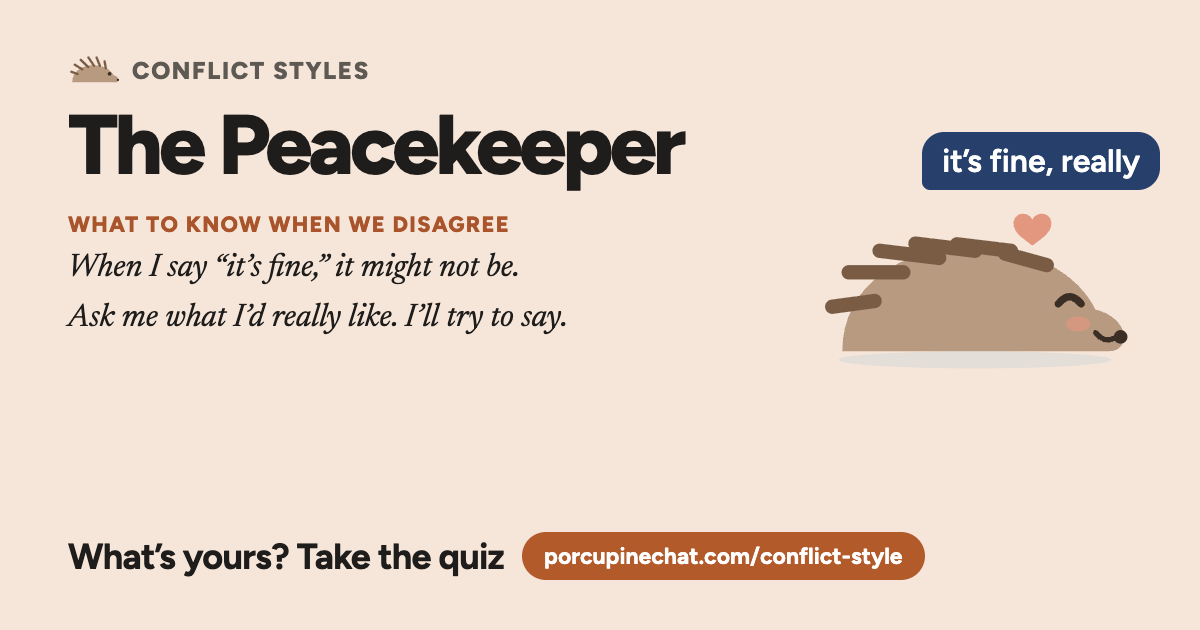
The Peacekeeper
You’ll give a lot to keep things good between you.
The Peacekeeper gives way to keep things good between you: letting small things go, and sometimes big ones, so nobody’s upset.
Find your conflict styleA free quiz: pick what you’d really do in 12 everyday moments. About 3 minutes.
What it looks like
Three everyday moments, handled the Peacekeeper way. Every style’s page uses the same three, so you can compare.
With a friend · They borrowed your car and brought it back with the tank empty.
Fill it up yourself. It’s only gas, and they’re a good friend.
With family · A parent rearranges your kitchen on every visit.
Learn where everything goes now. They’re trying to help.
At work · A coworker keeps leaving you off the emails about your project.
Ask someone else to forward the emails, so nobody has to feel awkward.
How it lands
What it does well
You notice what other people need, and you let small things go.
Where it trips
What you give up can build up quietly, and they may never know there was anything to give.
One thing to try
Porcupine · a tipPick one small thing this week and say what you’d like.
Instead ofWhatever you want is fine.
TryI’d actually prefer Thai tonight.
A guide that may help: How to say no without feeling guilty ›
With other styles
With people who speak up more
The Firecracker · The Untangler · The Case Maker · The Deal Maker
It may feel settled to them before it does to you.
Try: Say one thing you’d otherwise keep: “I see it differently.”
With people who make less room
What you give up may be easy for them to miss.
Try: Say your side too: “Here’s what matters to me.”
The Peacekeeper with each style
Where each pairing works, where it trips, and one thing each can try.
If someone handles it like this
“It’s fine, really” may be true. It may also be what’s easiest to say. A little room helps them tell you which.
Ask what they’d like
“What would you pick?” is easier to answer than “Are you sure?”
Make a real opening
If you’re asking, mean it, and wait for the answer. A quick “great, thanks!” closes the door.
Take it well
When they do tell you something, thank them for it. It’s how the next one gets said.
If they sayIt’s fine, really. You decide.
Porcupine · a tipGive them an easy way to say more.
You could sayI know you’d go along with it. If you were picking, what would you pick?
Common questions
What is a Peacekeeper in a conflict?
“It’s fine, really,” even when it isn’t quite. The other person’s comfort comes first, and small things get let go.
Is the Peacekeeper an accommodating conflict style?
Close. “Accommodating” is the usual name for giving way to what the other person wants. Porcupine made up the Peacekeeper, which also asks what that costs you.
Is keeping the peace a bad thing?
No. Noticing what others need and letting small things go is a real strength. It trips when what you give up builds up, and they never knew there was anything to give.
How do I stop saying “it’s fine” when it isn’t?
Start small. Pick one thing this week and say what you’d like, like “I’d actually prefer Thai tonight.”
Is keeping the peace ever the wrong call?
Yes. Letting small things go is one thing, and putting up with mistreatment is another. If you’re giving way because you’re afraid of how someone might react, that isn’t a style: put your safety first and talk to someone you trust.
Am I a Peacekeeper?
If you often give way to keep things good, maybe. The quiz gives you twelve everyday moments and shows what you tend to do when something’s wrong and how you come back from it, in about three minutes.
Know someone this sounds like?
What’s Your Conflict Style?
Pick what you’d really do in twelve everyday moments, and see your style, how you come back from it and one thing to try.
Find your conflict styleMore from Porcupine
All seven styles
- The FirecrackerQuick to light, quick to fizzle out.
- The UntanglerYou can’t rest until you get to the bottom of it.
- The PeacekeeperYou’ll give a lot to keep things good between you.
- The Quiet OneWhen it gets hard, you go quiet.
- The Case MakerYou have your facts straight, and you came prepared.
- The Deal MakerYou’d rather both get something than argue all night.
- The ChameleonNo one style stood out, and your choices moved around.
The five ways back
A way back is what you need after a fight. It goes with any of the seven styles.
- Talk It ThroughYou need to go back over it until you both understand.
- Sorry FirstYou’re the first to say sorry.
- Give It TimeYou need space before you can come back to it.
- Back to NormalA joke, a coffee, and it’s over.
- Fix ItYou want to know what’s different next time.
No style is the best one: each works sometimes and trips sometimes, and yours may change with the person and the day. The quiz is for fun and conversation. It isn’t a scientific test, and it isn’t therapy, counseling or professional advice. Porcupine made up these styles and ways back, drawing loosely on common ideas about conflict, and nobody has tested them. They describe what people do in a disagreement, not who they are or how a relationship is going. If you’re afraid of how someone might react, a page like this isn’t enough: put your safety first and talk to someone you trust (Safety first).