What’s Your Feelings Style? › The Clue Leaver and the Open Book
One of you hints at how they feel, the other says feelings as they come
The Clue Leaver and the Open Book
One says it as it comes. The other leaves clues, and a clue can go right past someone who expects things said.
A free quiz: pick what you’d really do in 12 everyday moments. About 3 minutes.
Where it works
The open side brings things into the light, and the hinting side leaves room to answer gently.
Where it trips
The open side may answer only what’s said out loud. And a feeling said plainly can feel like a lot to someone who’d have hinted it.
Where it shows up
- Choosing dinner
- One says what they want. The other says “anything’s fine,” and may be hoping for tacos.
- A sharp joke
- One says “that stung” right away. The other may have felt it too, and bring it up days later, sideways.
- A long day
- One says “I’m wiped.” The other sighs a lot on the couch, and hopes someone asks.
How each can be misread
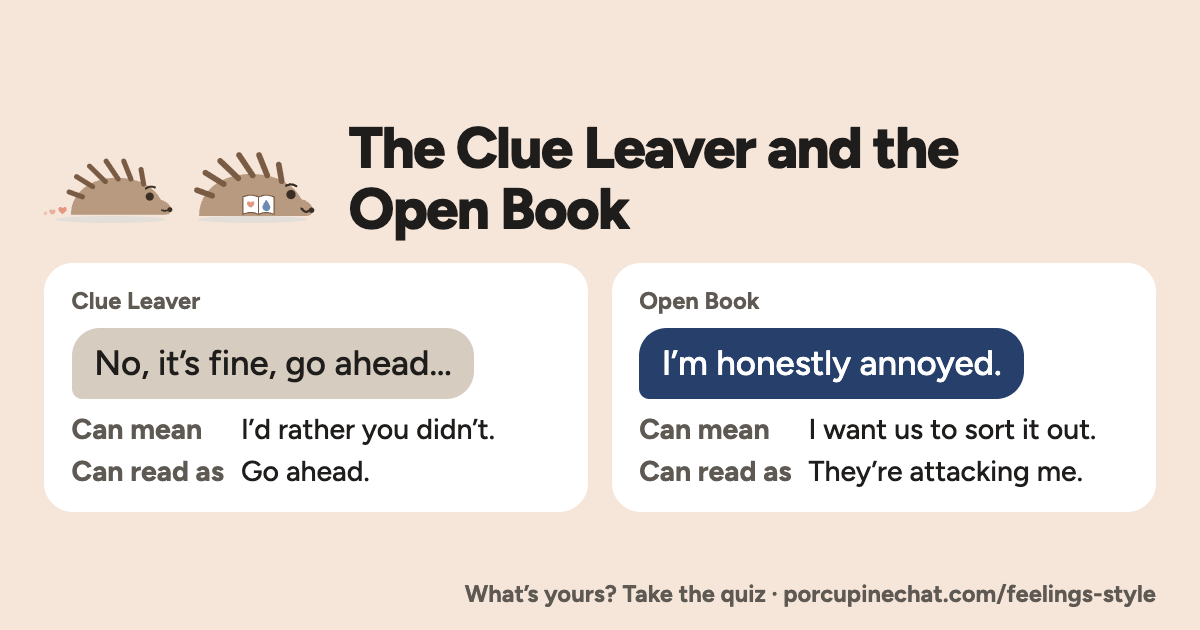
Clue LeaverNo, it’s fine, go ahead…
- Can mean
- I’d rather you didn’t.
- Can read as
- Go ahead.
Open BookI’m honestly annoyed.
- Can mean
- I want us to sort it out.
- Can read as
- They’re attacking me.
How it can go
A couple planning a weekend. One wants to visit family, and the other would rather not.
Open BookI’d really love to see my family this weekend.
Clue LeaverSure… if that’s what you want…
Open BookGreat, I’ll tell them we’re coming!
Porcupine“If that’s what you want” may mean not really. “Great” may have taken it at its word. “I’d rather stay home” hasn’t been said, and the family is already expecting them.
Why it helps: Check before assumingQuills down: the same moment, another way
Open BookYou sound unsure. What would you rather do?
Clue LeaverI’d rather stay home this time. Next month?
Open BookOkay. I’ll call them about next month.
One thing each can try
The Open Book
When an answer sounds unsure, check before you plan.
You sound unsure. What would you rather do?
Why it helps: Check before assumingThe Clue Leaver
Say what you’d like, even if it’s a no.
I’d rather stay home this time. Next month?
Why it helps: Honest and hearableFinding the word
A feeling is easier to answer when it has a name. “Upset” could mean a lot of things; “left out” or “let down” gives the other person something they can answer.
Find the word: Feelings FinderAsk each other
Pick an easy moment, when you both have time to listen.
Do I say things too fast for you to answer?
When I hint, would you rather I just say it?
How can I tell when “fine” means fine?
Does it bother you when I don’t say it plainly?
Common questions
Do a Clue Leaver and an Open Book get along?
One brings things into the open, and the other leaves room to answer gently. The tricky part is that the open side may take a hint at its word, and miss what was under it.
Why does a Clue Leaver say “it’s fine” when it isn’t?
Saying it plainly can feel like too much, so the feeling comes out as a clue instead: a pause, a sigh, a “sure.” Asking what they’d rather do can make room for the real answer.
Know a pair like this?
What’s Your Feelings Style?
Pick what you’d really do in twelve everyday moments, and see which feelings you say, hint at, let come out as something else or keep in, and one thing to try.
Find your feelings styleMore on these styles
- The Clue LeaverYou leave clues and hope they notice.
- The Open BookYou say it as it comes, the good and the hard.
- The five feelings stylesFive ways people let a feeling out, or keep it in.
The quiz is for fun and conversation. It isn’t a scientific test, therapy, counseling or professional advice. The styles are Porcupine’s own, and they describe what people do with a feeling, not who they are. Afraid of how someone might react? Put your safety first, and talk to someone you trust.
Updated