What’s Your Feelings Style? › The Clue Leaver and the Translator
One of you hints at how they feel, the other turns hurt into sarcasm
The Clue Leaver and the Translator
One leaves clues. The other’s hard feelings come out sharper. Neither says the soft part plainly.
A free quiz: pick what you’d really do in 12 everyday moments. About 3 minutes.
Where it works
You both notice when something’s off, and neither lets it pass without a sign.
Where it trips
A hint can get a sharp answer, and a sharp line can send the hinting side further into hints. The feeling under both stays unsaid.
Where it shows up
- Chores
- One leaves the full trash bag by the door. The other says “subtle.” Neither has asked for help yet.
- Waiting to hear
- One keeps asking if there’s news on the job offer. The other snaps “I said I’ll tell you.” Both may be worried.
- Canceled plans
- One says “guess that’s off, then.” The other says “figures.” Both may be more let down than they sound.
How each can be misread
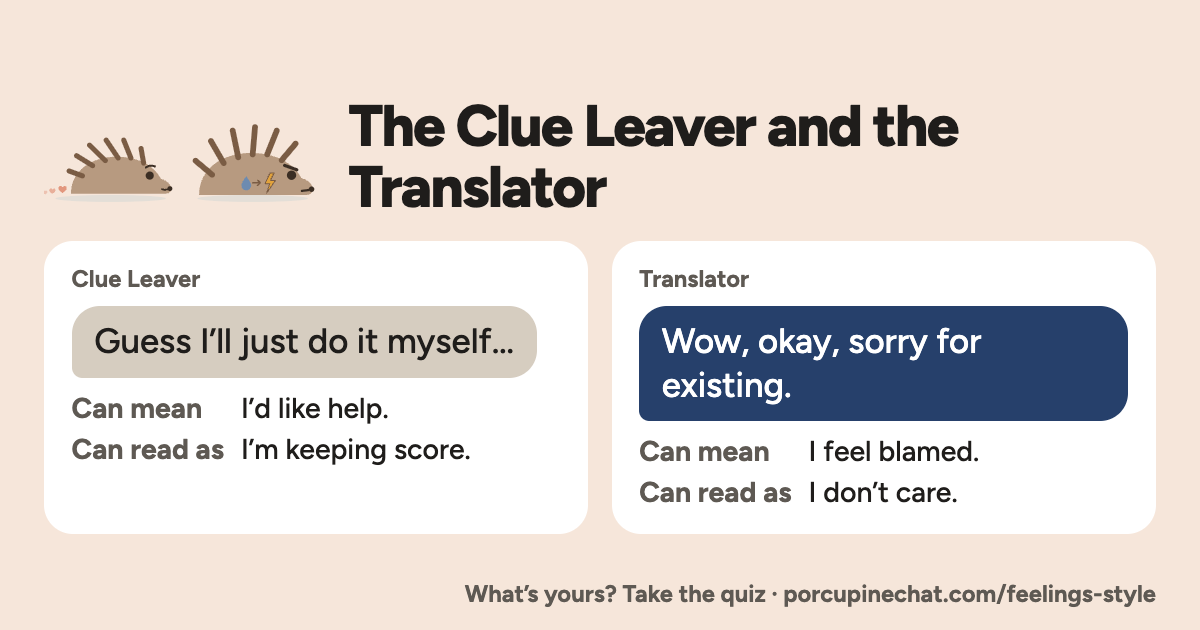
Clue LeaverGuess I’ll just do it myself…
- Can mean
- I’d like help.
- Can read as
- I’m keeping score.
TranslatorWow, okay, sorry for existing.
- Can mean
- I feel blamed.
- Can read as
- I don’t care.
How it can go
Coworkers sharing a project. The slides are due tomorrow.
Clue LeaverGuess I’ll stay late again then…
TranslatorNobody asked you to.
Clue LeaverRight. Never mind.
PorcupineStaying late may be a clue about needing help. “Nobody asked you to” may be feeling blamed. Both may want the deck done together, and nobody has asked who takes which slides.
Why it helps: Check before assumingQuills down: the same moment, another way
Clue LeaverCould you take the last five slides tonight?
TranslatorYes, I’ll take five. I was starting to feel blamed for the late nights.
Clue LeaverThank you. I should have just asked sooner.
One thing each can try
The Clue Leaver
Ask for the help plainly.
Could you take the last five slides tonight?
Why it helps: Honest and hearableThe Translator
When you notice the edge, name what’s under it.
Yes, I’ll take five. I was starting to feel blamed for the late nights.
Why it helps: Say what’s underneathFinding the word
A feeling is easier to answer when it has a name. “Upset” could mean a lot of things; “left out” or “let down” gives the other person something they can answer.
Find the word: Feelings FinderAsk each other
Pick an easy moment, when you both have time to listen.
When I drop a hint, how does it come across to you?
When I snap, what do you hear?
What could I say plainly that would be easier to answer?
When I sound sharp, what do you think is under it?
Common questions
Do a Clue Leaver and a Translator get along?
They can. Both notice when something’s off, and neither lets it pass without a sign. Saying the soft part plainly helps, since a hint can get a sharp answer, and a sharp answer can bring more hints.
Why does a Translator snap at a hint?
A hint can sound like blame, especially a sigh or a pointed comment. The sharp answer may come from feeling accused, rather than not caring. A plain ask is harder to hear as blame.
Know a pair like this?
What’s Your Feelings Style?
Pick what you’d really do in twelve everyday moments, and see which feelings you say, hint at, let come out as something else or keep in, and one thing to try.
Find your feelings styleMore on these styles
- The Clue LeaverYou leave clues and hope they notice.
- The TranslatorThe softer feelings come out sharper: hurt as sarcasm, worry as snapping.
- The five feelings stylesFive ways people let a feeling out, or keep it in.
The quiz is for fun and conversation. It isn’t a scientific test, therapy, counseling or professional advice. The styles are Porcupine’s own, and they describe what people do with a feeling, not who they are. Afraid of how someone might react? Put your safety first, and talk to someone you trust.
Updated