What’s Your Feelings Style? › The Open Book and the Vault
One of you says feelings as they come, the other keeps feelings in
The Open Book and the Vault
One says it as it comes. The other keeps most things in, and the gap can feel bigger than it is.
A free quiz: pick what you’d really do in 12 everyday moments. About 3 minutes.
Where it works
The open side says what’s going on, and the quiet side stays steady when feelings run high.
Where it trips
The open side may fill the quiet with guesses, and the quiet side may feel pushed to say more than they’re ready to.
Where it shows up
- Good news
- One says how thrilled they are. The other may be just as glad and say “nice,” and the first may wonder if it landed.
- A worry
- One says it the minute they feel it. The other turns it over first, and may bring it up days later, or not at all.
- After an argument
- One wants to talk it out now. The other may need a day before they know what they feel.
How each can be misread
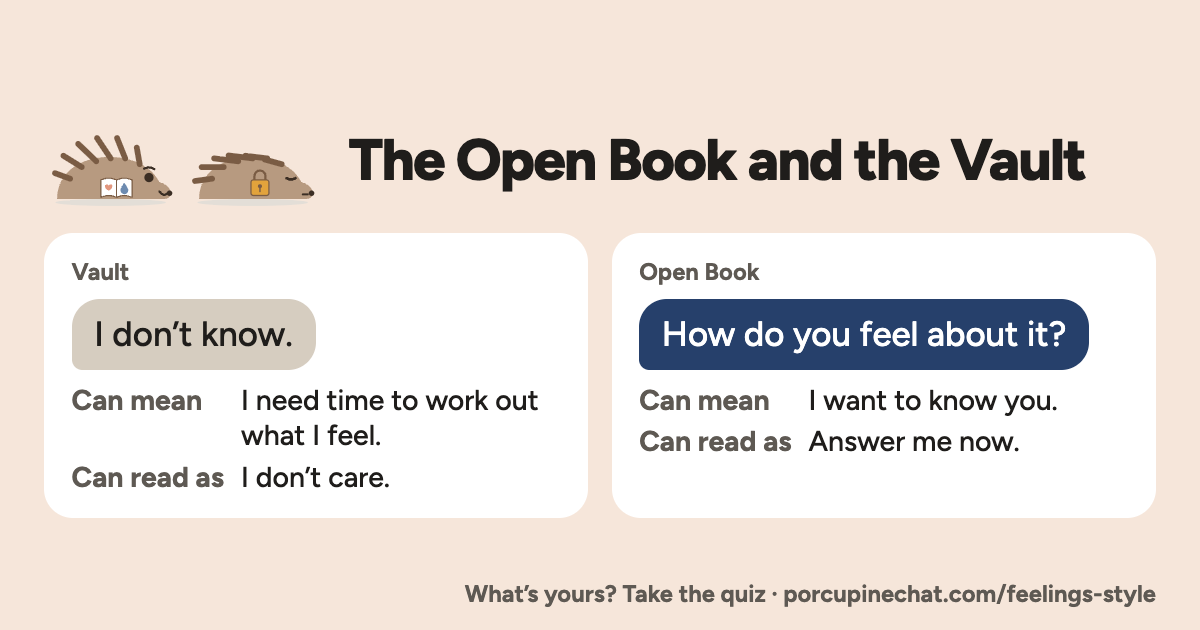
VaultI don’t know.
- Can mean
- I need time to work out what I feel.
- Can read as
- I don’t care.
Open BookHow do you feel about it?
- Can mean
- I want to know you.
- Can read as
- Answer me now.
How it can go
One of them just learned they might have to move for work.
Open BookI’m excited and scared and sad all at once. How do you feel?
VaultI don’t know yet.
Open BookHow can you not know?
Porcupine“I don’t know yet” may be honest: some people need time to know what they feel. “How can you not know?” may come from not wanting to face the move alone.
Why it helps: Check before assumingQuills down: the same moment, another way
Open BookNo rush. Can we talk about it this weekend?
VaultI don’t know yet, but I know I’m worried about us.
Open BookMe too. We’ll work it out together.
One thing each can try
The Open Book
Give them time, and say when you’ll ask again.
No rush. Can we talk about it this weekend?
Why it helps: Ask, don’t pressureThe Vault
Say one thing you do know, even a small one.
I don’t know yet, but I know I’m worried about us.
Why it helps: Honest and hearableFinding the word
A feeling is easier to answer when it has a name. “Upset” could mean a lot of things; “left out” or “let down” gives the other person something they can answer.
Find the word: Feelings FinderAsk each other
Pick an easy moment, when you both have time to listen.
When I say how I feel right away, is it ever too much?
When I go quiet, what do you wish I’d say, even if it’s small?
When is it easiest for you to say how you feel?
When I need time, how can I show you I’m not shutting you out?
Common questions
Do an Open Book and a Vault get along?
They can steady each other: one keeps feelings out in the open, and the other stays calm when things run high. The gap is mostly timing. One knows what they feel right away, and the other needs a while to find it.
Why does a Vault say “I don’t know” about a feeling?
Some people need time to sort out a feeling before they can name it. “I don’t know” can be honest, not a way of closing the door.
Know a pair like this?
What’s Your Feelings Style?
Pick what you’d really do in twelve everyday moments, and see which feelings you say, hint at, let come out as something else or keep in, and one thing to try.
Find your feelings styleMore on these styles
- The Open BookYou say it as it comes, the good and the hard.
- The VaultMost of it stays inside.
- The five feelings stylesFive ways people let a feeling out, or keep it in.
The quiz is for fun and conversation. It isn’t a scientific test, therapy, counseling or professional advice. The styles are Porcupine’s own, and they describe what people do with a feeling, not who they are. Afraid of how someone might react? Put your safety first, and talk to someone you trust.
Updated