What’s Your Feelings Style? › Two Translators
When you both turn hurt into sarcasm
Two Translators
Two people whose hard feelings come out sharper. Things get said, with an edge both ways.
A free quiz: pick what you’d really do in 12 everyday moments. About 3 minutes.
Where it works
Neither of you lets a problem slide, and you both know when something’s wrong.
Where it trips
Sharp meets sharp, and each answers the other’s edge, so the hurt or worry under both can go unanswered.
Where it shows up
- Moving day
- Boxes everywhere, and both get short with each other. Each may be tired and nervous, not angry.
- A homecoming
- “I missed you” may come out as “look who’s back.” Both may hear the joke and miss the hello.
- A forgotten plan
- One says “cool, I’ll just wait then.” The other says “you could’ve reminded me.” Both may feel let down.
How each can be misread
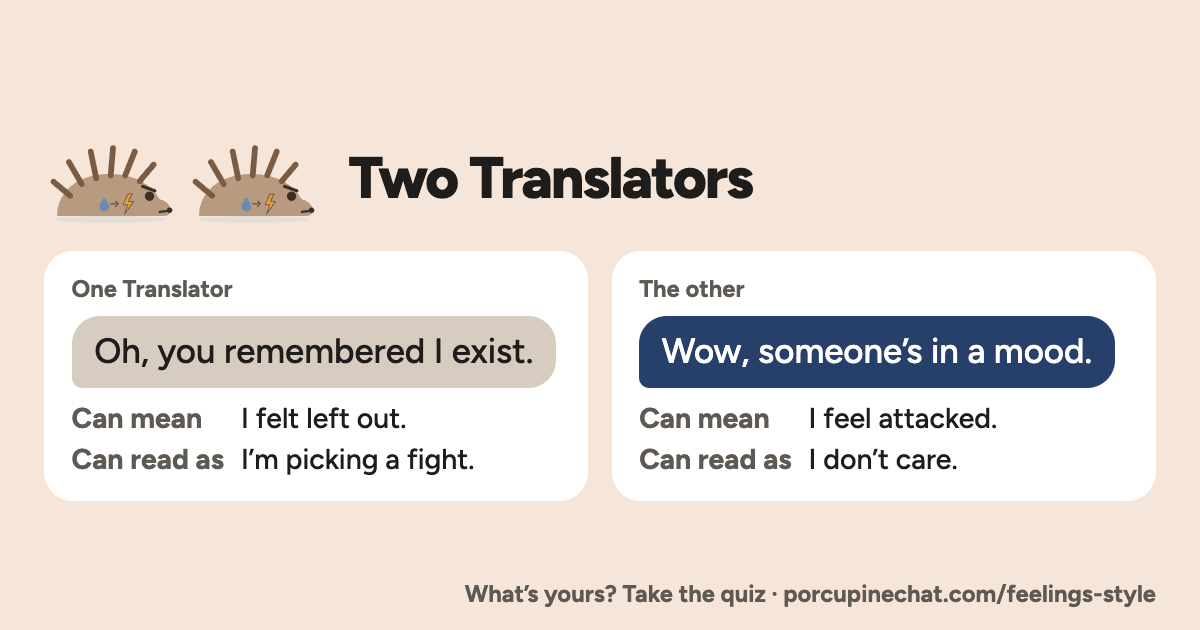
One TranslatorOh, you remembered I exist.
- Can mean
- I felt left out.
- Can read as
- I’m picking a fight.
The otherWow, someone’s in a mood.
- Can mean
- I feel attacked.
- Can read as
- I don’t care.
How it can go
Old friends. One of them found out about a party from the photos.
One TranslatorGreat party. Shame my invite got lost.
The otherOh, here we go.
One TranslatorForget it.
PorcupineThe joke may be about feeling left out. “Here we go” may be feeling accused. Both answered the edge, and “I wish I’d been asked” never came up.
Why it helps: Check before assumingQuills down: the same moment, another way
One TranslatorI felt left out when I saw the photos.
The otherI’m sorry. I should have asked you. I didn’t think.
One TranslatorThanks. Next one’s at my place.
One thing each can try
Whoever goes first
Name the feeling, not the edge.
I felt left out when I saw the photos.
Why it helps: Say what’s underneathWhoever answers
When it sounds sharp, answer what’s under it.
I’m sorry. I should have asked you. I didn’t think.
Why it helps: Own your partFinding the word
A feeling is easier to answer when it has a name. “Upset” could mean a lot of things; “left out” or “let down” gives the other person something they can answer.
Find the word: Feelings FinderAsk each other
Pick an easy moment, when you both have time to listen.
When I get sharp, what do you think I’m really feeling?
Which of my jokes have stung more than I meant?
Would it help if I said “I’m hurt” instead of joking?
When we both get sharp, how could we call a pause?
Common questions
Do two Translators get along?
They can. Neither lets a problem slide, and both know when something’s off. The catch is edge meeting edge: each may answer the sharp words, and the softer feeling under them gets lost.
Why does sarcasm make a small hurt bigger?
Sarcasm is easy to answer with more sarcasm, and each round gets a bit sharper. The small hurt under the first line, like feeling forgotten, may never get said. Naming it plainly can stop the loop.
Know a pair like this?
What’s Your Feelings Style?
Pick what you’d really do in twelve everyday moments, and see which feelings you say, hint at, let come out as something else or keep in, and one thing to try.
Find your feelings style- The TranslatorThe softer feelings come out sharper: hurt as sarcasm, worry as snapping.
- The five feelings stylesFive ways people let a feeling out, or keep it in.
The quiz is for fun and conversation. It isn’t a scientific test, therapy, counseling or professional advice. The styles are Porcupine’s own, and they describe what people do with a feeling, not who they are. Afraid of how someone might react? Put your safety first, and talk to someone you trust.
Updated