What’s Your Feelings Style? › The Cheerleader and the Open Book
One of you keeps it upbeat, the other says feelings as they come
The Cheerleader and the Open Book
You both say things out loud. One says all of it, and the other mostly the good.
A free quiz: pick what you’d really do in 12 everyday moments. About 3 minutes.
Where it works
Good news gets celebrated, and one of you says what’s hard, so not much stays hidden.
Where it trips
A hard feeling said plainly can meet more cheer than it wanted, and the cheerful side’s hard ones may stay in, so it can look like only one of you has any.
Where it shows up
- A celebration
- Both say it out loud, so good news gets twice the noise. It’s often where these two feel closest.
- Feeling left out
- One says “I felt left out” plainly. The other may feel the same and say “no big deal!”
- A friend moves
- One says how much they’ll miss them. The other says “you’ll visit all the time!” and may be sad too.
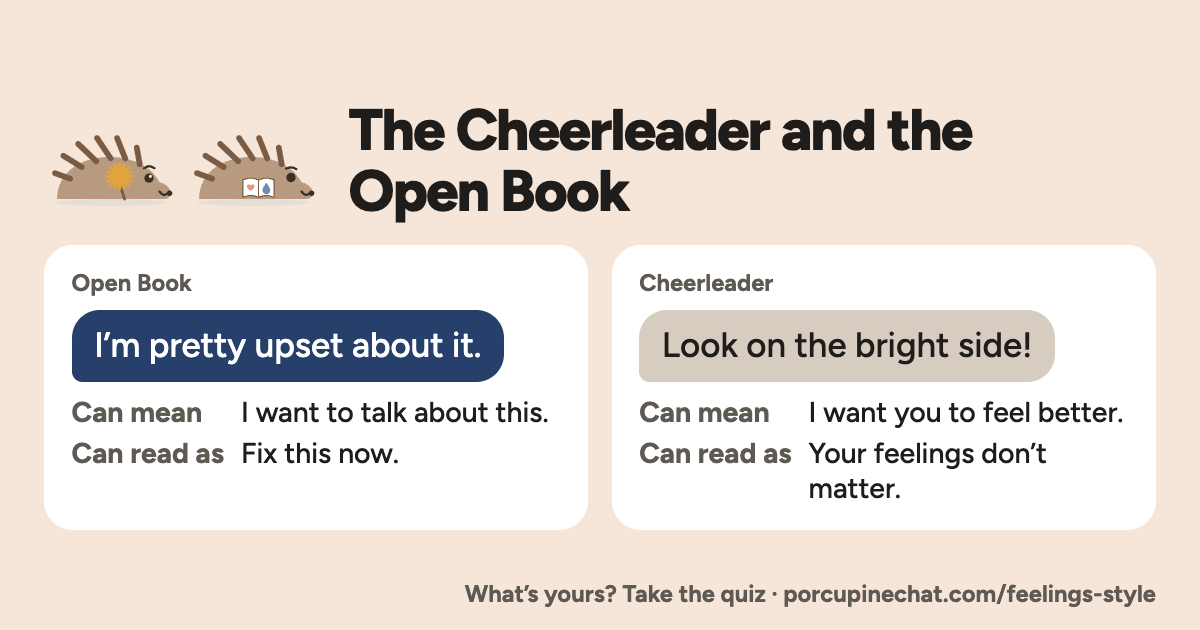
How each can be misread
Open BookI’m pretty upset about it.
- Can mean
- I want to talk about this.
- Can read as
- Fix this now.
CheerleaderLook on the bright side!
- Can mean
- I want you to feel better.
- Can read as
- Your feelings don’t matter.
How it can go
They just heard they didn’t get the apartment they wanted.
Open BookI’m crushed. I really thought we’d get it.
CheerleaderThere’ll be a better one! This is a sign.
Open BookCan I just be sad for a minute?
PorcupineThe bright side may be about wanting them to feel better. Being crushed may just need company first. The cheerful side may miss that apartment too, and hasn’t said.
Why it helps: Check before assumingQuills down: the same moment, another way
Open BookI don’t need it fixed. Can you just be bummed with me?
CheerleaderThat’s a real loss. I’m sad about it too.
Open BookThanks. Takeout and bad TV tonight?
One thing each can try
The Cheerleader
Stay with the hard feeling before you look for the bright side.
That’s a real loss. I’m sad about it too.
Why it helps: Understand before answeringThe Open Book
Say what you’d like from them.
I don’t need it fixed. Can you just be bummed with me?
Why it helps: Honest and hearableFinding the word
A feeling is easier to answer when it has a name. “Upset” could mean a lot of things; “left out” or “let down” gives the other person something they can answer.
Find the word: Feelings FinderAsk each other
Pick an easy moment, when you both have time to listen.
Is there a hard feeling you keep in so things stay upbeat?
When I try to cheer you up, what would help more?
Do I ever say the hard stuff in a way that’s a lot?
How can I bring up a small hurt without it turning big?
Common questions
Do a Cheerleader and an Open Book get along?
Good news tends to get a real celebration. The gap is with hard feelings: one says them plainly, and the other may answer with a bright side, or keep their own in.
Why does a Cheerleader look on the bright side?
It may be a way of caring: they want you to feel better. But it can come before the hard feeling has been heard. They may also find their own hard feelings harder to say than good ones.
Know a pair like this?
What’s Your Feelings Style?
Pick what you’d really do in twelve everyday moments, and see which feelings you say, hint at, let come out as something else or keep in, and one thing to try.
Find your feelings styleMore on these styles
- The CheerleaderThe good ones out loud, the hard ones kept in.
- The Open BookYou say it as it comes, the good and the hard.
- The five feelings stylesFive ways people let a feeling out, or keep it in.
The quiz is for fun and conversation. It isn’t a scientific test, therapy, counseling or professional advice. The styles are Porcupine’s own, and they describe what people do with a feeling, not who they are. Afraid of how someone might react? Put your safety first, and talk to someone you trust.
Updated