What’s Your Feelings Style? › The Open Book and the Translator
One of you says feelings as they come, the other turns hurt into sarcasm
The Open Book and the Translator
One says it as it comes. The other’s hard feelings come out sharper, and the plain side may answer the edge instead of what’s under it.
A free quiz: pick what you’d really do in 12 everyday moments. About 3 minutes.
Where it works
You both say when something’s wrong, so problems don’t hide for long.
Where it trips
The plain side may take a sharp line at its word and answer it, and the sharp side may hear a plain feeling as an attack.
Where it shows up
- A busy week
- One says “I’m stressed.” The other mutters about the inbox. It may be the same feeling, said two ways.
- A late reply
- One says “I felt ignored when you didn’t text back.” The other says “sorry I have a job.” Both may want to feel close.
- Saying sorry
- One says “I’m sorry, I was wrong.” The other may say “mark the calendar,” and still be glad to hear it.
How each can be misread
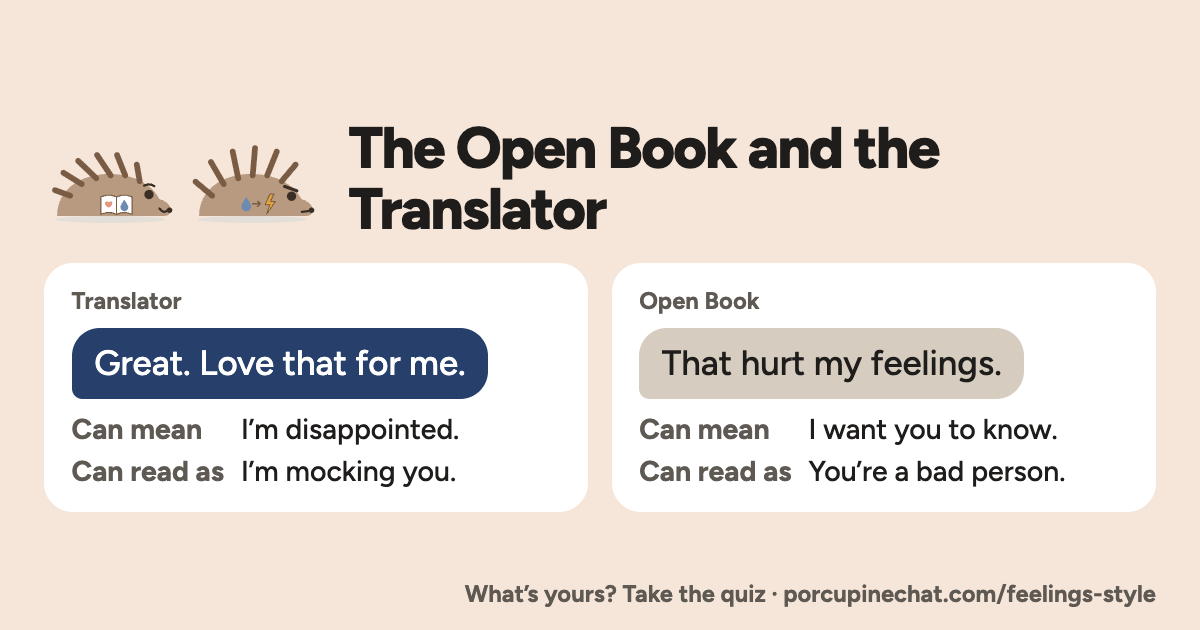
TranslatorGreat. Love that for me.
- Can mean
- I’m disappointed.
- Can read as
- I’m mocking you.
Open BookThat hurt my feelings.
- Can mean
- I want you to know.
- Can read as
- You’re a bad person.
How it can go
Roommates. One of them ate the other’s leftovers.
TranslatorOh good, my lunch is gone. Perfect.
Open BookWow, okay. That tone stung.
TranslatorNot as much as no lunch.
PorcupineThe joke may be about being hungry and annoyed. “That tone stung” may be honest. Each answered the other’s words, and the lunch is still gone.
Why it helps: Check before assumingQuills down: the same moment, another way
TranslatorI’m annoyed my lunch is gone. Can you replace it?
Open BookSorry, that was me. I’ll get you lunch today.
TranslatorThanks. Burritos?
One thing each can try
The Open Book
Answer what’s under the sharp line.
Sorry, that was me. I’ll get you lunch today.
Why it helps: Own your partThe Translator
Say the plain feeling first.
I’m annoyed my lunch is gone. Can you replace it?
Why it helps: Say what’s underneathFinding the word
A feeling is easier to answer when it has a name. “Upset” could mean a lot of things; “left out” or “let down” gives the other person something they can answer.
Find the word: Feelings FinderAsk each other
Pick an easy moment, when you both have time to listen.
When I say how I feel, does it ever sound like blame?
When I’m sarcastic, can you tell what I’m feeling?
What could I ask when you sound sharp?
What helps you hear the feeling under my edge?
Common questions
Do an Open Book and a Translator get along?
Both say when something’s wrong, so problems don’t hide. One says it plainly, the other with an edge, and each may answer the other’s words instead of the feeling under them.
Why does a Translator hear a plain feeling as an attack?
“I’m hurt” can sound like “you did this,” especially to someone whose own hurt comes out sharper. Adding what you’d like, not only what you feel, can make it easier to hear.
Know a pair like this?
What’s Your Feelings Style?
Pick what you’d really do in twelve everyday moments, and see which feelings you say, hint at, let come out as something else or keep in, and one thing to try.
Find your feelings styleMore on these styles
- The Open BookYou say it as it comes, the good and the hard.
- The TranslatorThe softer feelings come out sharper: hurt as sarcasm, worry as snapping.
- The five feelings stylesFive ways people let a feeling out, or keep it in.
The quiz is for fun and conversation. It isn’t a scientific test, therapy, counseling or professional advice. The styles are Porcupine’s own, and they describe what people do with a feeling, not who they are. Afraid of how someone might react? Put your safety first, and talk to someone you trust.
Updated