Guides › Boundaries
Guides · Boundaries
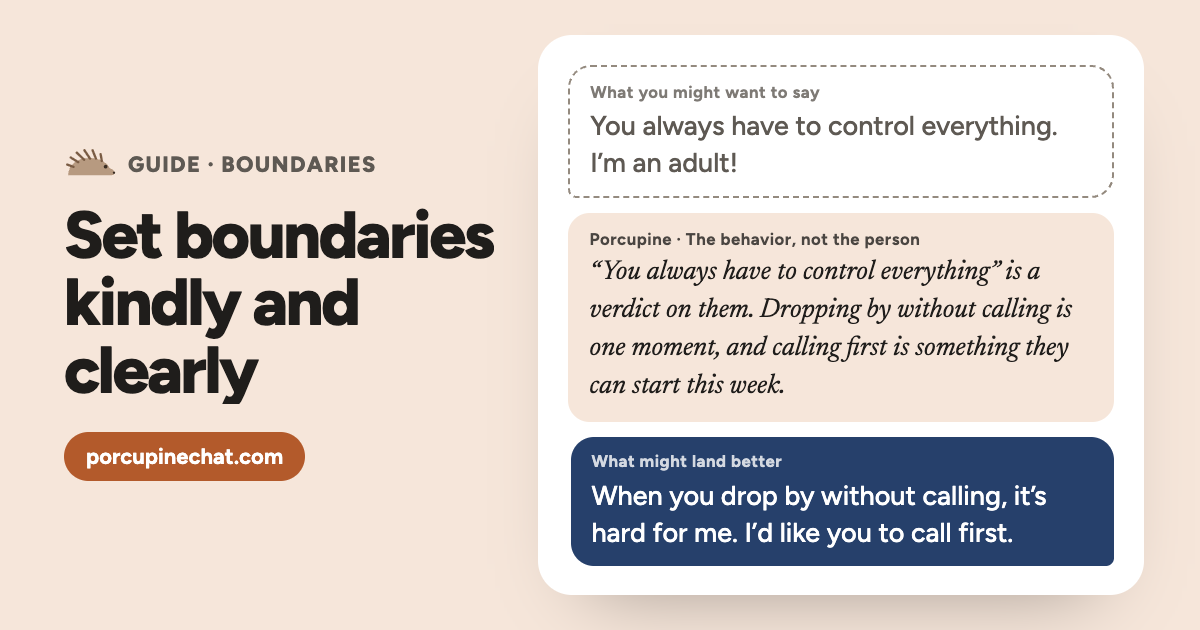
Set boundaries kindly and clearly
A boundary says what you need so the relationship can keep going. Here’s help saying it kindly and clearly, whoever it’s with.
With your parents and in-laws
- Set a boundary with your parents as an adult ›Like a call before they come over.
- Set a boundary with your in-laws ›When they mean well and still overstep.
- Ask grandparents to respect your parenting rules ›Keep the few rules that matter with your kids.
- Respond to unsolicited advice from your in-laws ›Thank them without promising to take it.
- Decline an invitation from your in-laws ›A warm no to a visit or a trip.
In a relationship
- Set boundaries in a new relationship ›Say what you need while it’s still new.
- Talk to your partner about phone use ›When phones keep coming to dinner.
- Ask for space without hurting someone ›Time to yourself, without them feeling pushed away.
- Tell your ex you don’t want to be friends ›When you need distance after a breakup.
With friends and roommates
- Set a boundary with a friend ›Like late-night calls that could wait until morning.
- Tell a friend you can’t afford their plans ›No to the trip, yes to the friend.
- Talk to your roommate about guests staying over ›Agree on how often, not on who.
At work
- Set boundaries at work ›After-hours messages, and what counts as urgent.
- Say no to extra work ›No, with what would have to move.
- Ask a coworker to stop interrupting you ›Finish your thought in meetings.
- Stop working with a client ›End it cleanly, with a handoff.
With anyone
- Say no without feeling guilty ›A short no and a reason, without a pile of apologies.
- Respond to an intrusive question ›Keep something private, kindly.
When to have each talk
- When you first notice it
- A small boundary said early is easier to hear than one after months of quiet resentment.
- At a calm moment
- Not in the heat of it. Pick a time when you both have a few minutes.
- When they push back
- Listen, answer what they’re worried about, and say it once more, briefly.
- If it happens again
- A short, friendly reminder, without a lecture: “Remember, a call first, please.”
- Later on
- Check how it’s working. A boundary can change as things do.
Have a kind answer ready
What someone might say, and what you could say back.
If they sayAfter everything we’ve done for you?
Porcupine · a tipGratitude and a boundary can both be true. You don’t have to choose.
You could sayI’m grateful for all of it. This is still something I need.
If they saySo we’re not welcome anymore?
Porcupine · a tipThey heard a rejection. Say what isn’t changing, and keep it to the one thing.
You could sayOf course you are. We love having you here. This is about one thing.
If they sayI thought you were my friend.
Porcupine · a tipThe boundary is how you keep being a good friend. Say so.
You could sayI am, and that’s why I’m telling you. I want to keep being there for you in a way I can keep up.
If they sayI thought you liked spending time with me.
Porcupine · a tipWanting time together and time alone aren’t opposites.
You could sayI do, a lot. I also need some nights to myself. Both are true.
If they sayEveryone else here answers after hours.
Porcupine · a tipYou don’t have to argue about the norm. Say what you’ll still do for what’s urgent.
You could sayI understand that’s been the norm. I’ll still be reachable by phone for anything urgent.
If they sayI’d do it for you.
Porcupine · a tipA no doesn’t need a better reason because they’d say yes. Thank them, and keep it.
You could sayI know, and I’m grateful. This weekend I just can’t.
Run a Quills Check on your boundary
Write the boundary however it comes out, sharp or buried in apologies. I’ll show you if the quills are up, and a version that says it plainly.
The Quills Check needs JavaScript. Please turn it on and reload the page.
Common questions
What’s an example of a healthy boundary?
“I’d love to see you. Could you call before you come over?” It names one thing, asks for something specific, and says what stays the same.
How do you set a boundary without feeling guilty?
Keep it short and kind, give one true reason if you like, and offer what you can do. Feeling guilty doesn’t mean you did something wrong. It often just means you’re saying something new.
Is setting boundaries selfish?
No. A boundary says what you need so you can keep showing up. It’s about what you’ll do, not about controlling what someone else does.
What if someone keeps ignoring your boundary?
Say it once more, briefly, and do what you said you would, like ending the call or not answering after 9. You don’t have to win the argument to keep the boundary.
How do you set boundaries with your parents?
Pick one thing, say it at a calm time, thank them for what they do, and ask for something specific, like a call before they visit.
Know someone this would help?
Find the words with Porcupine
PorcupineA boundary often takes more than one talk. I’ll help with what comes after: what they say back, and holding to it kindly.
Porcupine is coming soon. Sign up to be one of the first to try it.
We’ll email you when Porcupine opens and when we add new tools. Unsubscribe anytime. Privacy
Guides are general information, not legal, financial or professional advice. Afraid of how someone might react? Put your safety first, and talk to someone you trust.