Quills Check › Active listening
Free tool · Quills Check
Active listening, with examples
Paste something they said. See a few ways it could be meant, and a question that shows you’re listening before you answer.
The Quills Check needs JavaScript. Please turn it on and reload the page.
Listen to understand, not to answer
Active listening means showing you heard them before you make your own point. Say back what you heard, ask about it, and let them correct you.
What one study found
In an experiment, people who got active-listening responses, including paraphrasing, felt more understood than people who got advice or simple acknowledgments.
What active listeners do
- Say back what you heard, in your own words: “So the deadline moved again, and your weekend’s gone.”
- Name the feeling, even if you see things differently: “That sounds exhausting.”
- Ask a real question before giving advice: “Do you want ideas, or just to vent?”
Jumping in, or listening first
The same thing said, two ways to answer.
A friend saysMy boss moved the deadline up again, and now I have to work all weekend.
Jumping inUgh, you should just quit.
Listening firstAgain? So your whole weekend is gone. That sounds exhausting. Do you want to vent, or figure out a plan?
A partner saysI feel like I’m the only one who notices when we’re out of groceries.
Jumping inThat’s not true. I went shopping last week.
Listening firstSo keeping track of it all lands on you. That’s tiring. Can we figure out a way to share it?
A coworker saysI’ve redone this report three times, and it’s still not right.
Jumping inHere, let me just do it.
Listening firstThree times? That’s frustrating. What’s still not working about it?
A parent saysI just worry about you living so far away.
Jumping inI’m fine. You don’t need to worry.
Listening firstIt’s hard having me so far away. What would help you worry less?
Common questions
What is active listening?
Showing you understand someone before you answer: saying back what you heard, naming the feeling, and asking questions, instead of jumping to advice or your own side.
What are some examples of active listening?
“So what I’m hearing is…,” “That sounds really frustrating,” “What happened next?” and “Do you want advice, or should I just listen?”
Is active listening just repeating what they said?
No. Repeating their words back can feel mechanical. Say what you understood in your own words, and check whether you got it right.
Do I have to agree with them?
No. Listening isn’t agreeing. Show you understand first, and then share your view. It’s easier to hear once they feel heard.
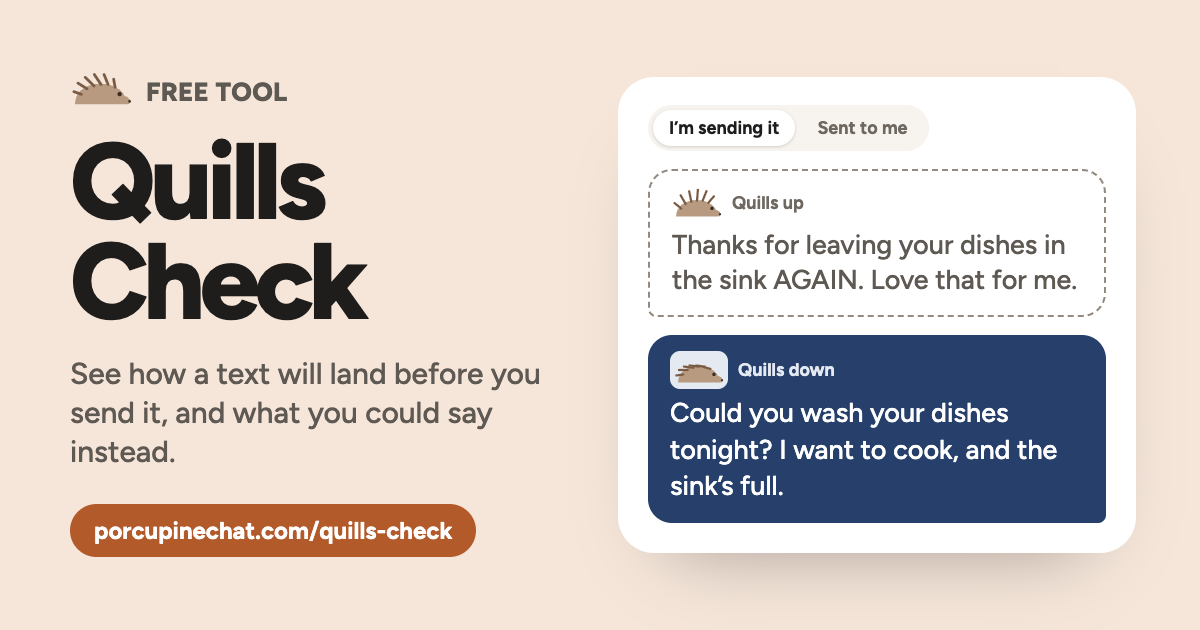
Know someone who overthinks their texts?
Find the words with Porcupine
PorcupineListening is half of it. In Porcupine, I’ll help with the other half: saying your side so they can hear it too.
Porcupine is coming soon. Sign up to be one of the first to try it.
We’ll email you when Porcupine opens and when we add new tools. Unsubscribe anytime. Privacy
Checking something specific?
- Is my text rude?A text you’re sending
- What does this text mean?A text you got
- Is this text passive-aggressive?A text you got
- Apology CheckerAn apology you’re sending
- What does a thumbs-up mean in a text?A text you got
- Is this text sarcastic?A text you got
- Is this text dry?A text you got
- Does this sound needy?A text you’re sending
- Is this text flirty?A text you got
- I statements, with examplesA message you’re sending
- How to apologize, with examplesAn apology you’re sending
Guides that go with it
- How to calm down an argument before it gets worseAny relationship
- How to stop having the same argument over and overPartners
- How to talk to your adult child without arguingParents and adult children
- How to ask your manager for feedbackManagers and employees
- What to do when a family member keeps bringing up the pastAnyone in the family
- How to respond to a text that sounds passive-aggressiveAny relationship
Play Mixed Signals
A daily game: one short text, read a few ways. Guess what they meant, then see how everyone else read it. Play today’s
The Quills Check is general information about communication, not legal, financial or professional advice, and AI can get things wrong. Afraid of how someone might react? Put your safety first, and talk to someone you trust.