Data › Renters
How often do renters need repairs, or fall behind on rent?
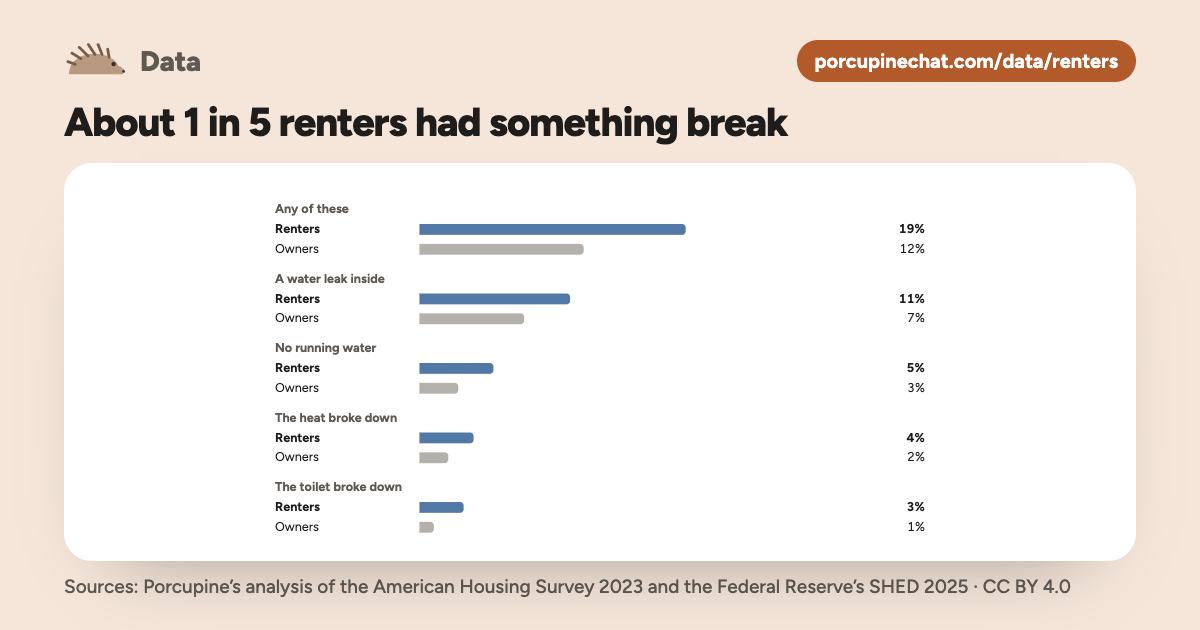
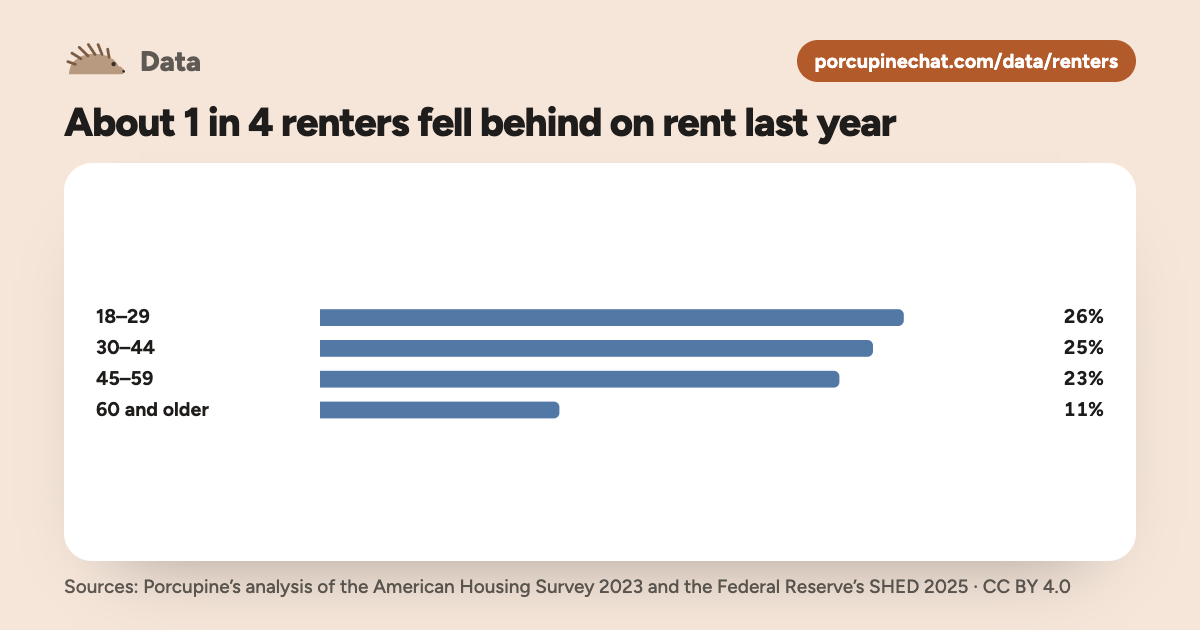
About 1 in 5 renters had something in their home break in a recent year, most often a leak. And about 1 in 4 fell behind on rent at some point last year.
From the American Housing Survey, 2023, and the Federal Reserve’s 2025 survey of household finances.
About 1 in 5 renters had something break
Renters and owners who had each problem.
Any of these
A water leak inside
No running water
The heat broke down
The toilet broke down
Leaks: past 12 months. Water and toilets: past 3 months. Heat: last winter, cold for a day or more. 2023.
Free to use, even commercially, under CC BY 4.0: credit Porcupine and link to this page.
Download the pictureChart: Porcupine, from the American Housing Survey 2023 and the Federal Reserve’s SHED 2025 (CC BY 4.0). porcupinechat.com/data/renters
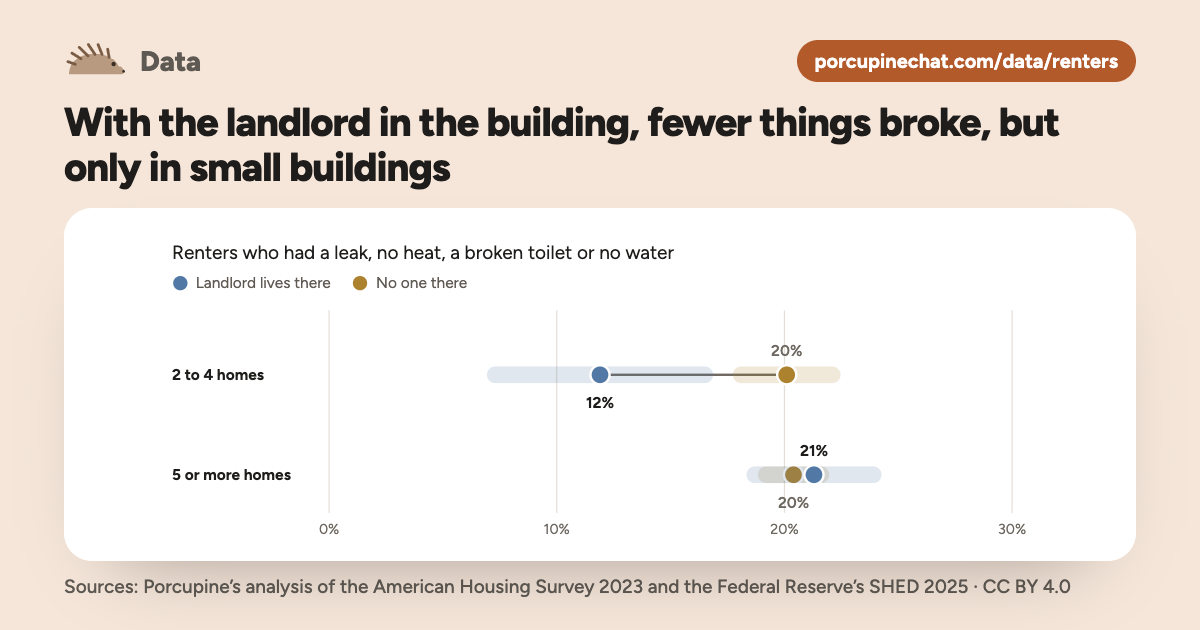
With the landlord in the building, fewer things broke, but only in small buildings
Renters who had a leak, no heat, a broken toilet or no water.
Pale bands: margin of error. In bigger buildings, “landlord” means an owner or a manager.
Free to use, even commercially, under CC BY 4.0: credit Porcupine and link to this page.
Download the pictureChart: Porcupine, from the American Housing Survey 2023 and the Federal Reserve’s SHED 2025 (CC BY 4.0). porcupinechat.com/data/renters
Newer tenants pay about $380 more a month
Average monthly rent, by when the renter moved in.
A snapshot of 2023, not one home followed over time: the homes and places differ too.
About 1 in 4 renters fell behind on rent last year
Renters behind on rent at any time in the past year, by age.
From the Federal Reserve’s 2025 survey.
Free to use, even commercially, under CC BY 4.0: credit Porcupine and link to this page.
Download the pictureChart: Porcupine, from the American Housing Survey 2023 and the Federal Reserve’s SHED 2025 (CC BY 4.0). porcupinechat.com/data/renters
When something breaks, or rent will be late
- Put repairs in writing. More than 8 in 10 apartment renters have no landlord living there, so a repair usually starts with a message. Say what broke and when it started; a dated note is easier to act on than a hallway mention. Describe, don’t diagnose
- Say it early. If rent will be late, telling them before it’s due gives you both more options. Honest and hearable
- Look for a fair middle. At renewal, a number you can both live with usually beats a move for either side. Fair to both
General ideas from the principles Porcupine is built on, not advice for your situation.
Write to your landlord or tenant
Write it the way it comes out. I’ll show you if the quills are up, and a version with them down.
The Quills Check needs JavaScript. Please turn it on and reload the page.
Common questions
How often do renters need repairs?
About 19% of American renters had a water leak, a heating breakdown, a broken toilet or no running water in a recent year, against 12% of owners, by Porcupine’s count of the 2023 American Housing Survey. Leaks were most common: about 1 in 10.
How many renters are late on rent?
About 23% of renters were behind on rent at some point in the past year, in the Federal Reserve’s 2025 survey: 26% at 18 to 29, 11% at 60 and older.
Do new tenants pay more rent?
In 2023, renters who moved in during 2022 or 2023 paid about $1,660 a month on average, against about $1,280 for renters who moved in before 2020.
Do renters have fewer repairs when the landlord lives in the building?
In small buildings, yes. In buildings of 2 to 4 homes, 12% of renters whose landlord lived there had a leak, a heating breakdown, a broken toilet or no running water in a recent year, against 20% where no one did, by Porcupine’s count of the 2023 American Housing Survey. In buildings of 5 or more homes, an owner or manager on site made no clear difference (21% against 20%).
Do bigger apartment buildings need fewer repairs?
No. About 19% to 21% of renters had something break in a recent year whether their building had 2 to 4 homes or 50 or more, against 15% of renters in a house.
Do more expensive rentals have fewer problems?
Only a little. About 21% of renters paying under $750 a month had something break in a recent year, against 17% of those paying $1,800 or more.
Guides for landlords and tenants
- How to ask your landlord for a repairLandlords and tenants
- How to tell your landlord your rent will be lateLandlords and tenants
- How to negotiate your rent when you renew your leaseLandlords and tenants
- How to tell your tenant the rent is going upLandlords and tenants
- How to ask for your security deposit backLandlords and tenants
- How to ask your landlord if you can get a petLandlords and tenants
Find the words with Porcupine
PorcupineWhether it’s a repair, a late payment or a renewal, the talk with your landlord or tenant goes better when it’s clear and early. I can help you find the words.
Porcupine is coming soon. Sign up to be one of the first to try it.
We’ll email you when Porcupine opens and when we add new tools. Unsubscribe anytime. Privacy
More from the data
- Who Fills Your Day?Partners, kids, friends and family, at every age
- How much time do couples spend together?5 hr 10 min a day, and what they do with it
- How much time do people spend with friends?By age, who sees friends least, and how it feels
- Are we in a friendship recession?Which ages lost the most time with friends since 2003, and where it went
- How much of your time with your parents is behind you?Pick your age to see your share
- How much time do people spend with family on the holidays?Thanksgiving, Christmas and five more holidays, by the clock
- What do neighbors complain about, and when?New York City’s 311 complaints, by hour, week and season
- How often do people ask for a raise, or for help with money?Who asks, who gets a raise, and who gets help paying the bills
- Do Americans still know their neighbors?Evenings with neighbors, friends and family since the 1970s
- When are people most alone, and who still calls?The hour the most people are alone, and who still calls
- How has the way we say sorry changed?Sorry, pardon and “sorry if,” in books since 1800
- Do couples agree on who does more at home?Chores, money and marriage, as women and men each tell it
- When did therapy-speak go mainstream?Boundaries, ghosting, gaslighting: in books, on Wikipedia and in searches
- What people asked advice columns, then and nowCourting faded, family took its place: 28,539 letters, a hundred years apart
- Etiquette then and now: which of Emily Post’s rules on what to say still hold?Her 73 rules from 1922: we’d keep 50, and every one we’d change said to keep your feelings, wants or questions to yourself
How we counted
- Repairs and rent: the American Housing Survey, run by the Census Bureau for HUD, which visited about 55,000 homes in 2023.
- Behind on rent: the Federal Reserve’s Survey of Household Economics and Decisionmaking, about 13,000 adults, 2025.
More on how we counted
- “Something broke” is any of the four: a leak inside in the past 12 months, the heat out long enough to be cold for a day or more last winter, a toilet breakdown or no running water in the past 3 months.
- “Landlord lives there” is the survey’s owner on the property, for buildings of 2 to 4 homes, and an owner or manager on the property for bigger ones. The survey can’t say why fewer things broke with the landlord living there. It isn’t newer buildings: the small buildings with the owner living there were older than most (46% built before 1950, against 30%).
- Rent is the average monthly rent in 2023, by the year the renter moved in. Margins of error come from the Census Bureau’s replicate weights; the Fed’s are approximate.
- Source: Porcupine’s analysis of the American Housing Survey 2023 (US Census Bureau and HUD) and the Survey of Household Economics and Decisionmaking 2025 (Federal Reserve Board), both public. Our charts and numbers are free to reuse under CC BY 4.0.
Updated