Data › Neighbors
What do neighbors complain about, and when?
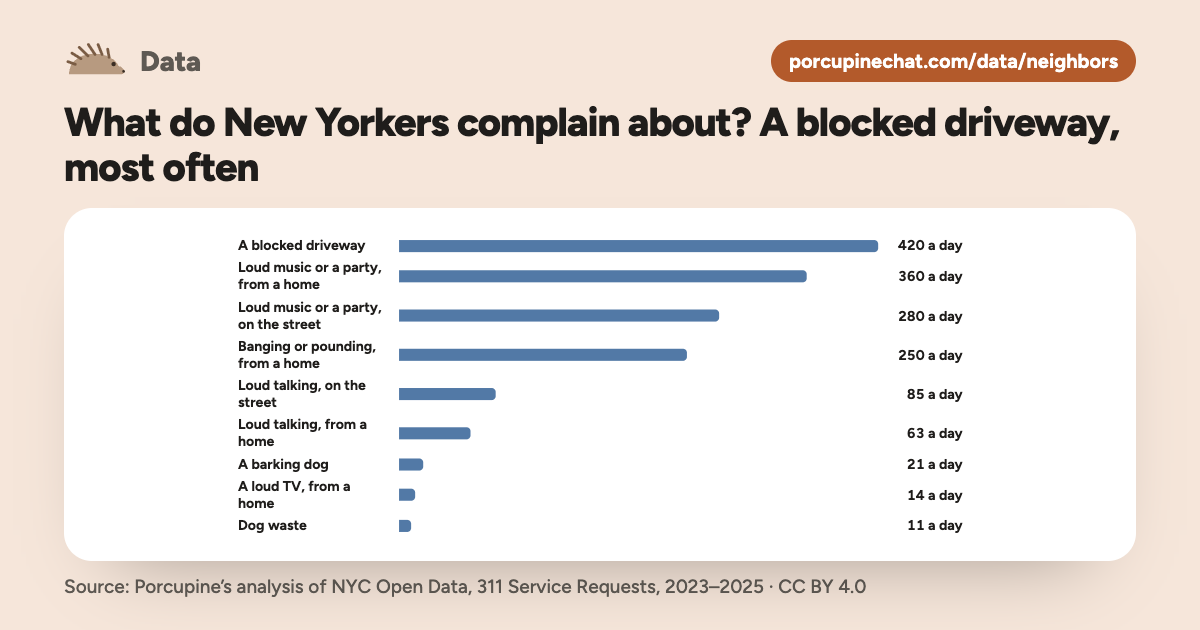
In New York City, people report about 420 blocked driveways and 360 homes playing loud music to 311 every day. Loud music complaints peak late on weekend nights.
From New York City’s 311 complaints, 2023–2025, each address counted once a day. Numbers last updated November 2026.
A blocked driveway is the most common single complaint
Complaints about neighbors, a day, 2025. Noise from homes, all kinds together, adds up to more.
Each address counted once a day, however many calls it got. New York City only.
Free to use, even commercially, under CC BY 4.0: credit Porcupine and link to this page.
Download the pictureChart: Porcupine, from NYC Open Data, 311 Service Requests (CC BY 4.0). porcupinechat.com/data/neighbors
Loud music peaks late at night; barking dogs, all day
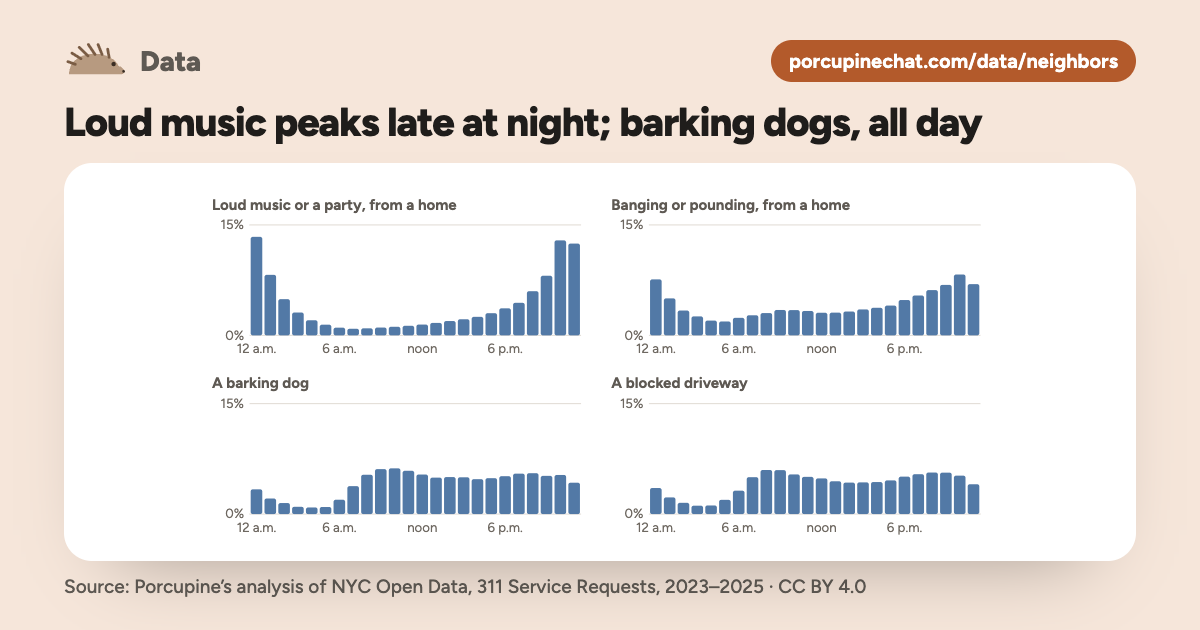
The share of each kind’s complaints made in each hour.
About 3 in 4 barking-dog complaints come between 8 a.m. and 10 p.m. Blocked driveways peak around 8 a.m., as people leave for work.
Free to use, even commercially, under CC BY 4.0: credit Porcupine and link to this page.
Download the pictureChart: Porcupine, from NYC Open Data, 311 Service Requests (CC BY 4.0). porcupinechat.com/data/neighbors
Loud music is a weekend complaint
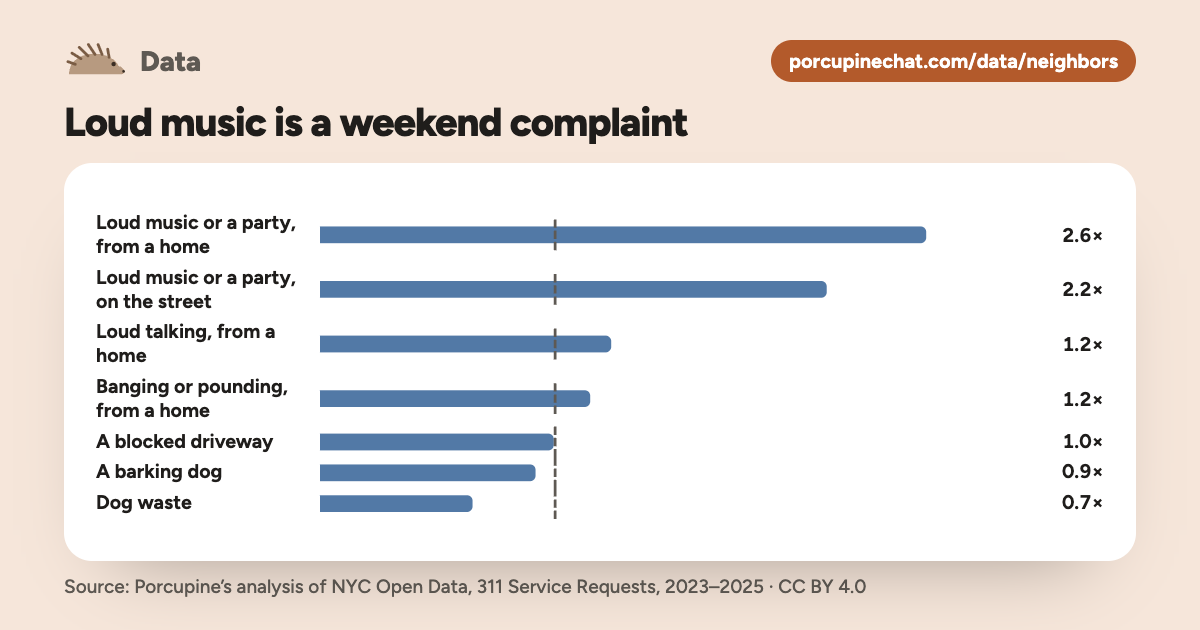
A Saturday or Sunday gets about 2½ times the complaints about loud music from a home that a weekday does.
Complaints on an average weekend day, for every 1 on an average weekday. The dashed line is 1×: just as many either way. Saturday includes the hours after midnight on Friday.
Free to use, even commercially, under CC BY 4.0: credit Porcupine and link to this page.
Download the pictureChart: Porcupine, from NYC Open Data, 311 Service Requests (CC BY 4.0). porcupinechat.com/data/neighbors
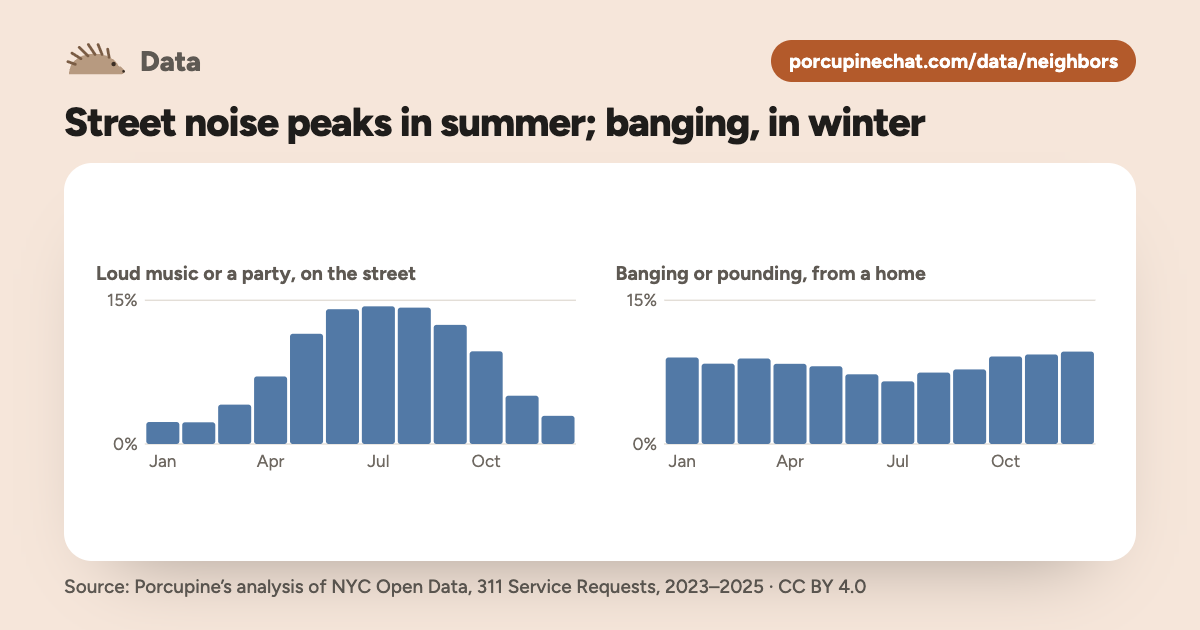
Street noise peaks in summer; banging, in winter
The share made in each month.
Free to use, even commercially, under CC BY 4.0: credit Porcupine and link to this page.
Download the pictureChart: Porcupine, from NYC Open Data, 311 Service Requests (CC BY 4.0). porcupinechat.com/data/neighbors
Police acted on about 4 in 10 calls about loud music
Each call ends with one outcome, so these add up to 100%.
As the police department recorded it, for addresses with one call that day, 2023–2025. “Something else” is mostly calls answered with more information, or outside the police department’s jurisdiction.
Why we count each address once a day
A few places get called in again and again. Almost half of all calls about loud music were about just 1% of the addresses people complained about. Counting every call would mostly measure those few, so this page counts each address once a day.
An address here is where the noise was, not who called. The record doesn’t say who called, so we can’t tell whether it was one neighbor or many.
Before you complain to a neighbor
- Say it on a calm day, not at midnight. Most noise complaints come late at night, when both of you are at your worst. A word the next afternoon lands better. Cool down, then talk
- Describe what you hear, and when. “The bass comes through our bedroom wall after 11 on Saturdays” is easier to act on than “You’re so loud.” Describe, don’t diagnose
- They may not know. A dog barks while its owner is out; music sounds quieter inside the room it’s in. Ask before you decide it’s on purpose. Check before assuming
General ideas from the principles Porcupine is built on, not advice for your situation.
Check a complaint before you send it
Write it the way it comes out. I’ll show you if the quills are up, and a version with them down.
The Quills Check needs JavaScript. Please turn it on and reload the page.
Common questions
What do neighbors complain about most?
In New York City, the most common single complaint is a blocked driveway, about 420 a day in 2025, then loud music or a party from someone’s home, about 360, counting each address once a day. Noise from homes, all kinds together, adds up to more.
What time do most noise complaints happen?
Late at night. About 4 in 10 complaints about loud music from a home come between 10 p.m. and 1 a.m., and a Saturday or Sunday gets about 2½ times as many as a weekday.
Does calling 311 about noise work?
Police took action on about 4 in 10 calls about loud music from a home, as they recorded it. Most of the rest, they found no evidence when they got there, or couldn’t get in.
Guides for neighbors
- How to talk to your neighbor about their barking dogNeighbors
- How to talk to your neighbor about parkingNeighbors
- How to ask your neighbor to pick up after their dogNeighbors
- How to talk to your roommate about noiseRoommates
- How to ask someone to keep it down in publicStrangers and acquaintances
Find the words with Porcupine
PorcupineA neighbor you’ll pass on the stairs for years is worth a careful first word. I can help you say it so it’s heard, and get ready for what they say back.
Porcupine is coming soon. Sign up to be one of the first to try it.
We’ll email you when Porcupine opens and when we add new tools. Unsubscribe anytime. Privacy
More from the data
- Who Fills Your Day?Partners, kids, friends and family, at every age
- How much time do couples spend together?5 hr 10 min a day, and what they do with it
- How much time do people spend with friends?By age, who sees friends least, and how it feels
- Are we in a friendship recession?Which ages lost the most time with friends since 2003, and where it went
- How much of your time with your parents is behind you?Pick your age to see your share
- How much time do people spend with family on the holidays?Thanksgiving, Christmas and five more holidays, by the clock
- How often do people ask for a raise, or for help with money?Who asks, who gets a raise, and who gets help paying the bills
- How often do renters need repairs, or fall behind on rent?Repairs, rent and running late, for renters
- Do Americans still know their neighbors?Evenings with neighbors, friends and family since the 1970s
- When are people most alone, and who still calls?The hour the most people are alone, and who still calls
- How has the way we say sorry changed?Sorry, pardon and “sorry if,” in books since 1800
- Do couples agree on who does more at home?Chores, money and marriage, as women and men each tell it
- When did therapy-speak go mainstream?Boundaries, ghosting, gaslighting: in books, on Wikipedia and in searches
- What people asked advice columns, then and nowCourting faded, family took its place: 28,539 letters, a hundred years apart
- Etiquette then and now: which of Emily Post’s rules on what to say still hold?Her 73 rules from 1922: we’d keep 50, and every one we’d change said to keep your feelings, wants or questions to yourself
How we counted
- 311 is New York City’s line for non-emergency complaints. Every call, app report and web form becomes a public record with its time, kind and place. We counted 2023 to 2025.
- Each address counts once a day, from its first call, and a call with no address once. The kinds are the ones callers choose from on 311’s list.
More on how we counted
- It’s one city, and only what people reported. Neighbors who talked it over, or put up with it, aren’t in it.
- What happened after a call is the police department’s own record, for addresses with one call that day, so each call’s outcome is its own.
- Left out: complaints about animal abuse, drugs and other things that aren’t about getting along with neighbors.
- Source: Porcupine’s analysis of NYC Open Data, 311 Service Requests. City law puts no limits on reusing it. Our charts and numbers are free to reuse under CC BY 4.0.
Updated