Data › Asking
How often do people ask for a raise, or for help with money?
Of workers who asked for a raise or promotion in the past year, about 6 in 10 got one. And almost half of adults under 30 had someone outside their home help pay a bill.
From the Federal Reserve’s Survey of Household Economics and Decisionmaking, 2025.
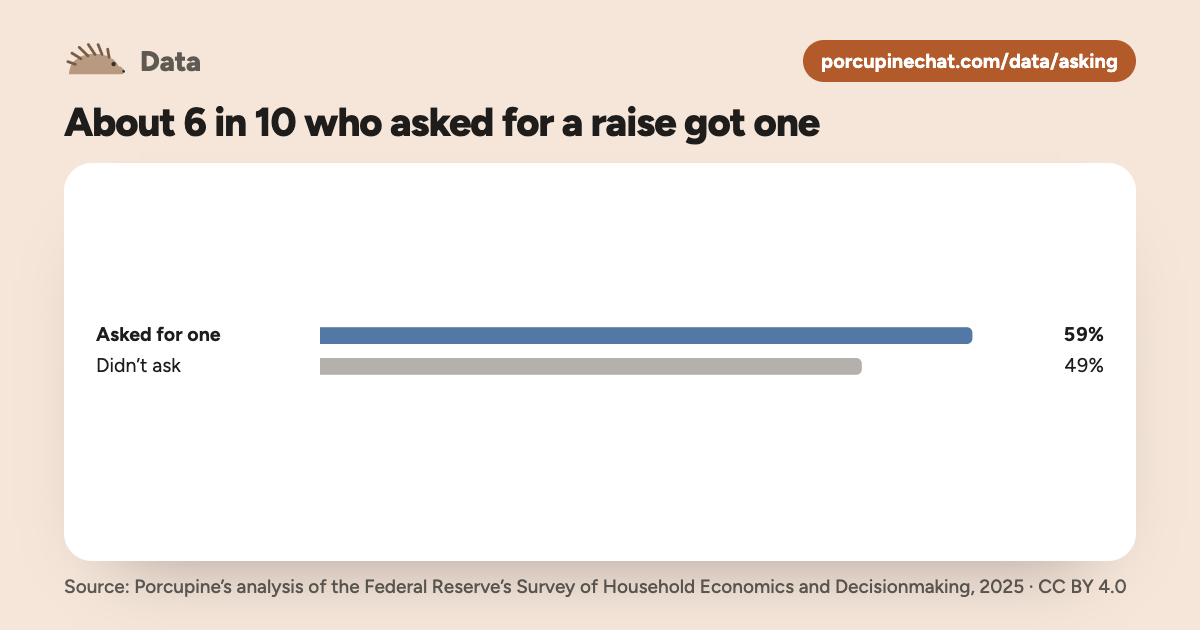
About 6 in 10 who asked for a raise got one
Workers who got a raise or promotion in the past year.
This shows what happened, not why: people who ask may differ in other ways too.
Free to use, even commercially, under CC BY 4.0: credit Porcupine and link to this page.
Download the pictureChart: Porcupine, from the Federal Reserve’s Survey of Household Economics and Decisionmaking (CC BY 4.0). porcupinechat.com/data/asking
Younger workers ask more
The share who asked for a raise or promotion, by age.
At every age, about 6 in 10 of those who asked got one.
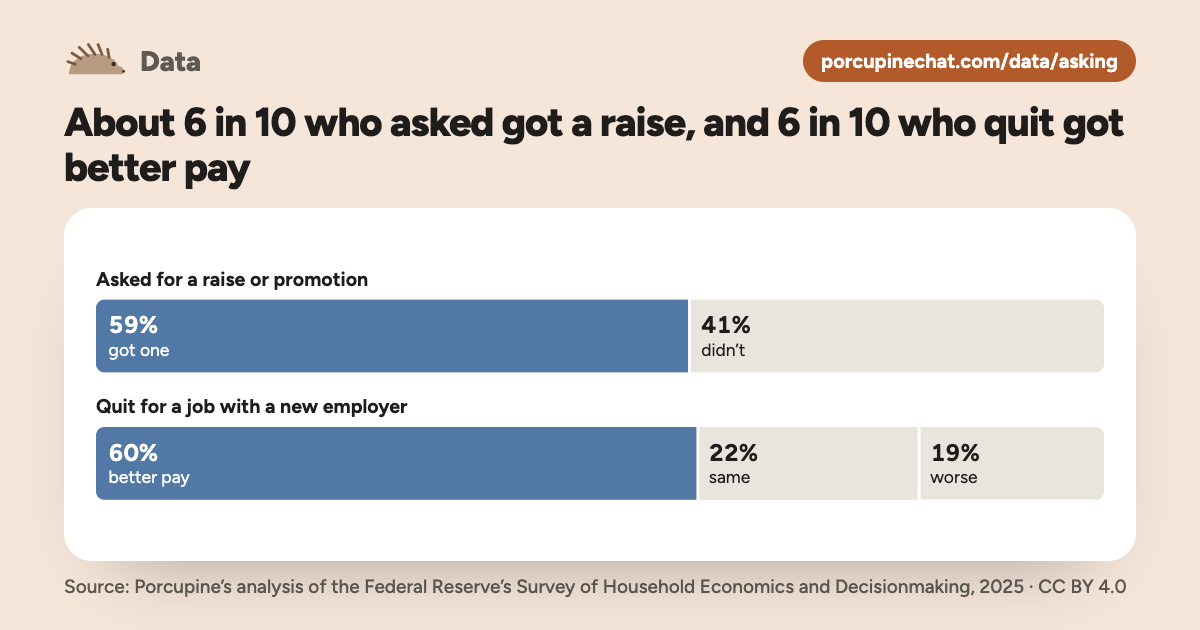
About 6 in 10 who asked got a raise, and 6 in 10 who quit got better pay
About 6 in 10 who asked for a raise got one, and about 6 in 10 who quit for a new employer got better pay or benefits.
Asked for a raise or promotion
Quit for a job with a new employer
About 1 in 5 who quit for a new employer said the pay or benefits got worse. Two different questions: a raise can be small, and a new job can trade pay for other things.
Free to use, even commercially, under CC BY 4.0: credit Porcupine and link to this page.
Download the pictureChart: Porcupine, from the Federal Reserve’s Survey of Household Economics and Decisionmaking (CC BY 4.0). porcupinechat.com/data/asking
Half who didn’t get the raise they asked for applied for a new job
The share who applied for a new job in the past year, by how asking for a raise went.
The survey doesn’t say which came first: the ask or the applying.
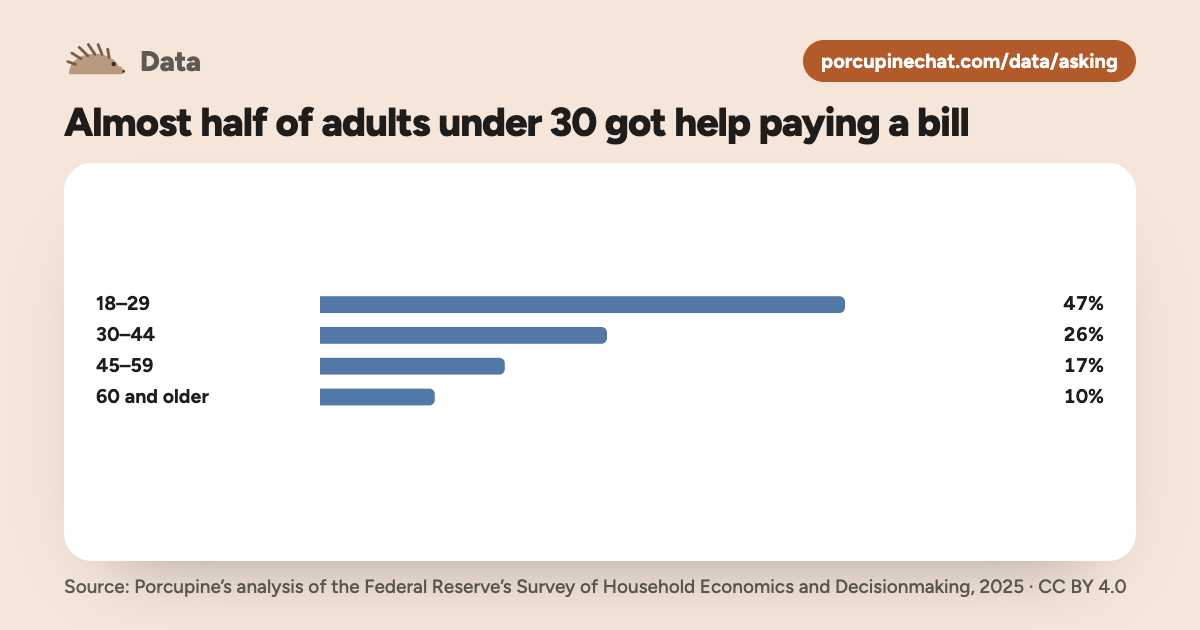
Almost half of adults under 30 got help paying a bill
The share who had someone outside their home help pay an expense in the past year, by age.
The survey doesn’t ask who helped.
Free to use, even commercially, under CC BY 4.0: credit Porcupine and link to this page.
Download the pictureChart: Porcupine, from the Federal Reserve’s Survey of Household Economics and Decisionmaking (CC BY 4.0). porcupinechat.com/data/asking
Phone bills come first
For adults 18 to 29, what the help paid for.
Many got help with more than one, so these don’t add up. Children’s costs are for those with children.
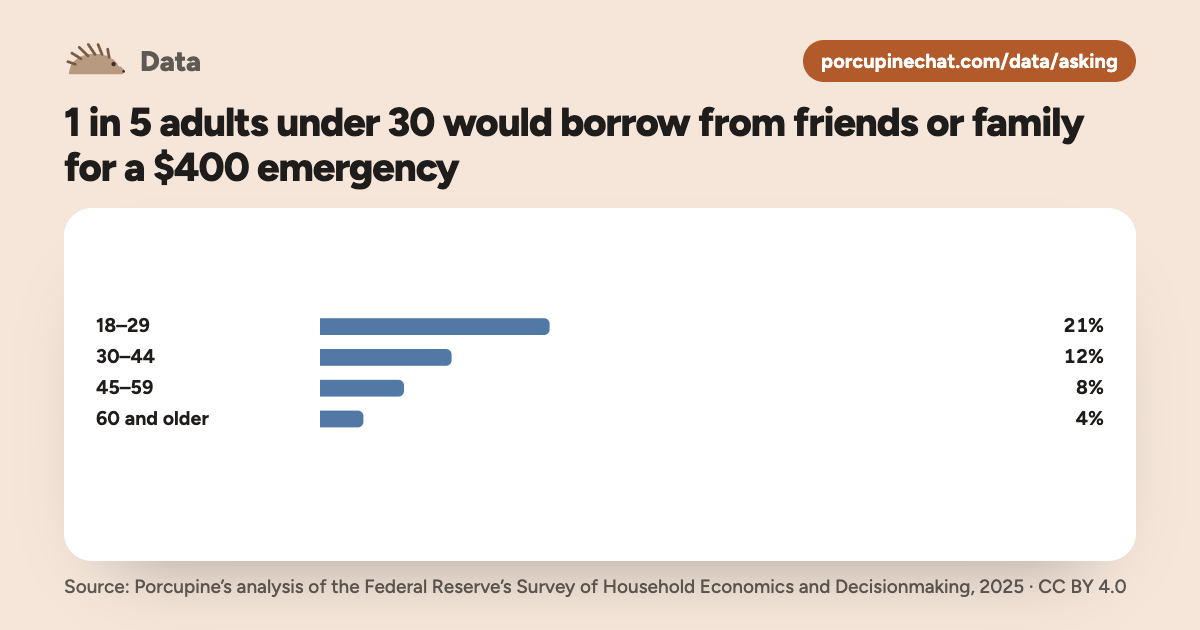
1 in 5 adults under 30 would borrow from friends or family for a $400 emergency
The share who’d borrow from a friend or family member to cover an unexpected $400 expense, by age.
The survey asked how people would pay an unexpected $400 bill, from a list that included savings, a credit card and borrowing from friends or family. People could pick more than one.
Free to use, even commercially, under CC BY 4.0: credit Porcupine and link to this page.
Download the pictureChart: Porcupine, from the Federal Reserve’s Survey of Household Economics and Decisionmaking (CC BY 4.0). porcupinechat.com/data/asking
Make it easy to say yes, or no
- Ask plainly. A clear ask, with a number, is easier to say yes to than a hint. Honest and hearable
- Make it easy to say no. A yes means more when no was possible, and it keeps the relationship safe either way. Ask, don’t pressure
- Agree on the terms up front. Whether it’s a loan or a gift, and when it comes back, saves an awkward talk later. Us against the problem
General ideas from the principles Porcupine is built on, not advice for your situation.
Something to ask?
Write it the way it comes out. I’ll show you if the quills are up, and a version with them down.
The Quills Check needs JavaScript. Please turn it on and reload the page.
Common questions
How many people ask for a raise?
About 17% of American workers asked for a raise or promotion in the past year, and more of the young: 22% at 18 to 29, 10% at 60 and older.
Does asking for a raise work?
Of workers who asked, about 59% got a raise or promotion that year, against 49% of workers who didn’t ask, by Porcupine’s count of the Federal Reserve’s 2025 survey. That shows what happened, not that asking caused it.
Is it better to ask for a raise or find a new job?
About 59% of workers who asked for a raise or promotion got one, and about 60% of those who quit for a job with a new employer said the pay or benefits were better, by Porcupine’s count of the Federal Reserve’s 2025 survey. About 19% who quit said they were worse.
What do people do when they don’t get a raise?
About half (54%) of workers who asked for a raise or promotion and didn’t get one applied for a new job that year, against 33% of those who got one and 24% of those who didn’t ask, by Porcupine’s count of the Federal Reserve’s 2025 survey.
Is it normal to get money help as an adult?
Yes. Almost half (47%) of Americans 18 to 29 had someone outside their home help pay an expense in the past year, and about 1 in 4 of those 30 to 44.
Guides for asking
- How to ask for a raiseManagers and employees
- How to ask your parents for help with moneyParents and adult children
- How to ask a friend to pay you backFriends
- How to ask for helpAny relationship
Just need the words?
Find the words with Porcupine
PorcupineAsking for money, from a boss or from family, is a hard conversation either way. I can help you say it plainly, and get ready for what they say back.
Porcupine is coming soon. Sign up to be one of the first to try it.
We’ll email you when Porcupine opens and when we add new tools. Unsubscribe anytime. Privacy
More from the data
- Who Fills Your Day?Partners, kids, friends and family, at every age
- How much time do couples spend together?5 hr 10 min a day, and what they do with it
- How much time do people spend with friends?By age, who sees friends least, and how it feels
- Are we in a friendship recession?Which ages lost the most time with friends since 2003, and where it went
- How much of your time with your parents is behind you?Pick your age to see your share
- How much time do people spend with family on the holidays?Thanksgiving, Christmas and five more holidays, by the clock
- What do neighbors complain about, and when?New York City’s 311 complaints, by hour, week and season
- How often do renters need repairs, or fall behind on rent?Repairs, rent and running late, for renters
- Do Americans still know their neighbors?Evenings with neighbors, friends and family since the 1970s
- When are people most alone, and who still calls?The hour the most people are alone, and who still calls
- How has the way we say sorry changed?Sorry, pardon and “sorry if,” in books since 1800
- Do couples agree on who does more at home?Chores, money and marriage, as women and men each tell it
- When did therapy-speak go mainstream?Boundaries, ghosting, gaslighting: in books, on Wikipedia and in searches
- What people asked advice columns, then and nowCourting faded, family took its place: 28,539 letters, a hundred years apart
- Etiquette then and now: which of Emily Post’s rules on what to say still hold?Her 73 rules from 1922: we’d keep 50, and every one we’d change said to keep your feelings, wants or questions to yourself
How we counted
- The Federal Reserve asks about 13,000 adults each fall about their finances and work. These numbers are from the 2025 survey, weighted to stand for American adults.
- The raise questions were asked of people with any job in the past 12 months. “Who asked and got one” is Porcupine’s own count from the survey’s answers.
- “Quit for a new employer” is workers who left a job by choice and whose main job is now with a different employer; they said whether its pay or benefits are better than the job they had a year ago. Asking against quitting, and who applied elsewhere, are Porcupine’s own counts too.
More on how we counted
- The survey’s file has no replicate weights, so each margin of error is approximate, from the weights’ effective sample size.
- Money help is “anyone outside of your household” helping pay an expense in the past 12 months. The survey doesn’t ask who.
- Source: Porcupine’s analysis of the Federal Reserve Board’s Survey of Household Economics and Decisionmaking (SHED) 2025, public use data. The Board’s data is in the public domain. Our charts and numbers are free to reuse under CC BY 4.0.
Updated