Data › Alone and on the phone
When are people most alone, and who still calls?
Outside work, more Americans are alone at 5 p.m. than at any other hour. And phone calls haven’t gotten rarer, just longer.
From the American Time Use Survey: about 259,000 Americans’ days, hour by hour, 2003 to 2025. We refresh the numbers each summer.
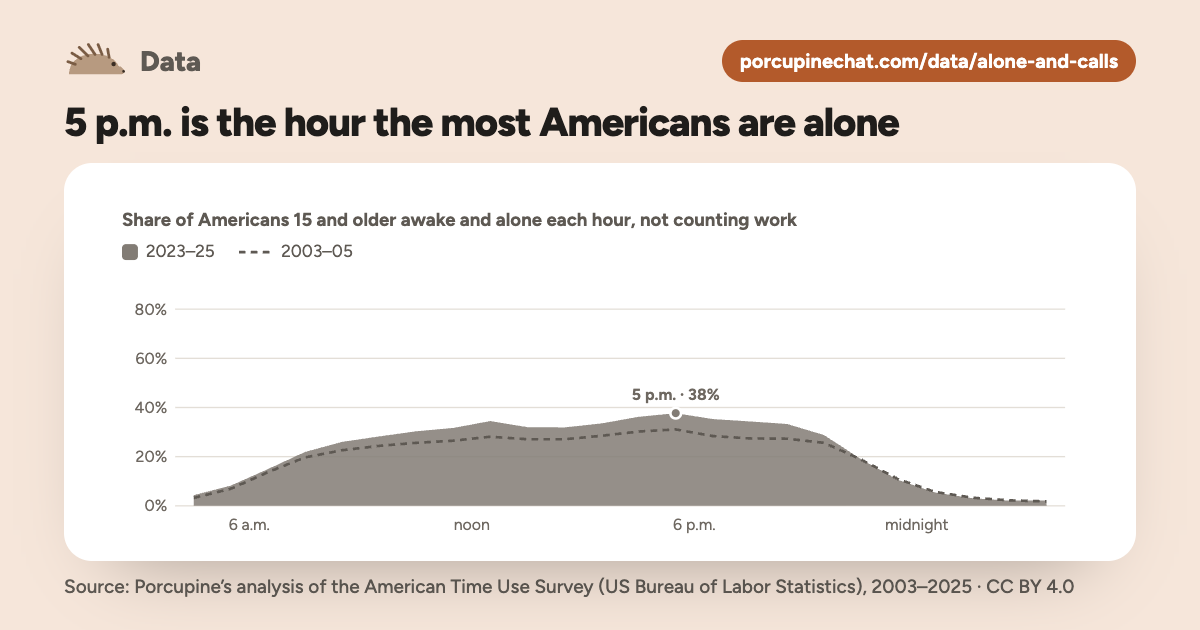
5 p.m. is the hour the most people are alone
About 38% of Americans are awake and alone at 5 p.m., not counting work. In 2003–05, it was 31%.
Americans 15 and older, not counting time at work. Alone isn’t the same as lonely: the survey asks who was there, not how people felt.
Free to use, even commercially, under CC BY 4.0: credit Porcupine and link to this page.
Download the pictureChart: Porcupine, from the American Time Use Survey (CC BY 4.0). porcupinechat.com/data/alone-and-calls
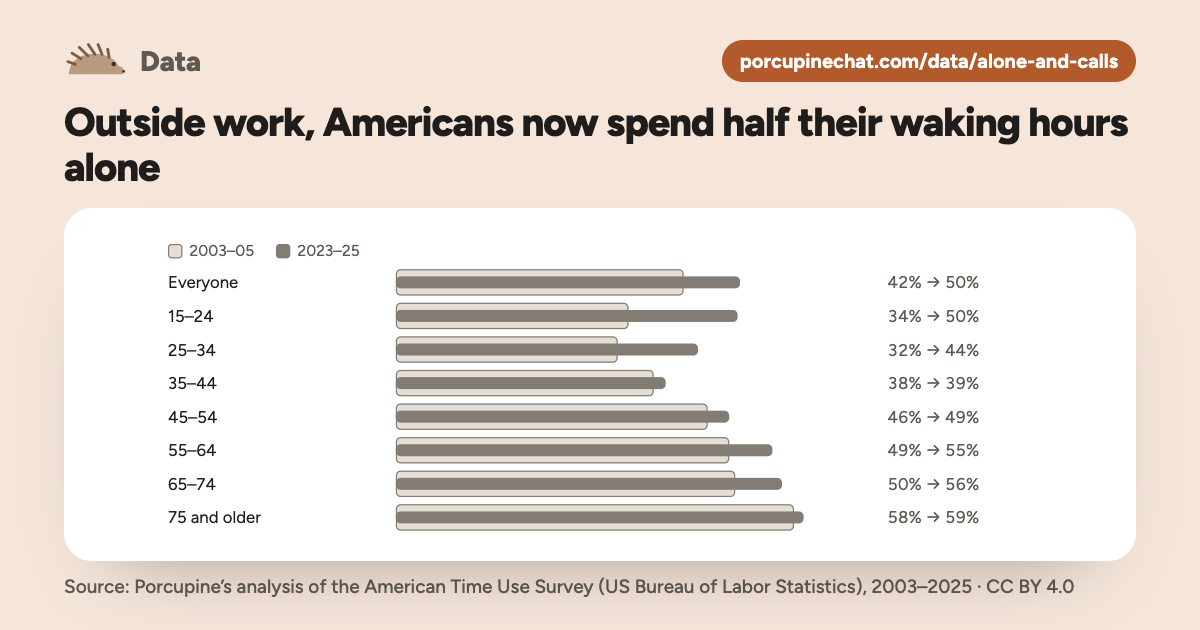
Outside work, we now spend half our waking hours alone
In 2003–05, it was 42%. The biggest change is among people under 35.
Share of waking hours spent with no one else there, not counting work or school.
Free to use, even commercially, under CC BY 4.0: credit Porcupine and link to this page.
Download the pictureChart: Porcupine, from the American Time Use Survey (CC BY 4.0). porcupinechat.com/data/alone-and-calls
People who live alone are most alone at dinnertime
From 6 to 8 p.m., about 7 in 10 people who live alone are awake and by themselves. At 65 and older, it’s about 8 in 10.
2023–25, not counting time at work.
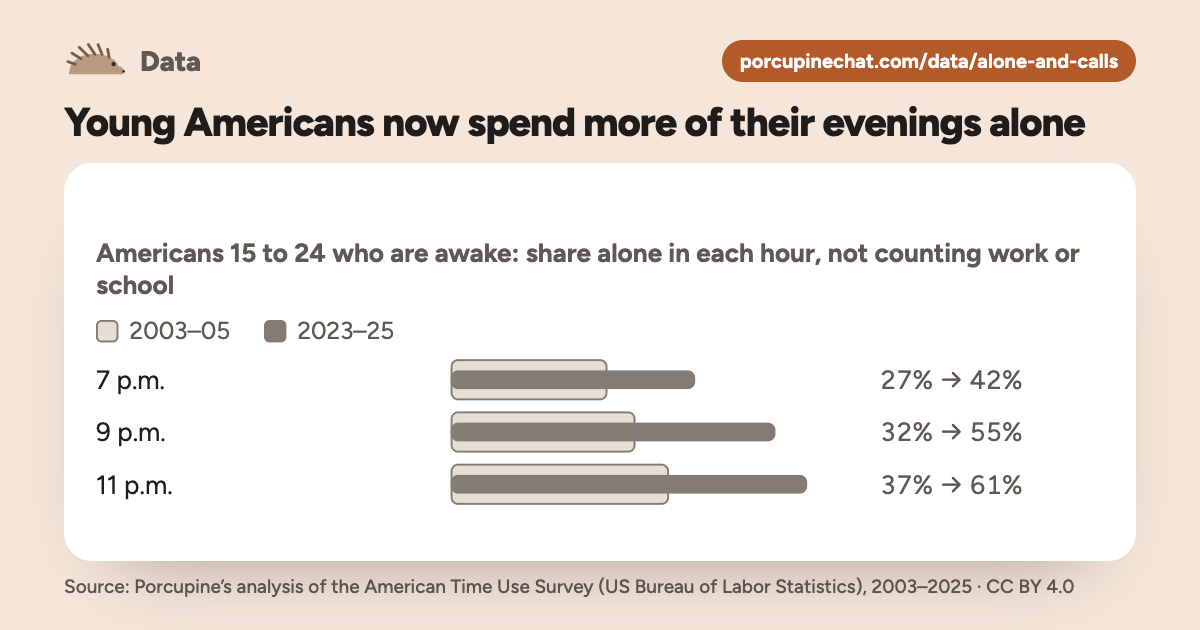
Young people now spend more of their evenings alone
At 9 p.m., 55% of 15- to 24-year-olds who are awake are alone. In 2003–05, it was 32%.
Ages 15 to 24: share of their waking time in each hour spent alone, not counting work or school.
Free to use, even commercially, under CC BY 4.0: credit Porcupine and link to this page.
Download the pictureChart: Porcupine, from the American Time Use Survey (CC BY 4.0). porcupinechat.com/data/alone-and-calls
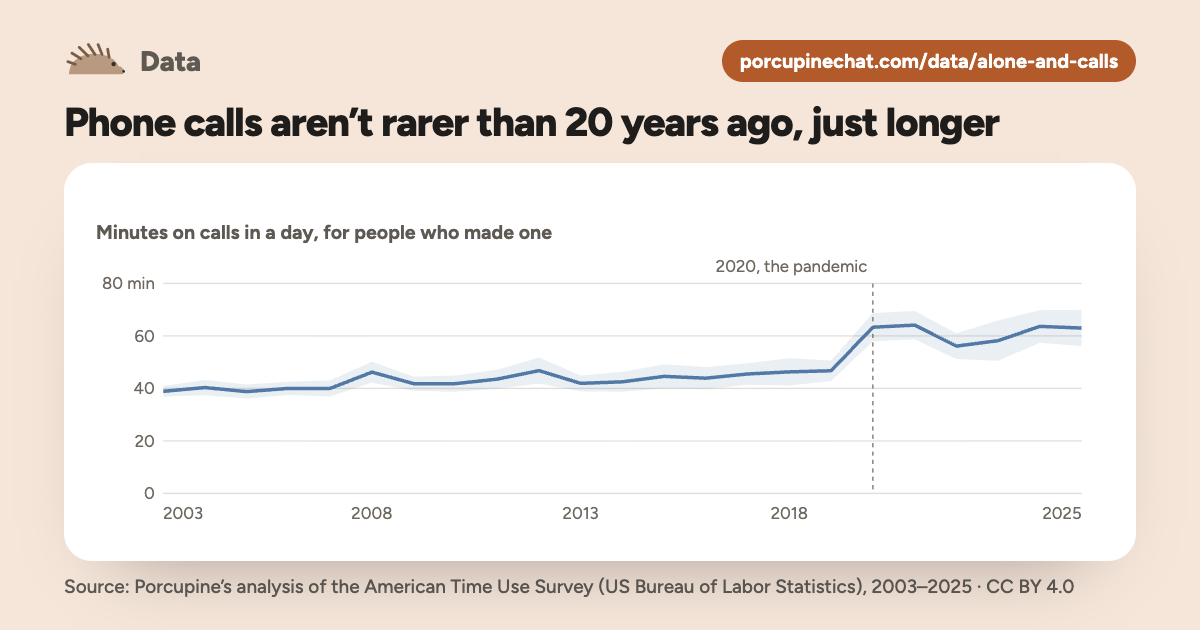
Phone calls aren’t rarer than 20 years ago, just longer
About 12% of Americans make a call on a given day, the same as in 2003–05. Those who call now spend about an hour on the phone that day, up from 39 minutes. The jump came in 2020 and stuck.
12%made a call on a given day in 2003–05
12%in 2023–25
1 hron calls that day, for those who called (39 min in 2003–05)
Minutes on calls that day, for people who made one. Video calls count as calls. Texts count too, but people rarely mention them.
Free to use, even commercially, under CC BY 4.0: credit Porcupine and link to this page.
Download the pictureChart: Porcupine, from the American Time Use Survey (CC BY 4.0). porcupinechat.com/data/alone-and-calls
Young people call less often, and stay on twice as long
11% of 15- to 24-year-olds make a call on a given day, down from 14%. When they do, they spend about an hour and a half on the phone, up from 47 minutes.
Share who made a call that day.
Men call more often than they used to, and women less
Women still call more often than men.
Share who made a call that day.
Phone time went up for everyone except parents with kids at home
Parents with kids under 18 at home still average about 3 minutes a day on calls. Everyone else went from about 6 minutes to 8.
3 → 3 minparents with kids under 18 at home
6 → 8 mineveryone else
Average minutes a day on calls, 2003–05 and 2023–25. The averages include people who made no calls that day.
When you need time alone, or a real call
- Time alone is normal. When you need some, say so, and say when you’ll be back in touch. Honest and hearable
- A call carries tone. When a text could mean more than one thing, a short call can clear it up. Check before assuming
- Make it regular. A standing call, like every Sunday evening, is easier than waiting for someone to reach out. Us against the problem
General ideas from the principles Porcupine is built on, not advice for your situation.
Something you’ve been meaning to say?
Write it the way it comes out. I’ll show you if the quills are up, and a version with them down.
The Quills Check needs JavaScript. Please turn it on and reload the page.
Common questions
What time of day are people most alone?
Between 5 and 6 p.m. In that hour, about 38% of Americans 15 and older are awake and alone, not counting work, more than at any other time of day, by Porcupine’s count of the American Time Use Survey, 2023–25. For people who live alone, it’s 6 to 8 p.m.
Do people still make phone calls?
Yes, as often as 20 years ago. About 12% of Americans make a call on a given day, the same as in 2003–05. Those who call spend about an hour on the phone that day, up from 39 minutes.
Who calls family the most?
People 65 and older: about 1 in 10 call family on a given day, against about 1 in 15 of all Americans and fewer than 1 in 30 people 15 to 24.
Is being alone the same as being lonely?
No. The survey records who was there, not how people felt. Plenty of time alone is chosen and welcome.
Guides for time alone and staying in touch
- How to ask for space without hurting someoneAny relationship
- How to tell someone you appreciate themAny relationship
- How to talk to your adult child without arguingParents and adult children
- How to respond to a text that sounds passive-aggressiveAny relationship
- How to calm down before replying to an angry textAny relationship
Find the words with Porcupine
PorcupineWhether you need some time to yourself or want to hear from someone more, saying so plainly helps. I can help you find the words.
Porcupine is coming soon. Sign up to be one of the first to try it.
We’ll email you when Porcupine opens and when we add new tools. Unsubscribe anytime. Privacy
More from the data
- Who Fills Your Day?Partners, kids, friends and family, at every age
- How much time do couples spend together?5 hr 10 min a day, and what they do with it
- How much time do people spend with friends?By age, who sees friends least, and how it feels
- Are we in a friendship recession?Which ages lost the most time with friends since 2003, and where it went
- How much of your time with your parents is behind you?Pick your age to see your share
- How much time do people spend with family on the holidays?Thanksgiving, Christmas and five more holidays, by the clock
- What do neighbors complain about, and when?New York City’s 311 complaints, by hour, week and season
- How often do people ask for a raise, or for help with money?Who asks, who gets a raise, and who gets help paying the bills
- How often do renters need repairs, or fall behind on rent?Repairs, rent and running late, for renters
- Do Americans still know their neighbors?Evenings with neighbors, friends and family since the 1970s
- How has the way we say sorry changed?Sorry, pardon and “sorry if,” in books since 1800
- Do couples agree on who does more at home?Chores, money and marriage, as women and men each tell it
- When did therapy-speak go mainstream?Boundaries, ghosting, gaslighting: in books, on Wikipedia and in searches
- What people asked advice columns, then and nowCourting faded, family took its place: 28,539 letters, a hundred years apart
- Etiquette then and now: which of Emily Post’s rules on what to say still hold?Her 73 rules from 1922: we’d keep 50, and every one we’d change said to keep your feelings, wants or questions to yourself
How we counted
- The American Time Use Survey, from the Bureau of Labor Statistics. Each year, thousands of Americans describe the day before, hour by hour: what they did and who was with them. 2003–2025, about 259,000 days.
- Alone means no one else was there. It’s counted only while people are awake and not at work or school, since the survey doesn’t ask who was there during sleep, washing or dressing, and didn’t ask at work before 2010.
- Every change and difference we name is bigger than the survey’s margin of error. Hover or tap a chart to see it.
More on how we counted
- Calls are calls to or from anyone. Video calls count as calls. Texts count too, but people rarely mention them. A call made while doing something else, like driving, is counted as driving.
- “Then” is 2003–05 and “now” is 2023–25, three years together, since one year has too few diaries for some groups. 2020 is in the year-by-year chart, though the survey stopped from March to May.
- Who Fills Your Day? counts time alone at work too, so its share alone through the working day is higher than this page’s.
- Margins of error are 95%, from the survey’s replicate weights. Source: Porcupine’s analysis of the American Time Use Survey, US Bureau of Labor Statistics, which hasn’t reviewed these pages, 2003–2025. Our charts and numbers are free to reuse under CC BY 4.0.
Updated