Data › Etiquette
Etiquette then and now: which of Emily Post’s rules on what to say still hold?
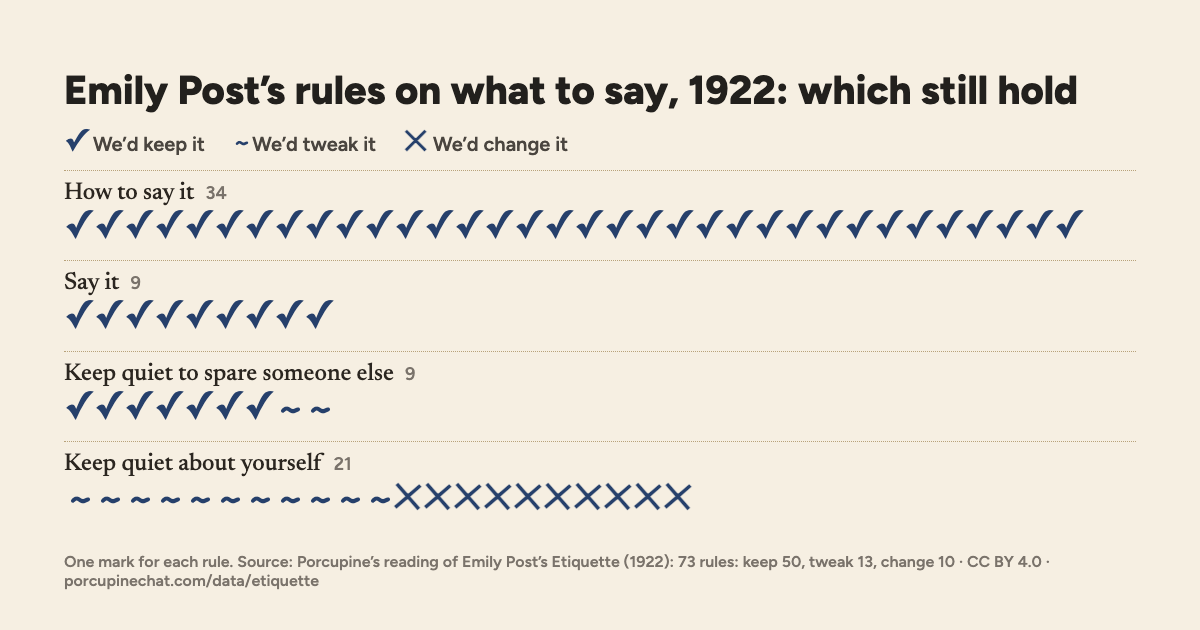
We pulled every rule about what to say to people, and how, out of Emily Post’s 1922 bestseller Etiquette: 73 of them. We’d keep 50. Every one we’d change told you to keep your feelings, wants or questions to yourself.
Porcupine’s reading of Etiquette (1922), from the public-domain text. The verdicts are ours.
What would you do with her rules?
Her rules, in her words. Tap one that catches your eye, say what you’d do, and Porcupine says what we’d do.
Etiquette, 1922Twelve to start with
- 9.✓
One who is well-bred never says “You are wrong!” or “Nothing of the kind!”
We’d keep it. Say what you think, not what’s wrong with them.
- 20.✕
Do not be too apparently clever if you would be popular. The cleverest woman is she who, in talking to a man, makes him seem clever.
We’d change it. Say what you know. Nobody has to shrink for a conversation to go well.
- 21.~
The faults of commission are far more serious than those of omission; regrets are seldom for what you left unsaid.
We’d tweak it. Fair, for a chatterer, which is who she wrote it for. For most of us, plenty of regrets are for what went unsaid. Say it, gently, before it festers.
- 22.✓
Only the very small mind hesitates to say “I don’t know.”
We’d keep it. “I don’t know” keeps a talk honest.
- 25.✓
…your answer is so long delayed that you begin with an apology, which is always a lame duck … even an opening apology may be attractive rather than repellent
We’d keep it. One light line of sorry, then answer what they wrote.
Try: “Sorry for the slow reply! Yes, I’m in for Saturday.” What to say when you forgot to text someone back
- 32.~
For all emotions written words are a bad medium.
We’d tweak it. Some talks belong in person. But a text that says how you feel, plainly, is often the kindest way in.
- 35.✓
Never send a letter without reading it over and making sure that you have said nothing that can possibly “sound different” from what you intend to say.
We’d keep it. It’s what the Quills Check is for.
Try: “That message came across as annoyed. Did I read it wrong?” How to respond to a text that sounds passive-aggressive
- 37.✕
Never write anything that can be construed as sentimental.
We’d change it. She was warning young women writing to men. Today, write it: “I really like spending time with you” is allowed.
- 38.✕
Never take a man to task about anything; never ask for explanations
We’d change it. Ask. Saying you’re unsure where you stand, and that you’d like to know, is fair.
Try: “I’ve been feeling unsure where we stand, and I’d like to know.” How to ask someone you’re dating where things are going
- 60.✓
…you could give her the benefit of the doubt and say (trustfully, not haughtily) “You have not had time to clean the silver, have you?”
We’d keep it. Her question leaves room for a reason you don’t know yet.
Try: “I missed you on Saturday. Did something come up?” How to tell a friend they hurt you
- 67.✕
A very well-bred man intensely dislikes the mention of money, and never speaks of it (out of business hours) if he can avoid it.
We’d change it. Money is one of the talks couples and friends most need to have. Have it calmly.
Try: “Having savings makes me feel safe. When the balance drops, I get anxious.” How to talk about money with your partner without fighting
- 73.✕
Furthermore, parents must never disagree before the children. It simply can’t be!
We’d change it. Not a fight in front of them. But two parents disagreeing calmly, and settling it, isn’t something to hide.
The other 61, in her order
- 1.✓
Ideal conversation should be a matter of equal give and take
We’d keep it. A talk where only one person gets heard isn’t really a talk.
- 2.✓
Above all, stop and think what you are saying! This is really the first, last and only rule.
We’d keep it. Still the first rule. One breath before you send it saves most of the trouble.
- 3.~
Try to do and say those things only which will be agreeable to others.
We’d tweak it. Kind, yes. But the thing someone needs to hear isn’t always agreeable, and it can still be said kindly.
- 4.✓
Try not to repeat yourself
We’d keep it. In a hard talk too: say it once, clearly, then let them answer.
- 5.✓
…never drag the incident into the conversation merely to flatter A.
We’d keep it. Praise lands when it’s real and specific, not laid on.
- 6.✓
Be careful not to let amiable discussion turn into contradiction and argument.
We’d keep it. When it starts to tip, slow down and ask what they mean.
- 7.~
The tactful person keeps his prejudices to himself
We’d tweak it. You can say what you think. “I see it differently” keeps it a talk.
- 8.✓
…says quietly “No. I don’t think I agree with you” or “It seems to me thus and so.”
We’d keep it. Nearly our words. “I see it differently” says the same thing.
Try: “I see it differently. Can I tell you why?” How to handle a family disagreement at the holidays
- 10.~
If he finds another’s opinion utterly opposed to his own, he switches to another subject for a pleasanter channel of conversation.
We’d tweak it. At a dinner, still good. With someone close, set it down for today, and come back to it.
- 11.✓
When some one is talking to you, it is inconsiderate to keep repeating “What did you say?”
We’d keep it. Listening closely the first time tells people they matter.
- 12.✓
…you must not talk about the unattractiveness of old age to the elderly, about the joys of dancing and skating to the lame, or about the advantages of ancestry to the self-made
We’d keep it. Think about who’s listening before you pick the topic.
- 13.✓
It is also dangerous, as well as needlessly unkind, to ridicule or criticize others, especially for what they can’t help.
We’d keep it. It’s never just a joke to the person it’s about.
- 14.✓
…it is impossible, almost, to meet anyone who has not something of interest to tell you if you are but clever enough yourself to find out what it is
We’d keep it. Curiosity is the easiest way into any talk.
- 15.~
Also you must not take your conversation “out of the drawing-room.” Operations, ills or personal blemishes … are neither suitable nor pleasant topics
We’d tweak it. Fine for a party. With people close to you, how you’re really doing is the conversation.
- 16.~
Don’t dilate on ills, misfortune, or other unpleasantnesses.
We’d tweak it. Don’t go on and on, sure. But telling a friend you’re struggling isn’t a burden on them.
- 17.✓
…never to speak of anyone without, in imagination, having them overhear what you say
We’d keep it. A good test before you vent about someone, too.
- 18.✕
One often hears the exclamation “I would say it to her face!” At least be very sure that this is true, and not a braggart’s phrase and then—nine times out of ten think better of it and refrain.
We’d change it. If it’s worth saying to her face, say it to her face, with your quills down.
- 19.✕
…telling people disagreeable things to their faces or behind their backs is not a pleasant occupation
We’d change it. Behind their back, still no. To their face, kindly, is how things get better.
Try: “Honestly, I’m angry about it, and I wanted to tell you instead of letting it fester.” How to tell a friend they hurt you
- 23.✓
Remember also that the sympathetic (not apathetic) listener is the delight of delights.
We’d keep it. Feeling heard is half of what people want from a hard talk.
- 24.✓
Suppose you merely change the wording of the above sentences, so that instead of slamming the door in your friend’s face, you hold it open
We’d keep it. Texts too: open with warmth, not with why you’re late.
- 26.✓
Just as the beginning of a letter should give the reader an impression of greeting, so should the end express friendly or affectionate leave-taking.
We’d keep it. How you sign off is often what they remember.
- 27.~
Even in so personal a matter as the letter to an absent member of one’s immediate family, it should be borne in mind, not to write needlessly of misfortune or unhappiness.
We’d tweak it. Not needlessly, fair. But with family, telling them how you really are is what lets them help.
- 28.✓
If the writers of all such letters would merely read over what they have written, and ask themselves if they could find pleasure in receiving messages of like manner and matter
We’d keep it. Still the best test for a hard text: how would it feel to get it?
- 29.✓
…a letter does not have to be long to be welcome—it can be very good indeed if it has a message that seems to have been spoken
We’d keep it. A short text that sounds like you beats a long one that doesn’t.
- 30.✓
The letter written by a person with an apologetic habit of mind, is different totally from the sometimes necessary letter of genuine apology. The former is as senseless as it is irritating
We’d keep it. Save sorry for when you mean it, and it means more.
- 31.✓
…both quip and gossip become deadly poison when transferred permanently to paper
We’d keep it. Screenshots make this truer than ever.
- 33.✓
…momentary annoyance should never be more than briefly expressed
We’d keep it. Name it in a line, then move on.
- 34.✓
There is a great deal in the letter about Mary, not only about what she has been doing, but what she has been thinking, or perhaps, feeling.
We’d keep it. That’s what makes a message feel close.
- 36.✓
Never so long as you live, write a letter to a man—no matter who he is—that you would be ashamed to see in a newspaper above your signature.
We’d keep it. Today: assume it could be screenshotted.
- 39.✕
Say nothing ever, that can be construed as demanding, asking, or even being eager for, his attentions!
We’d change it. Saying what you want, and asking what they want, is how you find out.
- 40.✓
Always keep in mind and never for one instant forget that a third person, and that the very one you would most object to, may find and read the letter.
We’d keep it. Texts get forwarded.
- 41.✓
…don’t write baby-talk and other sillinesses that would make you feel idiotic if the letter were to fall into strange hands
We’d keep it. Sensible for anything that could be passed around.
- 42.✓
…never by word or gesture must he compromise a woman
We’d keep it. For anyone: don’t write what could hurt someone’s name.
- 43.✓
Even the letters of older persons, although they are more restrained than those of youth, avoid anything suggesting pedantry and affectation.
We’d keep it. Plain words sound like you.
- 44.✓
…it is absolutely necessary that you write a letter of thanks to your hostess within a few days after the visit
We’d keep it. A thank you within a few days, by text or card, still lands.
- 45.✓
Don’t be afraid that your note is too informal
We’d keep it. Warm beats formal.
- 46.✓
Never think, because you can not easily write a letter, that it is better not to write at all.
We’d keep it. A clumsy message beats silence.
- 47.✓
…even such a one would be far more apt to take a new niece to her heart if the new niece herself gave evidence of having one
We’d keep it. Warmth goes first, and it usually comes back.
- 48.✕
Never ask for letters of introduction
We’d change it. Ask for the introduction, plainly, and make it easy to say no.
- 49.✓
…it is far better to refuse in the beginning, than to hedge
We’d keep it. A clear no early is kinder than a maybe that drags on.
- 50.~
…it has become the custom to say what one truthfully can of good, and leave out the qualifications that are bad
We’d tweak it. Say the true good things, yes. But if leaving something out would mislead, it’s kinder to say it.
- 51.✓
Say what you truly feel. Say that and nothing else.
We’d keep it. The heart of a note to someone grieving.
- 52.✓
Don’t dwell on the details of illness or the manner of death; don’t quote endlessly from the poets and Scriptures.
We’d keep it. Write about the person, and to the person you’re writing to.
- 53.✓
Write as simply as possible and let your heart speak as truly and as briefly as you can.
We’d keep it. Simple and short is what people keep.
- 54.✓
Ask if there is anything you can do at any time to be of service to his people.
We’d keep it. Even better, offer one specific thing.
- 55.✓
Grace of expression counts for nothing; sincerity alone is of value.
We’d keep it. Nobody needs it polished, just meant.
- 56.~
The polite thing—unless his manner does not ring true, is to say “Why, of course, I do.”
We’d tweak it. Kind to spare them. But “Remind me where we met?” is honest, and most people don’t mind.
- 57.✓
…if he persists you may say: “My name is Simpson, not Simpkin.”
We’d keep it. Saying it plainly, and lightly, is fine.
- 58.✓
…there is no greater example of injustice than to reprimand those about you because you happen to be in a bad humor
We’d keep it. If you’re in a bad mood, it can wait.
- 59.✓
There is also no excuse for “correcting” either a servant or a child before people.
We’d keep it. Bring it up in private.
- 61.✓
And when you do correct, do not forget to make allowances, if there be any reason why allowance should be made.
We’d keep it. Ask what got in the way before you decide.
- 62.~
…exacts that you give no outward sign of your repugnance and that you make a pretence at least for a little while, of talking together
We’d tweak it. Civil at the table, sure. Then the fight still needs its own talk, somewhere quieter.
- 63.✓
…it is a breach of good manners to congratulate a bride on having secured a husband
We’d keep it. Congratulate them both, on each other.
- 64.✓
Do not launch into long conversation or details of yourself, how you feel or look or what happened to you, or what you wore when you were married!
We’d keep it. Their day, their story.
- 65.✓
One who is by choice or accident selected to come in contact with those in new affliction should, like a trained nurse, banish all consciousness of self
We’d keep it. Keep the focus on them.
- 66.✓
…no one expects more than a word—but that word should be seemingly personal
We’d keep it. A short, personal line beats a long general one.
- 68.✓
A man is a cad who tells anyone, no matter who, what his wife told him in confidence
We’d keep it. What’s told in confidence stays there.
- 69.✓
A gentleman does not lose control of his temper.
We’d keep it. If you’re losing it, take a break and come back.
- 70.~
Exhibitions of anger, fear, hatred, embarrassment, ardor or hilarity, are all bad form in public.
We’d tweak it. No scenes, fair. But saying “I’m angry about it” to the person, calmly, isn’t a scene.
- 71.✕
Children should be taught from the time they are little not to talk about what they like and don’t like.
We’d change it. Kids, and grown-ups, can say what they like and don’t. It’s how they’re asked that matters.
- 72.~
…it is bad form to discuss one’s private affairs before any one
We’d tweak it. Pick the place, yes. Private things deserve a private talk, not none.
Her rules on how to say it still hold. Her rules on keeping quiet about yourself don’t.
All 73 of her rules for talking and writing, by what each asks of you. One mark for each rule.
Etiquette, 1922Our marks
✓ we’d keep it~ we’d tweak it✕ we’d change it
How to say it Wording, tone, listening, reading it over
✓✓✓✓✓✓✓✓✓✓✓✓✓✓✓✓✓✓✓✓✓✓✓✓✓✓✓✓✓✓✓✓✓✓
34 rules: 34 keep
Say it Write the note, say what you feel
✓✓✓✓✓✓✓✓✓
9 rules: 9 keep
Keep quiet to spare someone else Gossip, secrets, cruel or tactless remarks
✓✓✓✓✓✓✓~~
9 rules: 7 keep · 2 tweak
Keep quiet about yourself Your feelings, troubles, views and questions
~~~~~~~~~~~✕✕✕✕✕✕✕✕✕✕
21 rules: 11 tweak · 10 change
Every mark is one rule, so a longer row is more rules.
Free to use, even commercially, under CC BY 4.0: credit Porcupine and link to this page.
Download the pictureChart: Porcupine’s reading of Emily Post’s Etiquette (1922) (CC BY 4.0). porcupinechat.com/data/etiquette
9 in 10 of her words on hard conversations were about writing them down
Notes of thanks, regret, apology and sympathy. She knew what we know about texts:
Without the interpretation of the voice, gaiety becomes levity, raillery becomes accusation. Moreover, words of a passing moment are made to stand forever.
Her fix still works: “Never send a letter without reading it over and making sure that you have said nothing that can possibly “sound different” from what you intend to say.”
Quills up
You’re being passive-aggressive, and it’s really childish.
Quills down Porcupine’s version
That message came across as annoyed. Did I read it wrong?
What changed: “Passive-aggressive” and “childish” are about who they are. “Came across as annoyed” is about one message, and “did I read it wrong?” lets them correct you.
From Porcupine’s guide: How to respond to a text that sounds passive-aggressive
Read it over before you send it
Write it the way it comes out. I’ll show you if the quills are up, and a version with them down.
The Quills Check needs JavaScript. Please turn it on and reload the page.
What we’d keep from her rules, and what we’d drop
- Keep her how. Plain, short and kind, and read it over before you send it. Honest and hearable
- Drop her hush. How you feel, what worries you and what you want to know are all allowed. Say what’s underneath
- Ask before you decide why. Her silver question still works. Check before assuming
General ideas from the principles Porcupine is built on, not advice for your situation.
Common questions
Is Emily Post’s advice still good?
Mostly. Of the 73 rules in her 1922 Etiquette about what to say and how, Porcupine would keep 50 as written. Nearly all of her advice on how to say things holds up. The rules that don’t were about keeping your feelings, worries and questions to yourself.
What did Emily Post say about disagreeing?
To say quietly “No. I don’t think I agree with you” or “It seems to me thus and so,” and never “You are wrong!”
What did Emily Post say about apologizing?
Her model note of apology says what happened and what’s being done so it won’t happen again. She also warned against the letter of “a person with an apologetic habit of mind,” which she called “as senseless as it is irritating.”
What did Emily Post say to write in a condolence letter?
“Say what you truly feel. Say that and nothing else.” She added that sincerity counts more than grace: “Grace of expression counts for nothing; sincerity alone is of value.”
Find the words with Porcupine
PorcupineHer rules on how to say it still work. I can help you say the rest, so the other person can hear it.
Porcupine is coming soon. Sign up to be one of the first to try it.
We’ll email you when Porcupine opens and when we add new tools. Unsubscribe anytime. Privacy
More from the data
- Who Fills Your Day?Partners, kids, friends and family, at every age
- How much time do couples spend together?5 hr 10 min a day, and what they do with it
- How much time do people spend with friends?By age, who sees friends least, and how it feels
- Are we in a friendship recession?Which ages lost the most time with friends since 2003, and where it went
- How much of your time with your parents is behind you?Pick your age to see your share
- How much time do people spend with family on the holidays?Thanksgiving, Christmas and five more holidays, by the clock
- What do neighbors complain about, and when?New York City’s 311 complaints, by hour, week and season
- How often do people ask for a raise, or for help with money?Who asks, who gets a raise, and who gets help paying the bills
- How often do renters need repairs, or fall behind on rent?Repairs, rent and running late, for renters
- Do Americans still know their neighbors?Evenings with neighbors, friends and family since the 1970s
- When are people most alone, and who still calls?The hour the most people are alone, and who still calls
- How has the way we say sorry changed?Sorry, pardon and “sorry if,” in books since 1800
- Do couples agree on who does more at home?Chores, money and marriage, as women and men each tell it
- When did therapy-speak go mainstream?Boundaries, ghosting, gaslighting: in books, on Wikipedia and in searches
- What people asked advice columns, then and nowCourting faded, family took its place: 28,539 letters, a hundred years apart
How we counted
- The book: Emily Post, Etiquette in Society, in Business, in Politics and at Home (Funk & Wagnalls, 1922), public domain in the US, from Project Gutenberg’s text. We quote only the 1922 edition.
- The rules: every rule about what to say to someone, or how to say it, in her chapters on conversation and on letters, her notes of thanks, apology, condolence and introduction, and the few sections elsewhere about talking to people. Not her rules on titles, paper, ink or pronunciation. A rule she gives twice counts once.
- Our verdicts: each rule is sorted by what it asks of you and given our verdict against Porcupine’s guides. That part is our reading, so every rule and verdict is listed above.
- The words: we counted the words in each of the book’s 717 sections, by its own headings. Which sections count as a hard conversation is our call.
- Her name: Porcupine isn’t connected with Emily Post or the Emily Post Institute. We name her as the author of the 1922 book; the verdicts and advice here are ours.
Updated