We counted 28,539 letters to newspaper advice columns, a century apart, to see what people asked then and what they ask now.
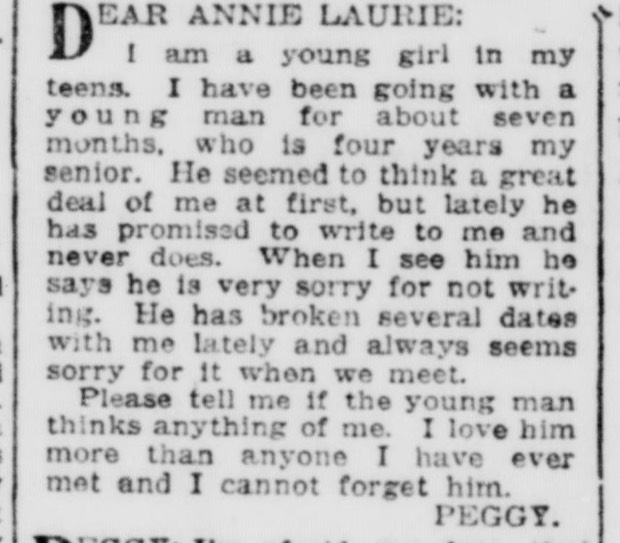
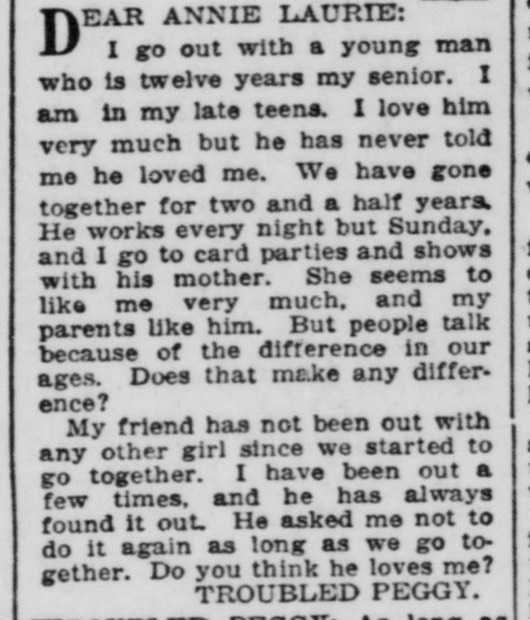
Peggy’s letter to “Annie Laurie,” Brownsville Herald (Texas), December 11, 1928.
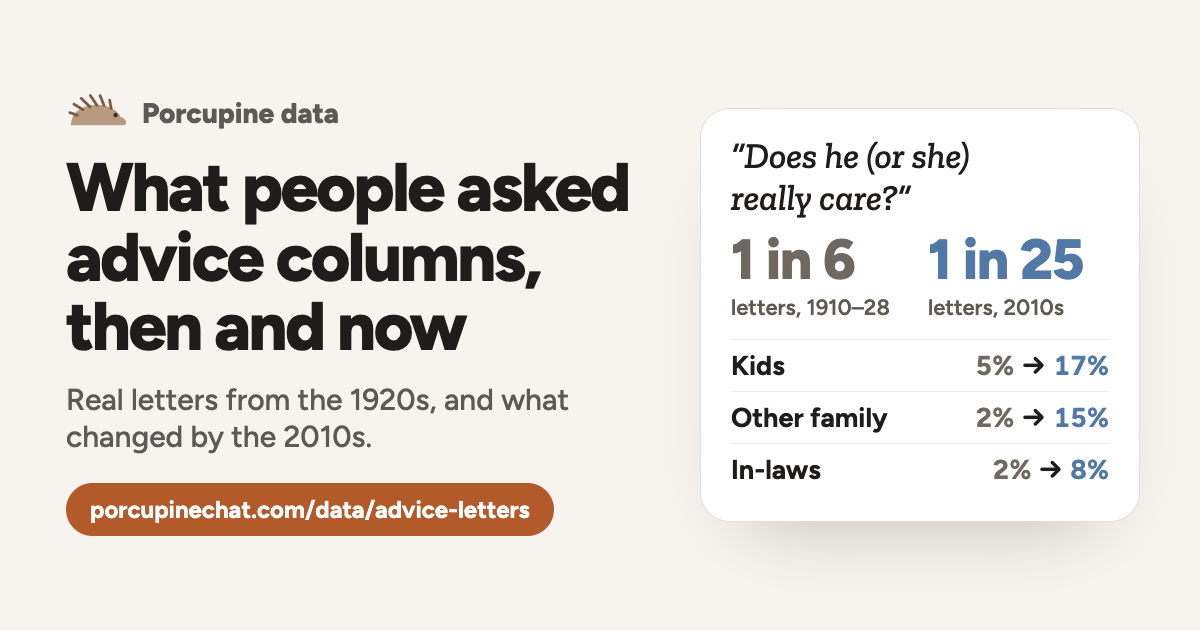
Peggy’s young man kept breaking dates, so she wrote to the paper to ask if he thought anything of her. About 1 in 6 letters about people from 1910–28 asked “Does he (or she) really care?” In Dear Abby’s letters from the 2010s, it was about 1 in 25.
Less courting, more family
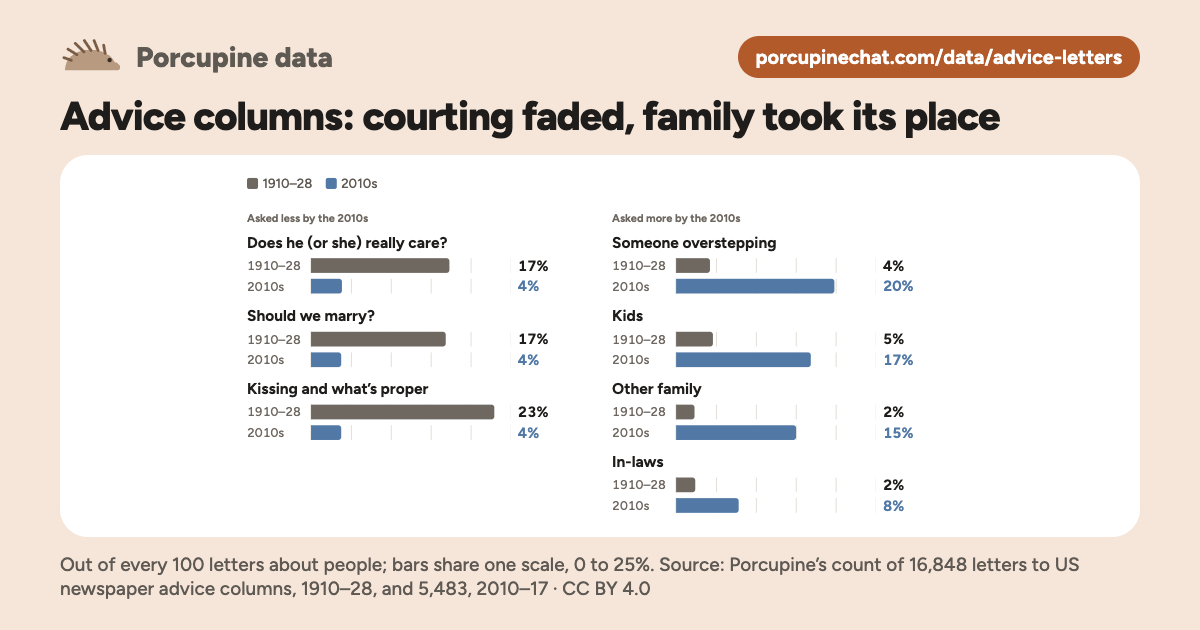
Out of every 100 letters, how many asked about each topic, then and now. Courting faded, and family took its place.
1910–282010s
Asked less by the 2010s
Does he (or she) really care?
1910–2817%
2010s4%
Should we marry?
1910–2817%
2010s4%
Kissing and what’s proper
1910–2823%
2010s4%
Asked more by the 2010s
Someone overstepping: meddling, imposing, ignoring a no
1910–284%
2010s20%
Kids
1910–285%
2010s17%
Other family: siblings, cousins, grandparents
1910–282%
2010s15%
In-laws
1910–282%
2010s8%
About the same
Money9% then · 10% now
Parents8% then · 10% now
Work7% then · 8% now
A quarrel or a breakup8% then · 6% now
Bars share one scale, from 0 to 25% of letters.
Free to use, even commercially, under CC BY 4.0: credit Porcupine and link to this page.
Chart: Porcupine’s count of letters to newspaper advice columns, 1910–28 and 2010–17 (CC BY 4.0). porcupinechat.com/data/advice-letters
See the numbers
Topic
1910–28
2010s
Does he (or she) really care?
17.3%
3.9%
Kissing and what’s proper
23%
3.8%
Should we marry?
16.9%
3.8%
A rival or jealousy
12.8%
7.3%
Health and looks
10.4%
15.6%
Money
9.3%
10.3%
Manners: weddings, gifts, guests
8.3%
22.3%
A quarrel or a breakup
7.5%
5.7%
Parents
7.5%
10.3%
Trouble in a marriage
6.9%
14.9%
Work
6.5%
7.8%
A call, letter or text
6.1%
4.7%
Lonely or shy
5.7%
3.2%
Kids
4.6%
16.9%
An age gap
4.2%
1.1%
Friends
4.2%
11.2%
Someone overstepping
4.2%
19.8%
Stopped writing or calling
3.3%
1.4%
Different religion or background
3.2%
2.9%
Not feeling it
3%
1.5%
In-laws
2.4%
7.8%
Other family
2.3%
15%
Drinking
1.4%
2.6%
Out of every 100 letters about people: 16,848 letters then, 5,483 now. A letter can ask about more than one.
The old columns were written mostly for the lovelorn, and Dear Abby took letters from everybody. So some of this is the columns changing, and some is the century.
Write to the column
Porcupine is a coach for hard conversations. Try it on the worries readers wrote about a hundred years ago.
Read a real letter from the 1920s
Pick what you’d tell the writer
See what the columnist wrote back
Turn the same worry into a text today, with Porcupine’s help
Pick a worry:
Dear Annie Laurie:
I am a young girl in my teens. I have been going with a young man for about seven months, who is four years my senior. He seemed to think a great deal of me at first, but lately he has promised to write to me and never does. When I see him he says he is very sorry for not writing. He has broken several dates with me lately and always seems sorry for it when we meet.
Please tell me if the young man thinks anything of me. I love him more than anyone I have ever met and I cannot forget him.
Peggy
“Annie Laurie,” Brownsville Herald (Texas), December 11, 1928, page 6
See the original letter
1What would you tell her?
Let him go, and find someone more considerate.Annie Laurie’s answerYou
Give him time. He’s probably busy.You
Ask him plainly where you stand.Porcupine’s pickYou
Every reader’s pick since the page opened, counted by choice only, never who picked what.
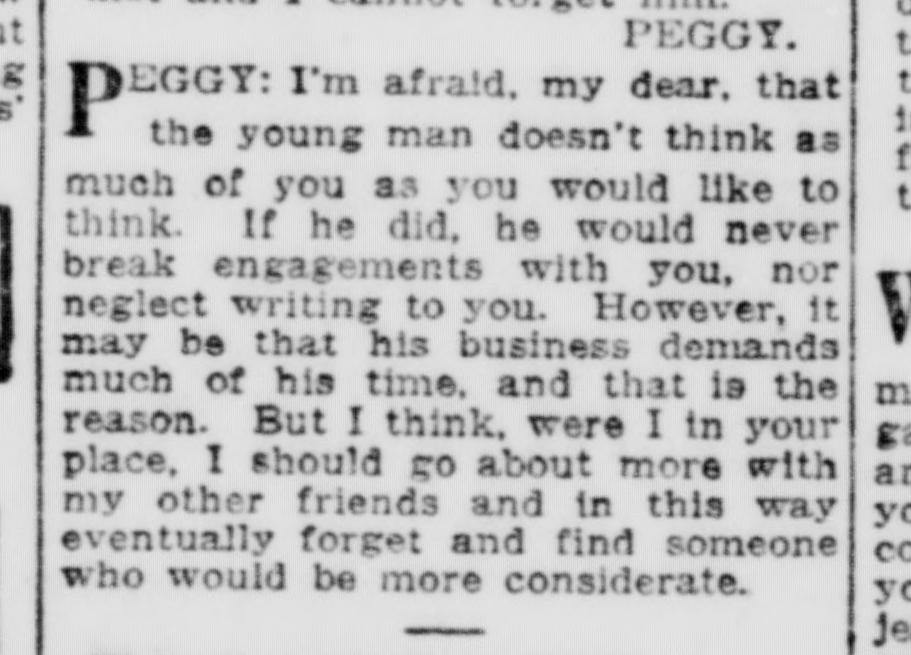
2What Annie Laurie wrote back
I’m afraid, my dear, that the young man doesn’t think as much of you as you would like to think. If he did, he would never break engagements with you, nor neglect writing to you. However, it may be that his business demands much of his time, and that is the reason. But I think, were I in your place, I should go about more with my other friends and in this way eventually forget and find someone who would be more considerate.
See the original reply
PorcupineAnnie Laurie guessed at what he felt. We’d have Peggy ask him. Saying what she’s noticed, then asking one question he can answer, gets her a real reply.
3The same worry, today
If Peggy texted him today, hurt by the broken dates, it might come out like this:
Quills up
So you’re ghosting me now? Cool.
Quills down Porcupine’s version
I’ve noticed we talk a lot some weeks and barely at all others, and it leaves me unsure where we stand. Are you looking for something serious right now? Either answer is okay. I’d just rather know.
What changed: It asks for the truth and makes it easy to give. “Either answer is okay” is what takes the pressure off.
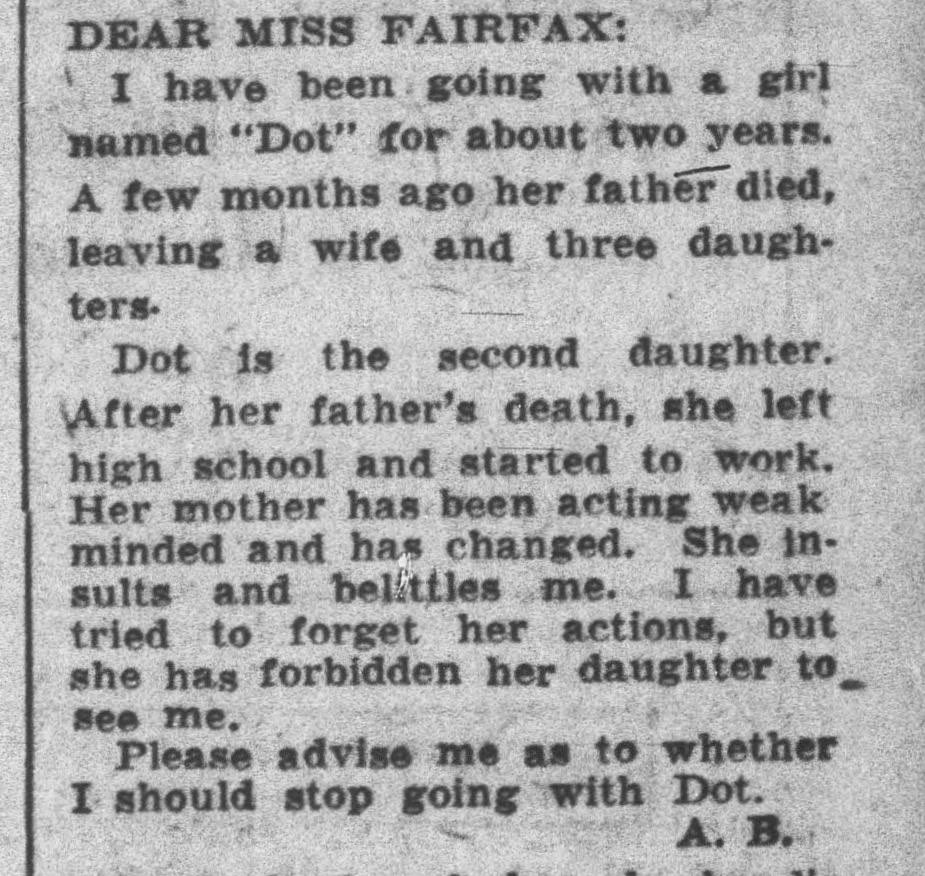
I have been going with a girl named “Dot” for about two years. A few months ago her father died, leaving a wife and three daughters.
Dot is the second daughter. After her father’s death, she left high school and started to work. Her mother has been acting weak minded and has changed. She insults and belittles me. I have tried to forget her actions, but she has forbidden her daughter to see me.
Please advise me as to whether I should stop going with Dot.
A. B.
Beatrice Fairfax’s column, Washington Times, October 17, 1928, page 13
See the original letter
1What would you tell him?
Stop seeing her. Her mother has decided.You
Be patient with her mother, and talk it over with her.Miss Fairfax’s answerPorcupine’s pickYou
Tell her that her mother is being unfair.You
Every reader’s pick since the page opened, counted by choice only, never who picked what.
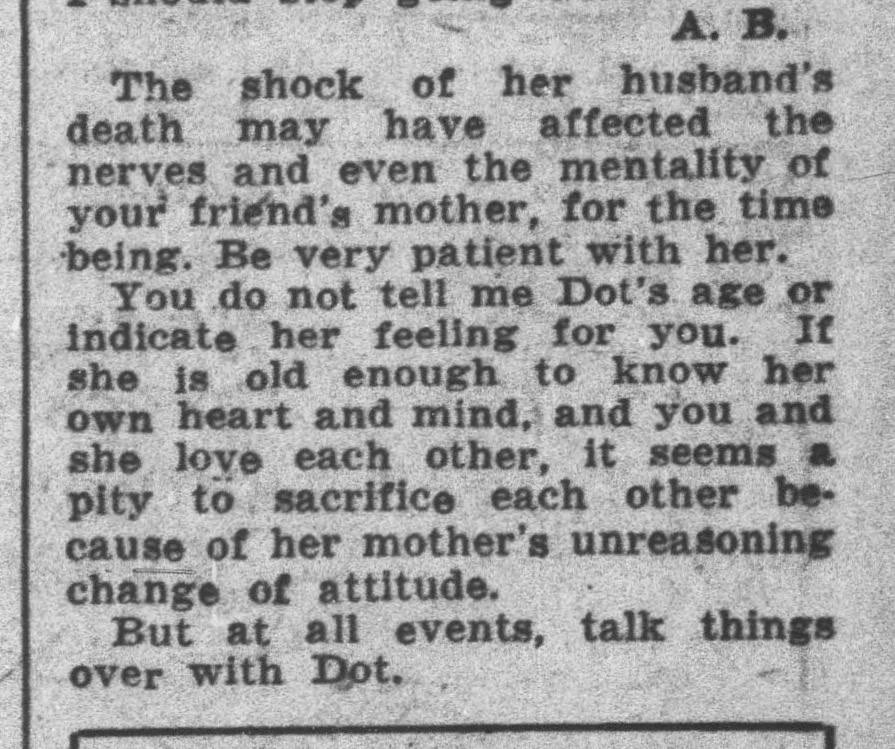
2What Miss Fairfax wrote back
The shock of her husband’s death may have affected the nerves and even the mentality of your friend’s mother, for the time being. Be very patient with her.
You do not tell me Dot’s age or indicate her feeling for you. If she is old enough to know her own heart and mind, and you and she love each other, it seems a pity to sacrifice each other because of her mother’s unreasoning change of attitude.
But at all events, talk things over with Dot.
See the original reply
PorcupineBe patient with a grieving mother and talk it over with the girl he loves, Miss Fairfax said, and we agree. We’d have him start with how it felt, not with what’s wrong with her mother.
3The same worry, today
If he brought it up with Dot today, stung by her mother, he might start like this:
Quills up
She clearly hates me.
Quills down Porcupine’s version
I felt judged, and I wasn’t sure you noticed.
What changed: “She clearly hates me” guesses at her feelings. Saying how you felt, and that you weren’t sure they noticed, keeps it to what you know.
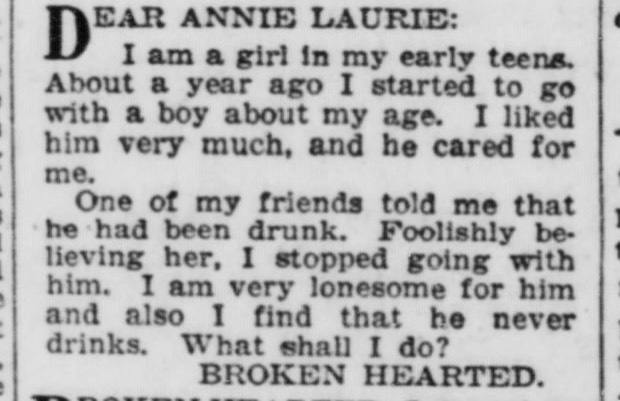
I am a girl in my early teens. About a year ago I started to go with a boy about my age. I liked him very much, and he cared for me.
One of my friends told me that he had been drunk. Foolishly believing her, I stopped going with him. I am very lonesome for him and also I find that he never drinks. What shall I do?
Broken Hearted
“Annie Laurie,” Brownsville Herald (Texas), May 18, 1928, page 8
See the original letter
1What would you tell her?
Wait for him to come back to you.You
Tell him it was your friend’s fault.You
Write him a note, explain and apologize.Annie Laurie’s answerPorcupine’s pickYou
Every reader’s pick since the page opened, counted by choice only, never who picked what.
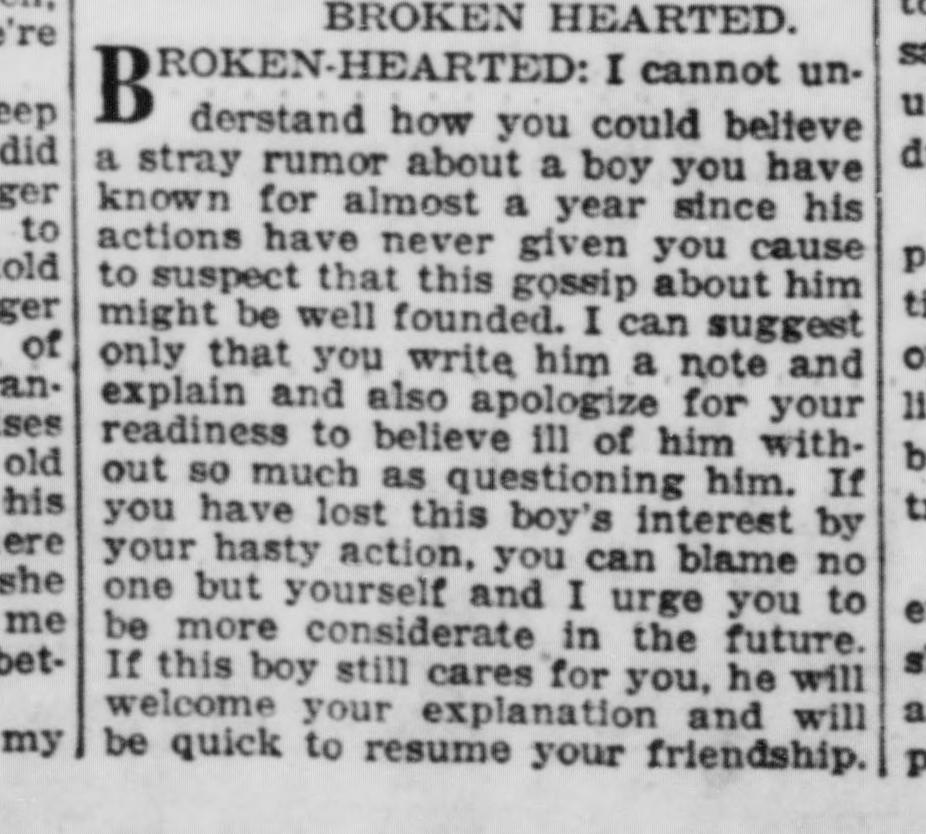
2What Annie Laurie wrote back
I cannot understand how you could believe a stray rumor about a boy you have known for almost a year since his actions have never given you cause to suspect that this gossip about him might be well founded. I can suggest only that you write him a note and explain and also apologize for your readiness to believe ill of him without so much as questioning him. If you have lost this boy’s interest by your hasty action, you can blame no one but yourself and I urge you to be more considerate in the future. If this boy still cares for you, he will welcome your explanation and will be quick to resume your friendship.
See the original reply
PorcupineIf you picked Annie Laurie’s answer, you picked well. We’d just leave out the scolding. Own what you did, then give him room to answer.
3The same worry, today
If she texted him today, anxious to fix it, she might end like this:
Quills up
So are we good now?
Quills down Porcupine’s version
Take whatever time you need. I just wanted you to know I’m sorry.
What changed: “So are we good now?” asks for forgiveness on your timing. “Take whatever time you need” leaves it on theirs.
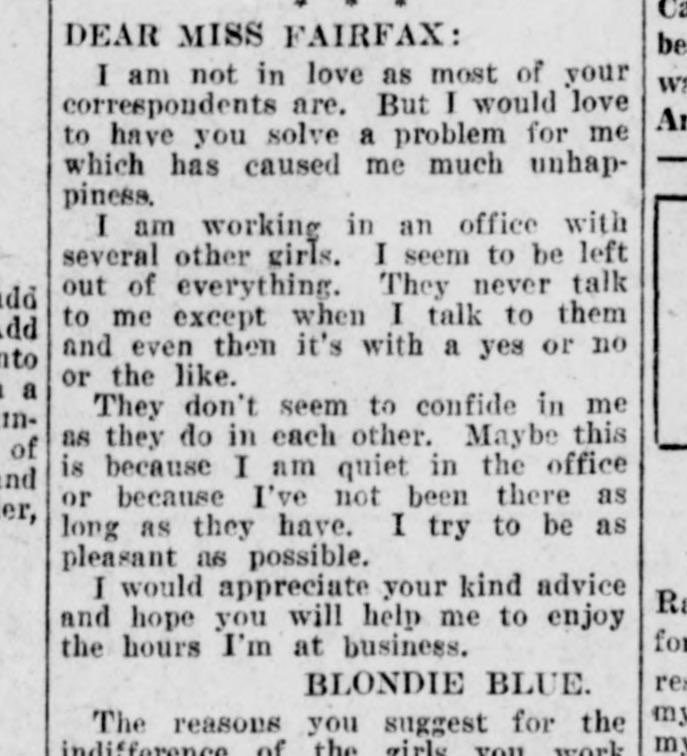
I am not in love as most of your correspondents are. But I would love to have you solve a problem for me which has caused me much unhappiness.
I am working in an office with several other girls. I seem to be left out of everything. They never talk to me except when I talk to them and even then it’s with a yes or no or the like.
They don’t seem to confide in me as they do in each other. Maybe this is because I am quiet in the office or because I’ve not been there as long as they have. I try to be as pleasant as possible.
Blondie Blue
Beatrice Fairfax’s column, San Antonio Light (Texas), December 3, 1925, page 7
See the original letter
1What would you tell her?
Give them time, keep being kind, and focus on your work.Miss Fairfax’s answerYou
Tell one of them you’ve felt left out, and ask about it.Porcupine’s pickYou
Keep to yourself. It’s only work.You
Every reader’s pick since the page opened, counted by choice only, never who picked what.
2What Miss Fairfax wrote back
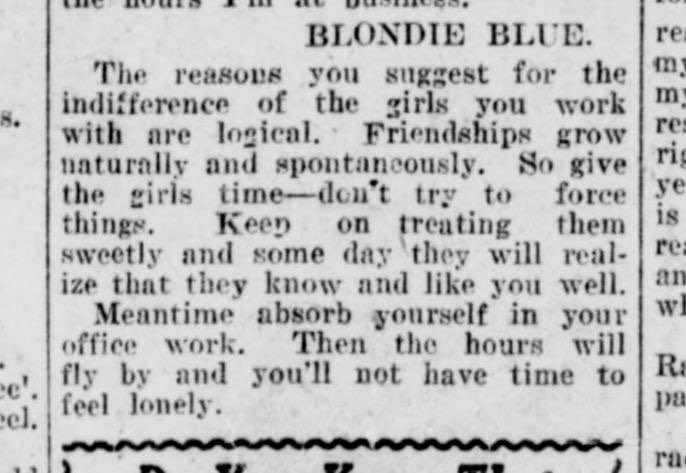
The reasons you suggest for the indifference of the girls you work with are logical. Friendships grow naturally and spontaneously. So give the girls time—don’t try to force things. Keep on treating them sweetly and some day they will realize that they know and like you well.
Meantime absorb yourself in your office work. Then the hours will fly by and you’ll not have time to feel lonely.
See the original reply
PorcupineMiss Fairfax said to give them time and keep being kind, which isn’t bad. We’d add one small, brave step. Tell one of them how it feels, and ask, before deciding what their quiet means.
3The same worry, today
If she told one of the girls today, after weeks of yes-or-no answers, it might come out like this:
Quills up
Guess I’m not invited to things anymore. Cool.
Quills down Porcupine’s version
I saw the photos from Saturday and felt a bit left out. Did I miss a message?
What changed: “Guess I’m not invited anymore” decides what it meant. “Did I miss a message?” leaves room for a reason you haven’t heard.
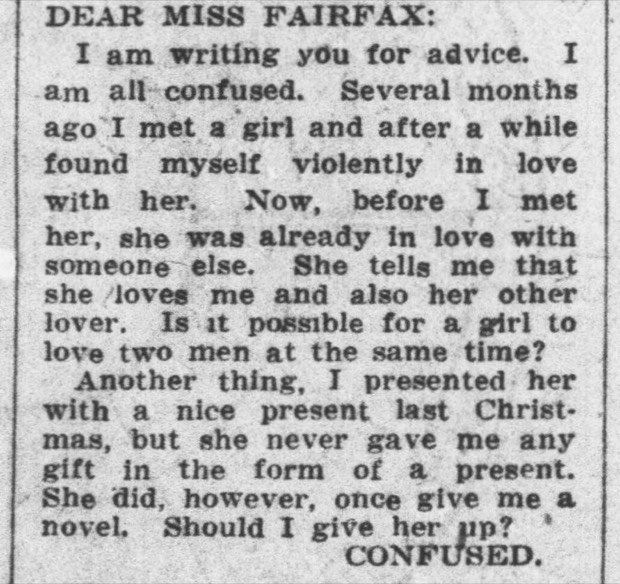
I am writing you for advice. I am all confused. Several months ago I met a girl and after a while found myself violently in love with her. Now, before I met her, she was already in love with someone else. She tells me that she loves me and also her other lover. Is it possible for a girl to love two men at the same time?
Another thing, I presented her with a nice present last Christmas, but she never gave me any gift in the form of a present. She did, however, once give me a novel. Should I give her up?
Confused
Beatrice Fairfax’s column, Washington Times, October 26, 1928
See the original letter
1What would you tell him?
Stay her loyal friend, and hope she picks you.Miss Fairfax’s answerYou
Tell her what you want, and ask what she wants.Porcupine’s pickYou
Give her up.You
Every reader’s pick since the page opened, counted by choice only, never who picked what.
2What Miss Fairfax wrote back
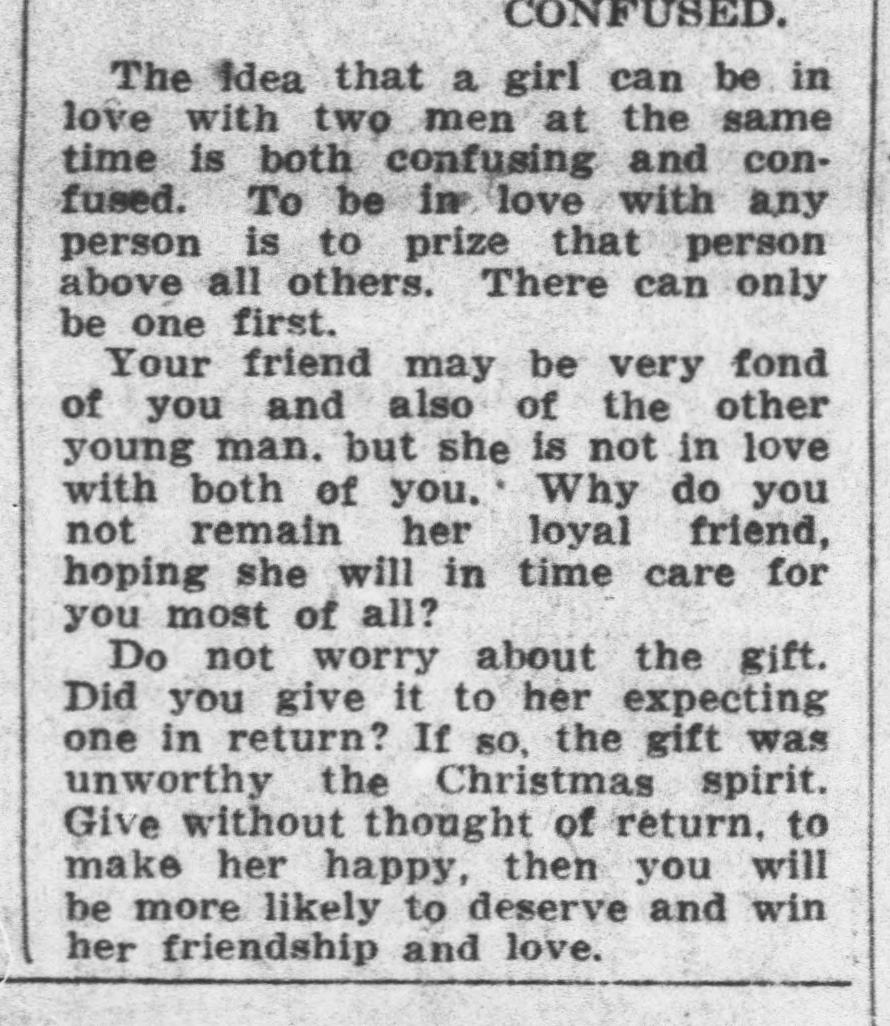
The idea that a girl can be in love with two men at the same time is both confusing and confused. To be in love with any person is to prize that person above all others. There can only be one first.
Your friend may be very fond of you and also of the other young man, but she is not in love with both of you. Why do you not remain her loyal friend, hoping she will in time care for you most of all?
Do not worry about the gift. Did you give it to her expecting one in return? If so, the gift was unworthy the Christmas spirit. Give without thought of return, to make her happy, then you will be more likely to deserve and win her friendship and love.
See the original reply
PorcupineMiss Fairfax told him to wait and hope. We’d have him say what he wants, and ask what she wants, so neither of them has to guess.
3The same worry, today
If he told her today, tired of sharing her, it might come out as an ultimatum:
Quills up
Either we’re exclusive by Friday or I’m done.
Quills down Porcupine’s version
I’d like us to be exclusive. Is that something you’d want?
What changed: “By Friday or I’m done” sets a deadline on their feelings. “Is that something you’d want?” asks about them.
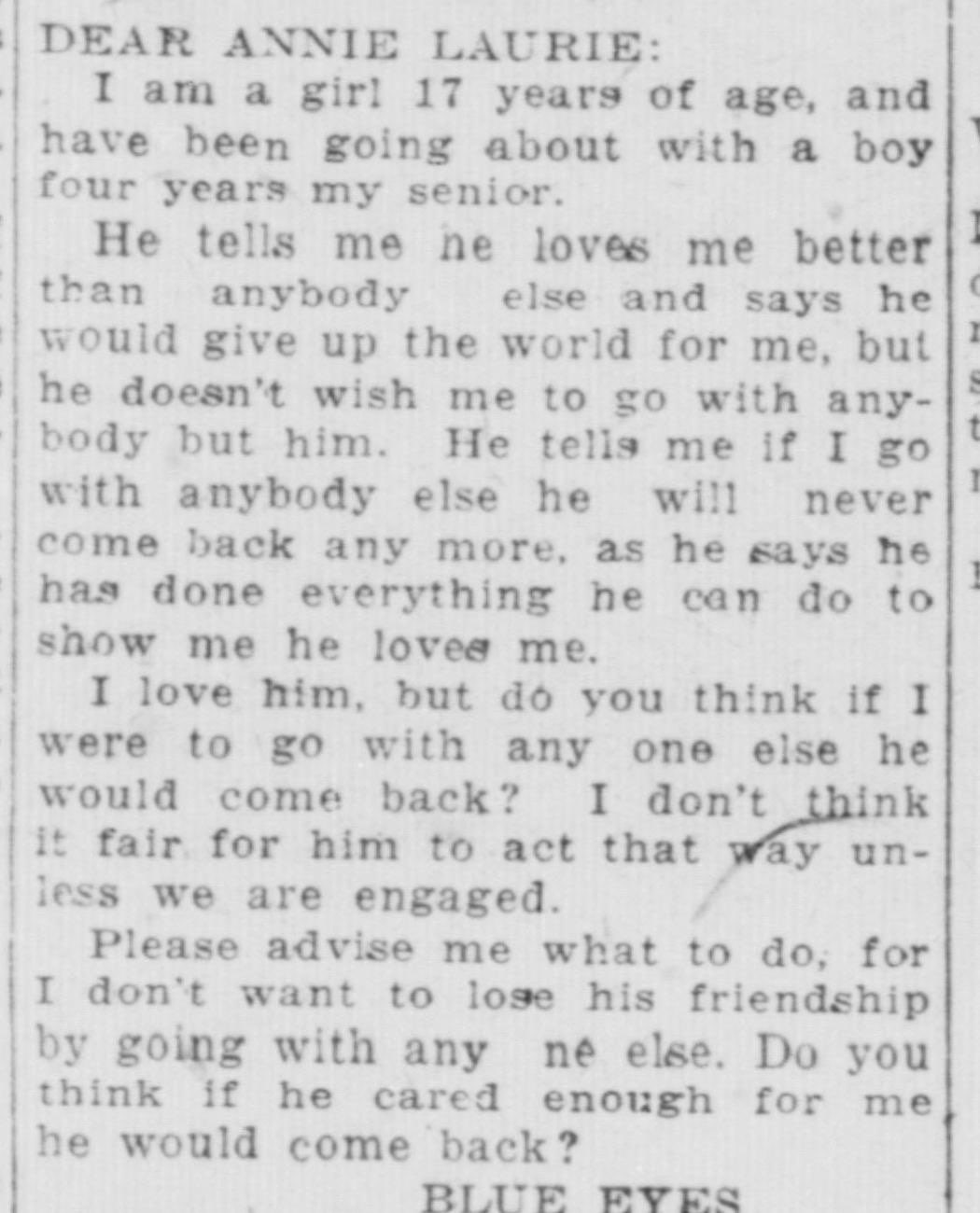
I am a girl 17 years of age, and have been going about with a boy four years my senior.
He tells me he loves me better than anybody else and says he would give up the world for me, but he doesn’t wish me to go with anybody but him. He tells me if I go with anybody else he will never come back any more, as he says he has done everything he can do to show me he loves me.
I love him, but do you think if I were to go with any one else he would come back? I don’t think it fair for him to act that way unless we are engaged.
Blue Eyes
“Annie Laurie,” South Bend News-Times (Indiana), September 15, 1922, page 7
See the original letter
1What would you tell her?
Give up your other friends, so you don’t lose him.You
Make him jealous, so he sees what he’d lose.You
Keep your friends. It isn’t fair of him to ask.Annie Laurie’s answerPorcupine’s pickYou
Every reader’s pick since the page opened, counted by choice only, never who picked what.
2What Annie Laurie wrote back
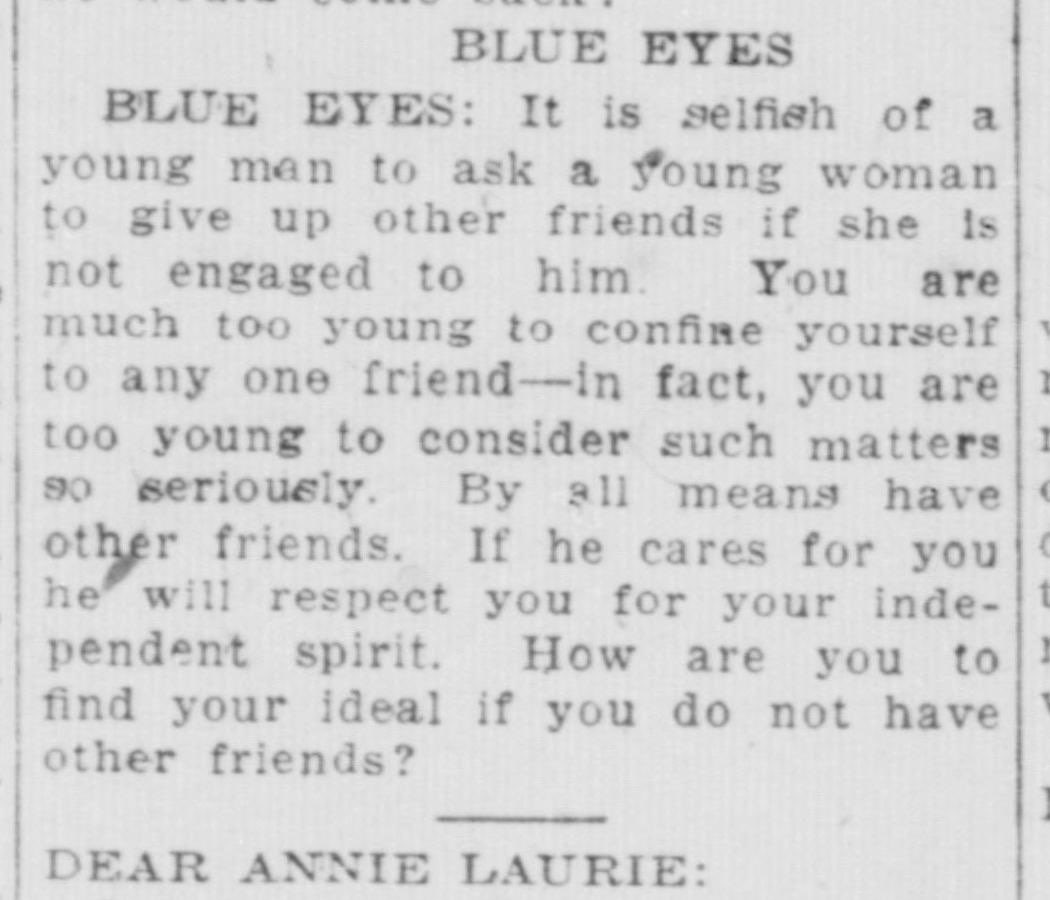
It is selfish of a young man to ask a young woman to give up other friends if she is not engaged to him. You are much too young to confine yourself to any one friend—in fact, you are too young to consider such matters so seriously. By all means have other friends. If he cares for you he will respect you for your independent spirit. How are you to find your ideal if you do not have other friends?
See the original reply
PorcupineAnnie Laurie is right that he can ask but can’t set the rules alone. We’d help her say what she needs plainly and early, without asking his permission.
3The same worry, today
If she told him today, afraid of losing him, she might shrink it into a favor:
Quills up
Haha I mean it’s fine, I just sometimes kind of like having my own nights, if that’s okay?
Quills down Porcupine’s version
I really like seeing you, and I also need a couple of nights a week to myself. I wanted to say that early.
What changed: “Haha… if that’s okay?” makes a need sound like a favor. “I really like seeing you, and I also need” holds both.
I go out with a young man who is twelve years my senior. I am in my late teens. I love him very much but he has never told me he loved me. We have gone together for two and a half years.
… But people talk because of the difference in our ages. Does that make any difference?
Troubled Peggy
“Annie Laurie,” Brownsville Herald (Texas), May 7, 1928, page 6
See the original letter
1What would you tell her?
Ask him how he feels about you.Porcupine’s pickYou
Date other young men too, and don’t mind the gap.Annie Laurie’s answerYou
Listen to the people who talk.You
Every reader’s pick since the page opened, counted by choice only, never who picked what.
2What Annie Laurie wrote back
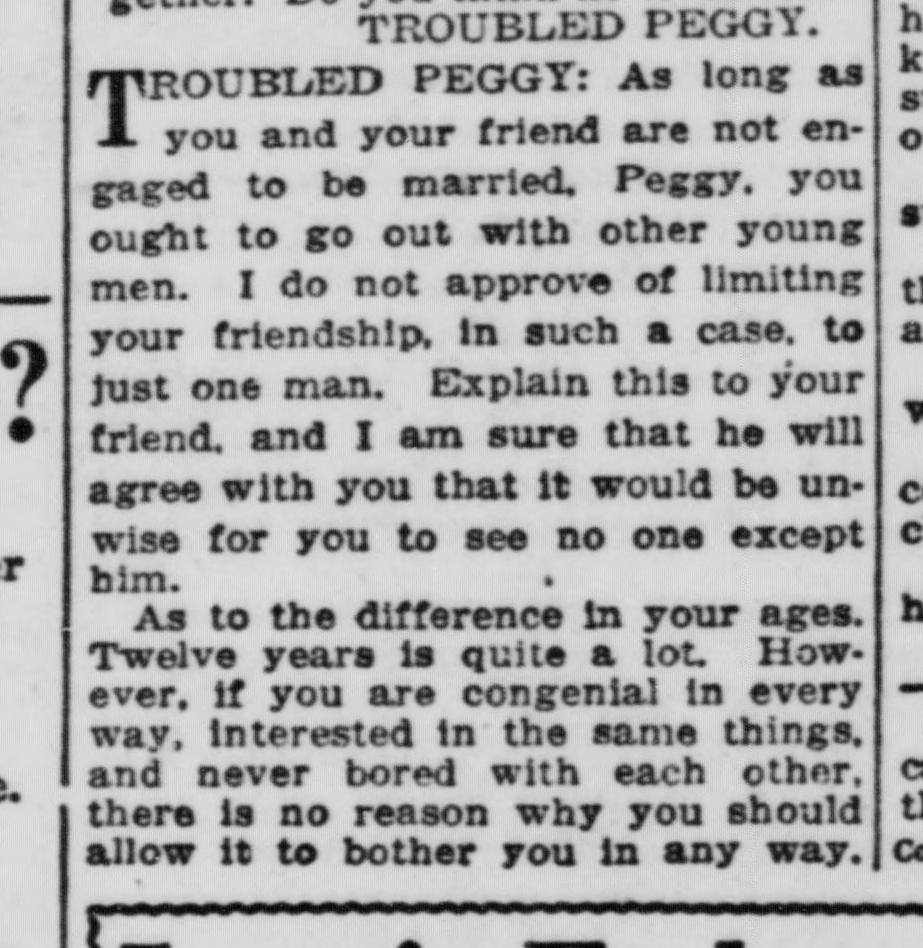
As long as you and your friend are not engaged to be married, Peggy, you ought to go out with other young men. I do not approve of limiting your friendship, in such a case, to just one man. Explain this to your friend, and I am sure that he will agree with you that it would be unwise for you to see no one except him.
As to the difference in your ages. Twelve years is quite a lot. However, if you are congenial in every way, interested in the same things, and never bored with each other, there is no reason why you should allow it to bother you in any way.
See the original reply
PorcupineAnnie Laurie answered about the age gap. Nobody answered “he has never told me he loved me.” After two and a half years, that’s the question we’d help her ask.
3The same worry, today
If she asked him today, after two and a half years of wondering, it might come out like this:
Quills up
So are we a thing or am I wasting my time here?
Quills down Porcupine’s version
I really like spending time with you, and I’ve been wondering where we stand. I’d like us to be exclusive. How do you feel about that?
What changed: “Am I wasting my time” turns the question into a test. Saying plainly that you’d like to be exclusive tells them where you are, and “How do you feel about that?” leaves room for an honest answer.
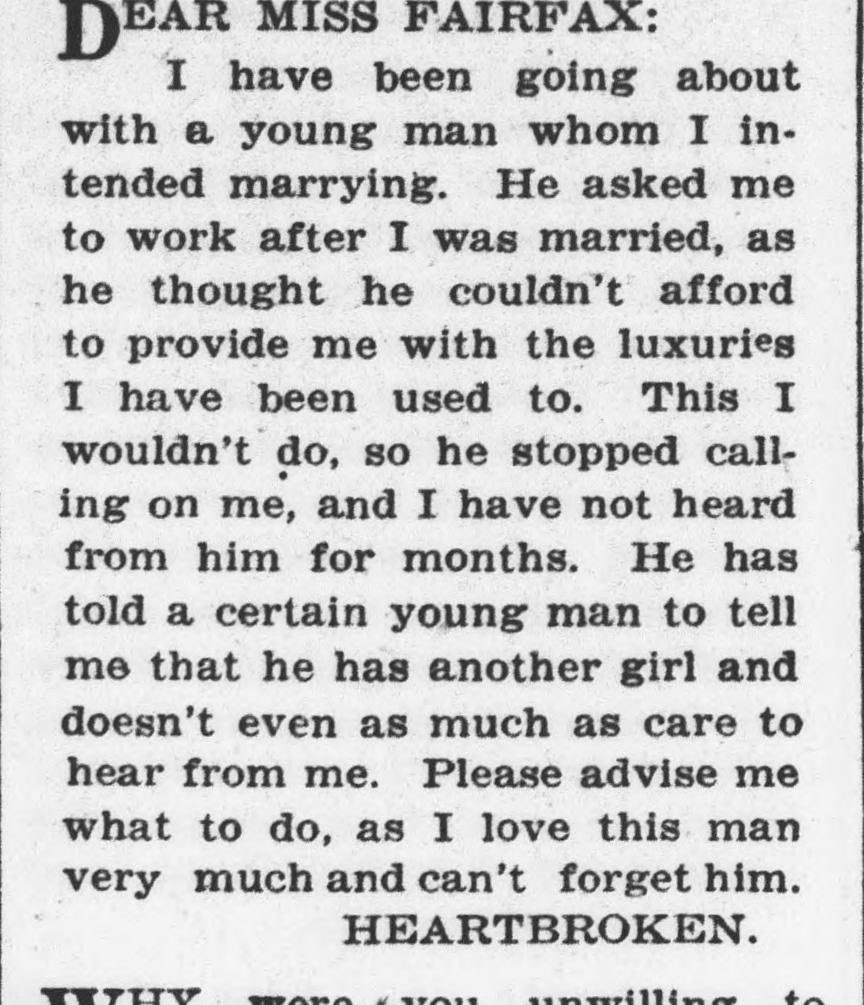
I have been going about with a young man whom I intended marrying. He asked me to work after I was married, as he thought he couldn’t afford to provide me with the luxuries I have been used to. This I wouldn’t do, so he stopped calling on me, and I have not heard from him for months.
He has told a certain young man to tell me that he has another girl and doesn’t even as much as care to hear from me. Please advise me what to do, as I love this man very much and can’t forget him.
Heartbroken
Beatrice Fairfax’s column, Washington Times, June 13, 1923, page 16
See the original letter
1What would you tell her?
Let him go. He didn’t ask kindly.You
Admit you were wrong, and win him back.Miss Fairfax’s answerYou
Ask to talk it over: work, money, and what you each want.Porcupine’s pickYou
Every reader’s pick since the page opened, counted by choice only, never who picked what.
2What Miss Fairfax wrote back
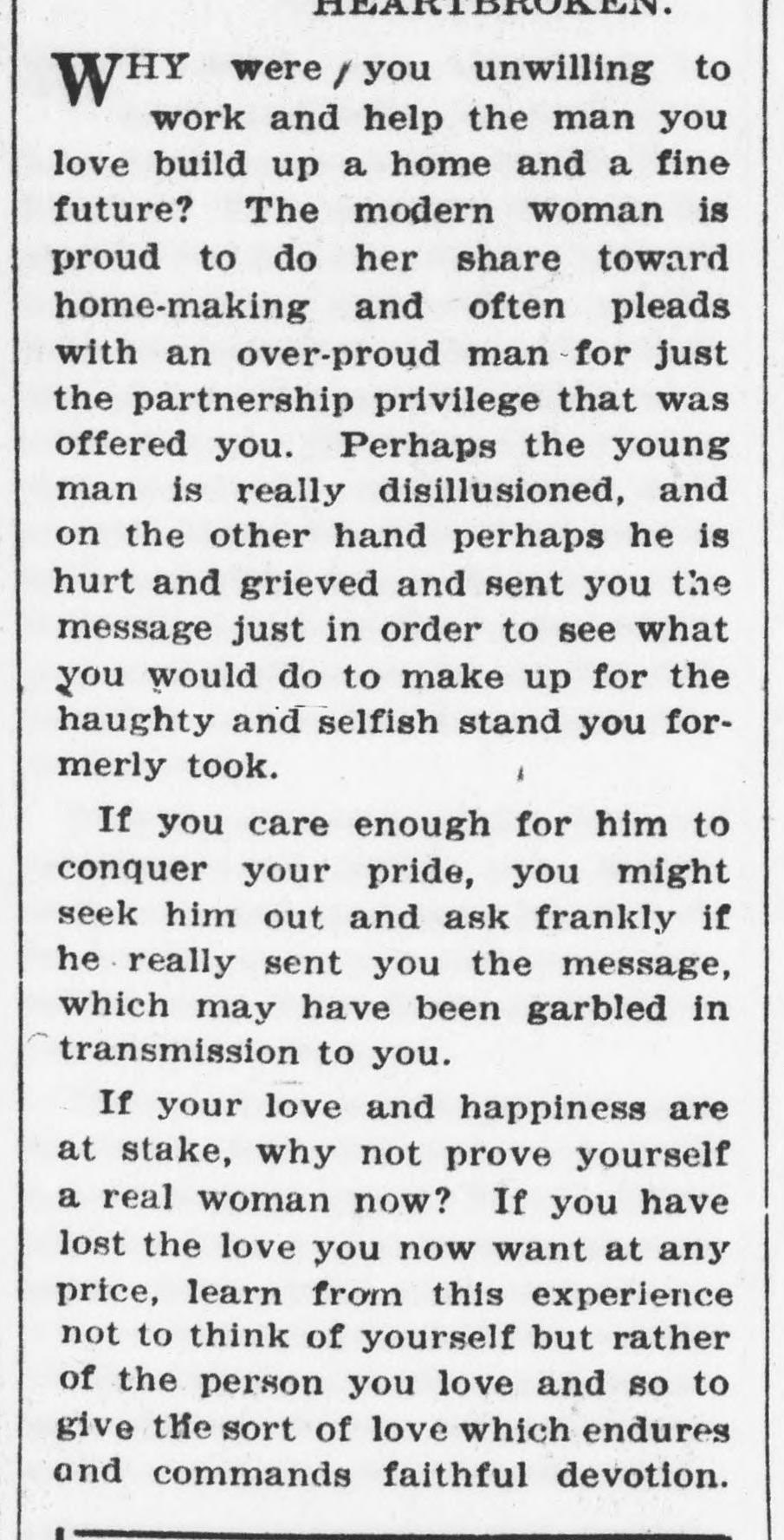
Why were you unwilling to work and help the man you love build up a home and a fine future? The modern woman is proud to do her share toward home-making and often pleads with an over-proud man for just the partnership privilege that was offered you. Perhaps the young man is really disillusioned, and on the other hand perhaps he is hurt and grieved and sent you the message just in order to see what you would do to make up for the haughty and selfish stand you formerly took.
If you care enough for him to conquer your pride, you might seek him out and ask frankly if he really sent you the message, which may have been garbled in transmission to you.
If your love and happiness are at stake, why not prove yourself a real woman now? If you have lost the love you now want at any price, learn from this experience not to think of yourself but rather of the person you love and so to give the sort of love which endures and commands faithful devotion.
See the original reply
PorcupineMiss Fairfax’s best line is “ask frankly.” We’d skip deciding who was “haughty and selfish.” They saw work and money differently, and that’s a talk two people have together, on the same side.
3The same worry, today
If she asked him today to talk it over, still stung, it might come out like this:
Quills up
We need to talk about money. Now.
Quills down Porcupine’s version
Could we sit down Sunday morning and go over our money together?
What changed: “Now” turns it into an emergency. Suggesting Sunday morning gives you both time to come ready, and “together” says you’re on the same side.
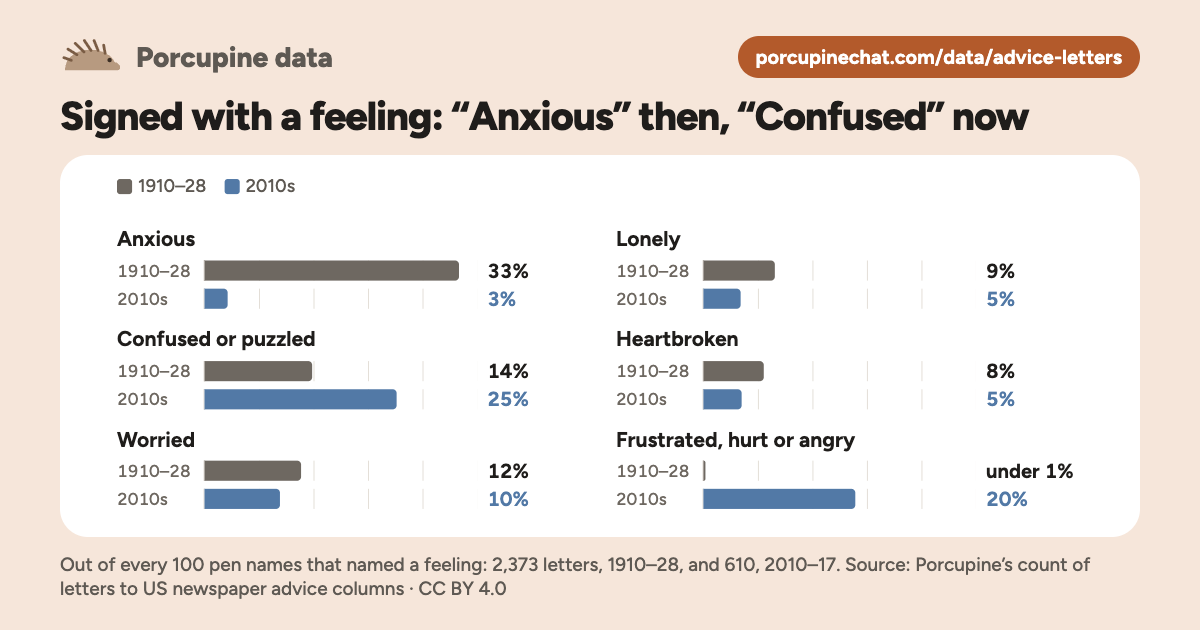
Readers signed with a made-up name, and about 1 in 7 was a feeling. These are the most used from 1910 to 1928, sized by how many letters used each.
Anxious.560
Constant Reader.218
Worried.200
Blue Eyes.156
Perplexed.150
Brown Eyes.138
Puzzled.114
Troubled.88
Heartbroken.79
Undecided.75
Doubtful.64
Broken Hearted.61
Lonesome.59
Waiting.51
A century later, “Anxious” went from 1 in 3 feeling pen names to 3 in 100, and “Frustrated,” “Hurt” or “Angry” went from almost none to 1 in 5.
1910–282010s
Anxious
1910–2833%
2010s3%
Confused or puzzled
1910–2814%
2010s25%
Worried
1910–2812%
2010s10%
Lonely
1910–289%
2010s5%
Heartbroken
1910–288%
2010s5%
Frustrated, hurt or angry
1910–28under 1%
2010s20%
Out of every 100 pen names that named a feeling (“Anxious,” “Anxious Mother,” “Confused in Ohio”). That was 2,373 letters in 1910–28 and 610 in the 2010s. Bars share one scale, from 0 to 35%.
Free to use, even commercially, under CC BY 4.0: credit Porcupine and link to this page.
Chart: Porcupine’s count of letters to newspaper advice columns, 1910–28 (CC BY 4.0). porcupinechat.com/data/advice-letters
Know someone who needs this?
Common questions
What did people ask advice columns 100 years ago?
In the letters about people from 1910 to 1928, the most common questions were about courting: what’s proper (23%), whether he or she really cared (17%) and whether to marry (17%).
How have letters to advice columns changed?
Courting faded and family took its place. Letters about kids went from 5% to 17%, other family from 2% to 15%, and in-laws from 2% to 8%, comparing 1910–28 with Dear Abby’s letters from the 2010s.
How did people sign letters to advice columns?
With a made-up name, and about 1 in 7 was a feeling. From 1910 to 1928, the most-signed pen name was “Anxious.” In the 2010s, “Confused” led, and 1 in 5 feeling pen names was “Frustrated,” “Hurt” or “Angry.”
Find the words with Porcupine
PorcupineThe questions haven’t changed much. I can help you say yours, so the other person can hear it.
Porcupine is coming soon. Sign up to be one of the first to try it.
We’ll email you when Porcupine opens and when we add new tools. Unsubscribe anytime. Privacy
The letters: 16,848 letters about people from 1910–28 newspapers, and 5,483 to Dear Abby in 2010–17. The shares count only letters about people, since one column also answered questions about recipes and ink stains. The Dear Abby letters are counted, never quoted.
Sorting: an AI sorted every letter by topic, the same way for both eras.
For fun and discussion: Porcupine’s count of the letters the columns chose to print. It’s a look at real letters, not a scientific study.
Old newspaper scans: Library of Congress, Chronicling America. Letter text: American Stories (Dell and others, 2023), CC BY 4.0; the letters quoted here were corrected against the scans. Dear Abby letters, 2010–17: The Pudding (MIT License), counted only.