Data › Apologies
How has the way we say sorry changed?
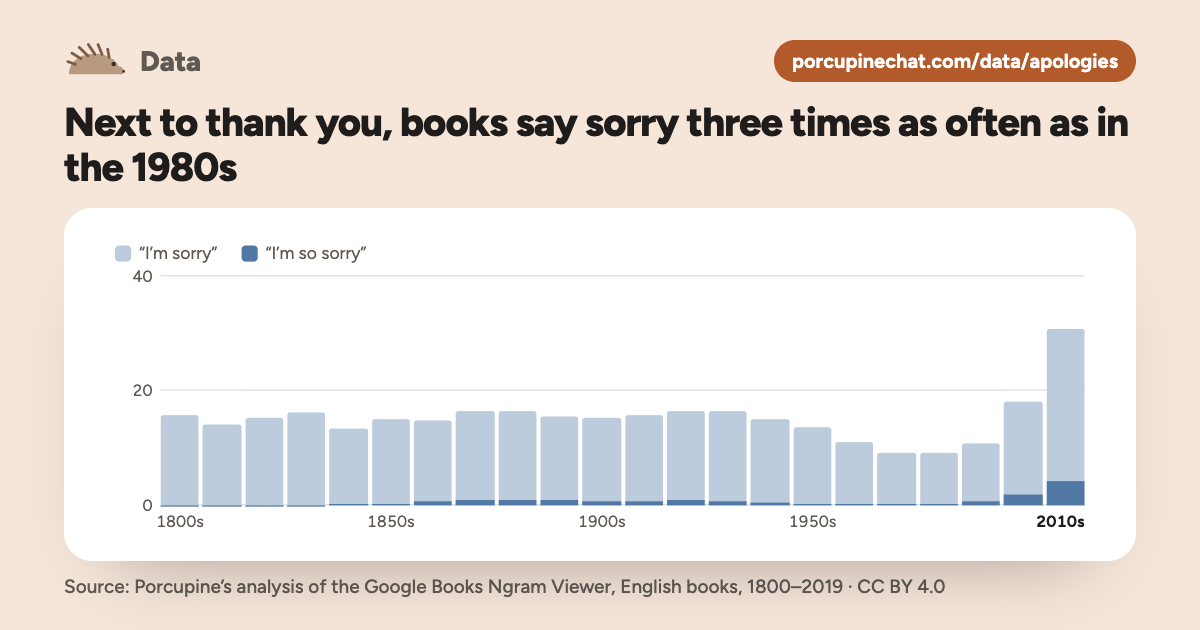
Next to thank you, books say sorry three times as often as in the 1980s, the most since 1800. “Pardon me” nearly vanished, and “sorry if I…” overtook “sorry that I…” in 2009.
Porcupine’s count of English-language books, 1800 to 2019, in the Google Books Ngram Viewer.
Next to thank you, sorry has tripled since the 1980s
Books have more people talking in them than they used to, so every polite phrase shows up more. Counting sorry against thank you, the other thing people say all day, shows whether apologizing grew on its own. It did: for every 100 thank yous, “I’m sorry” went from about 9 in the 1980s to 27 in the 2010s, the most since 1800.
“I’m so sorry” grew fastest: from under 1 for every 100 thank yous to about 4.
Each column is “I’m sorry” and “I am sorry” (light) and “I’m so sorry” (dark) for every 100 times books said “thank you” or “thanks.” Counted against “said” instead, sorry more than doubled since the 1980s, and the 2010s are still the highest.
Free to use, even commercially, under CC BY 4.0: credit Porcupine and link to this page.
Download the pictureChart: Porcupine, from the Google Books Ngram Viewer (CC BY 4.0). porcupinechat.com/data/apologies
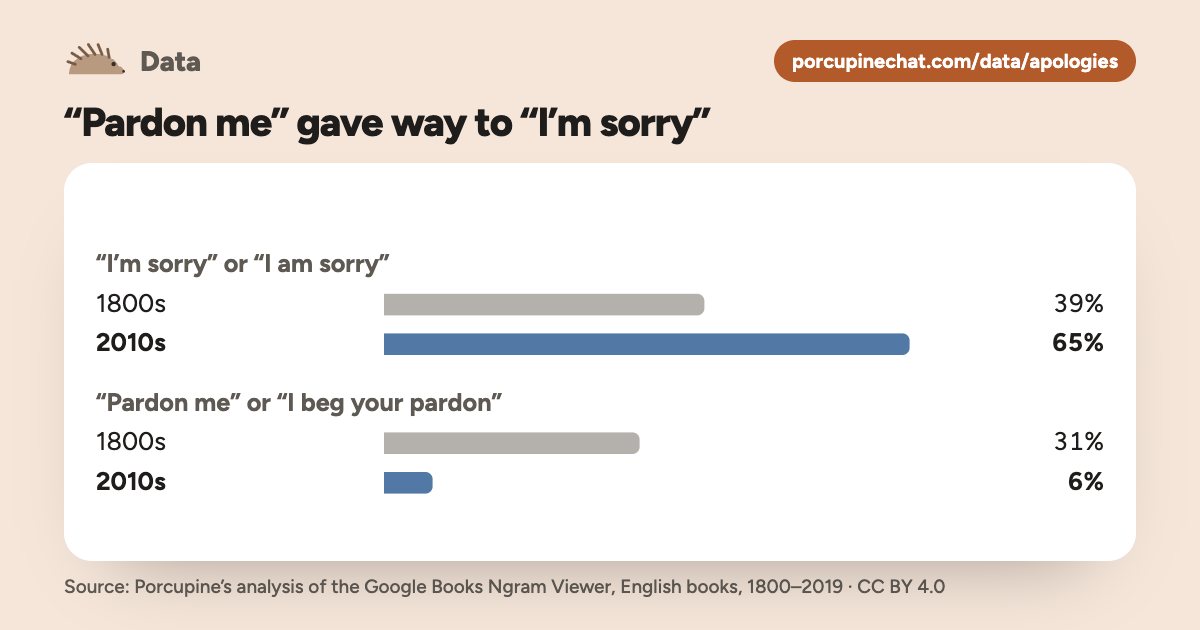
“Pardon me” gave way to “I’m sorry”
In the 1800s, about 1 in 3 apologies in books asked pardon. In the 2010s, 1 in 17.
“I’m sorry” or “I am sorry”
“Pardon me” or “I beg your pardon”
“Forgive me”
“Excuse me”
“I apologize” or “My apologies”
Each way’s share of all five, by decade.
Free to use, even commercially, under CC BY 4.0: credit Porcupine and link to this page.
Download the pictureChart: Porcupine, from the Google Books Ngram Viewer (CC BY 4.0). porcupinechat.com/data/apologies
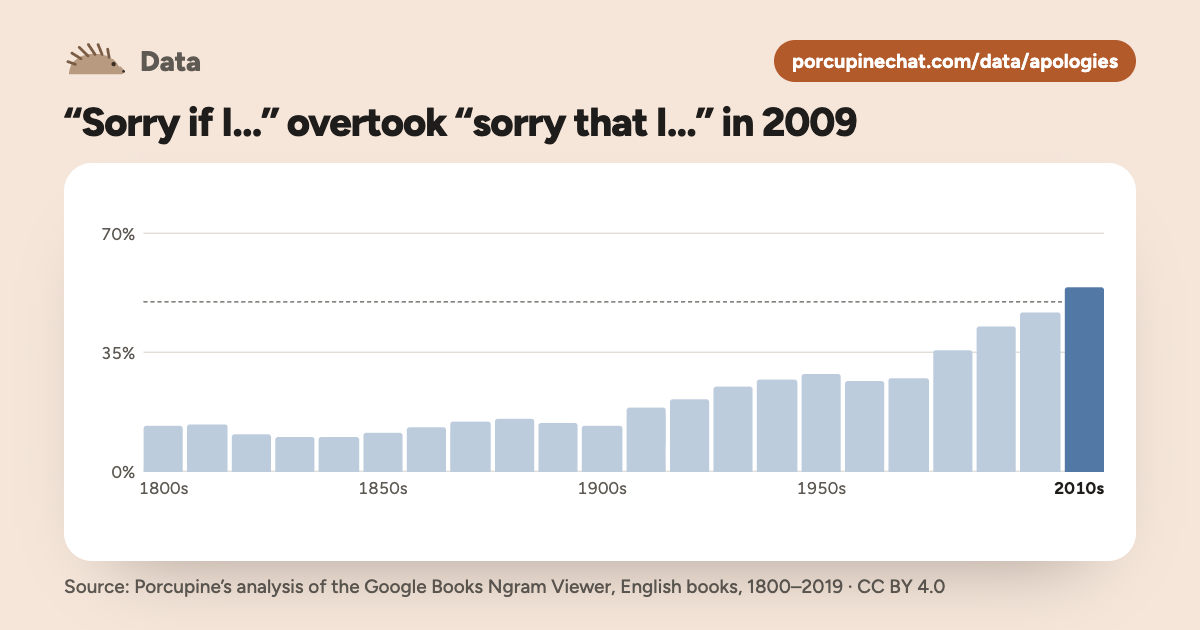
“Sorry if I…” overtook “sorry that I…” in 2009
“Sorry that I hurt you” says it happened. “Sorry if I hurt you” isn’t sure. The “if” went from about 1 in 7 in the 1800s to more than half.
The share that were “sorry if I.” The dashed line is half.
Free to use, even commercially, under CC BY 4.0: credit Porcupine and link to this page.
Download the pictureChart: Porcupine, from the Google Books Ngram Viewer (CC BY 4.0). porcupinechat.com/data/apologies
See the numbers
| Decade | “I’m sorry” per 100 thank yous | “I’m so sorry” per 100 thank yous | “Sorry if I” share |
|---|---|---|---|
| 1800s | 16 | under 1 | 14% |
| 1810s | 14 | under 1 | 14% |
| 1820s | 15 | under 1 | 11% |
| 1830s | 16 | under 1 | 10% |
| 1840s | 13 | under 1 | 10% |
| 1850s | 15 | under 1 | 12% |
| 1860s | 14 | under 1 | 13% |
| 1870s | 15 | under 1 | 15% |
| 1880s | 16 | under 1 | 16% |
| 1890s | 15 | under 1 | 14% |
| 1900s | 15 | under 1 | 14% |
| 1910s | 15 | under 1 | 19% |
| 1920s | 16 | under 1 | 21% |
| 1930s | 16 | under 1 | 25% |
| 1940s | 15 | under 1 | 27% |
| 1950s | 13 | under 1 | 29% |
| 1960s | 11 | under 1 | 27% |
| 1970s | 9 | under 1 | 28% |
| 1980s | 9 | under 1 | 36% |
| 1990s | 10 | under 1 | 43% |
| 2000s | 16 | 2 | 47% |
| 2010s | 27 | 4 | 55% |
Each decade’s total in English-language books in the Google Books Ngram Viewer. The last column is “sorry if I” as a share of “sorry if I” and “sorry that I.”
Saying sorry so it lands
- Drop the “if.” Say what you did: “I’m sorry I snapped at you,” not “sorry if I upset you.” Own your part
- Say it once. One plain “I’m sorry” lands better than three “so sorry”s, which can leave them comforting you. Own your part
- Thank them instead, sometimes. “Thanks for waiting” says the same thing as “sorry I’m late,” without the guilt. Honest and hearable
General ideas from the principles Porcupine is built on, not advice for your situation.
Working on an apology?
Write it the way it comes out. I’ll show you if the quills are up, and a version with them down.
The Quills Check needs JavaScript. Please turn it on and reload the page.
Common questions
Do people apologize more than they used to?
In books, yes. English-language books said “I’m sorry” about 27 times for every 100 thank yous in the 2010s, three times as often as in the 1980s and more than in any decade since 1800, by Porcupine’s count of the Google Books Ngram Viewer.
Do people still say “pardon me”?
Rarely, in books. In the 1800s, about 1 in 3 apologies in books asked pardon (“pardon me,” “I beg your pardon”). In the 2010s, about 1 in 17.
Is “sorry if I…” a real apology?
It can be, but “if” leaves room to doubt that anything happened. Since 2009, books have said “sorry if I” more often than “sorry that I.” Naming what you did makes it clear you know.
Has “I’m so sorry” become more common?
Yes. In books from the 2010s, about 1 in 7 “I’m sorry”s was “I’m so sorry,” up from about 1 in 17 in the 1990s.
Guides and pages about saying sorry
- How to apologize without making excusesAny relationship
- How to tell your manager you made a mistakeManagers and employees
- How to apologizeWith examples for a partner, a friend and work
- Apology CheckerFree tool
- What to say instead of sorrySwaps from the guides
- What to say when someone apologizesWhat to say when…
- The Over-ApologizerTexting style
Find the words with Porcupine
PorcupineAn apology lands when it names what you did and stops there. I can help you find the words, and with what to say when they answer.
Porcupine is coming soon. Sign up to be one of the first to try it.
We’ll email you when Porcupine opens and when we add new tools. Unsubscribe anytime. Privacy
More from the data
- Who Fills Your Day?Partners, kids, friends and family, at every age
- How much time do couples spend together?5 hr 10 min a day, and what they do with it
- How much time do people spend with friends?By age, who sees friends least, and how it feels
- Are we in a friendship recession?Which ages lost the most time with friends since 2003, and where it went
- How much of your time with your parents is behind you?Pick your age to see your share
- How much time do people spend with family on the holidays?Thanksgiving, Christmas and five more holidays, by the clock
- What do neighbors complain about, and when?New York City’s 311 complaints, by hour, week and season
- How often do people ask for a raise, or for help with money?Who asks, who gets a raise, and who gets help paying the bills
- How often do renters need repairs, or fall behind on rent?Repairs, rent and running late, for renters
- Do Americans still know their neighbors?Evenings with neighbors, friends and family since the 1970s
- When are people most alone, and who still calls?The hour the most people are alone, and who still calls
- Do couples agree on who does more at home?Chores, money and marriage, as women and men each tell it
- When did therapy-speak go mainstream?Boundaries, ghosting, gaslighting: in books, on Wikipedia and in searches
- What people asked advice columns, then and nowCourting faded, family took its place: 28,539 letters, a hundred years apart
- Etiquette then and now: which of Emily Post’s rules on what to say still hold?Her 73 rules from 1922: we’d keep 50, and every one we’d change said to keep your feelings, wants or questions to yourself
How we counted
- Google’s 2019 set of English books in the Ngram Viewer, 1800 to 2019, any capitalization. (The newer 2022 set can’t find contractions like “I’m.”)
- Books, not speech: most of these phrases are characters talking in novels. Every number compares one phrase with another, so it holds when the mix of books changes.
More on how we counted
- “I’m sorry” is “I’m sorry” and “I am sorry”; “I’m so sorry” is “I’m so sorry” and “I am so sorry.” Thank you is “thank you” and “thanks.”
- The five ways to say sorry: “I’m sorry” or “I am sorry”; “pardon me,” “beg pardon” or “I beg your pardon”; “forgive me”; “excuse me”; and “I apologize” or “my apologies.”
- “Thanks” includes “thanks to,” and the Viewer drops commas, so “I’m sorry, but” can’t be counted. Newer phrases like “my bad” and “no worries” have too many other uses to count.
- “Sorry if I…” overtook “sorry that I…” in 2009: the first year it stayed ahead, on a five-year average.
- Source: Porcupine’s analysis of the Google Books Ngram Viewer, whose data may be used for any purpose. Our charts and numbers are free to reuse under CC BY 4.0: credit Porcupine and link to this page.
This page is Porcupine’s analysis of how books word apologies. It isn’t a study of how people apologize, and a phrase showing up more in books doesn’t mean people say it more.
Updated