Data › Couples at home
Do couples agree on who does more at home?
Not quite. Women who live with a partner see a bigger gap than men do, most of all in planning and caring. Marriages are about as happy as in the 1990s.
Porcupine’s count of the General Social Survey, 1972 to 2024.
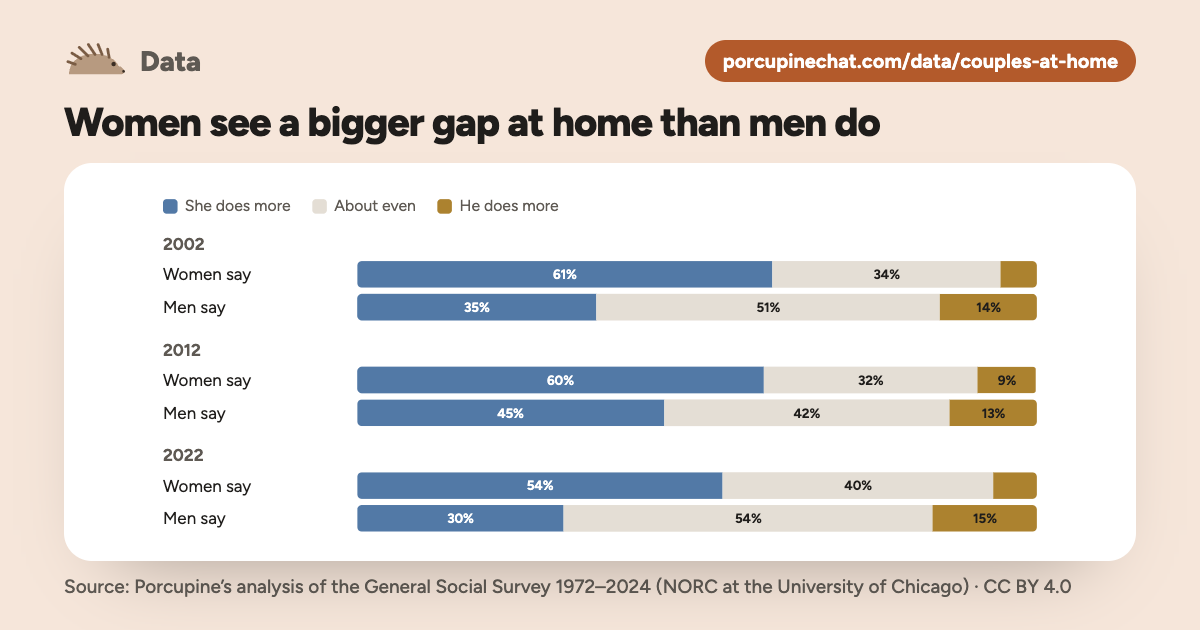
Women see a bigger gap at home than men do
How women and men who live with a partner say the housework is split.
2002
2012
2022
Each person was asked about their own share. A woman who says she does more than her fair share, and a man who says he does less than his, both count as “she does more.”
Free to use, even commercially, under CC BY 4.0: credit Porcupine and link to this page.
Download the pictureChart: Porcupine, from the General Social Survey 1972–2024, NORC at the University of Chicago (CC BY 4.0). porcupinechat.com/data/couples-at-home
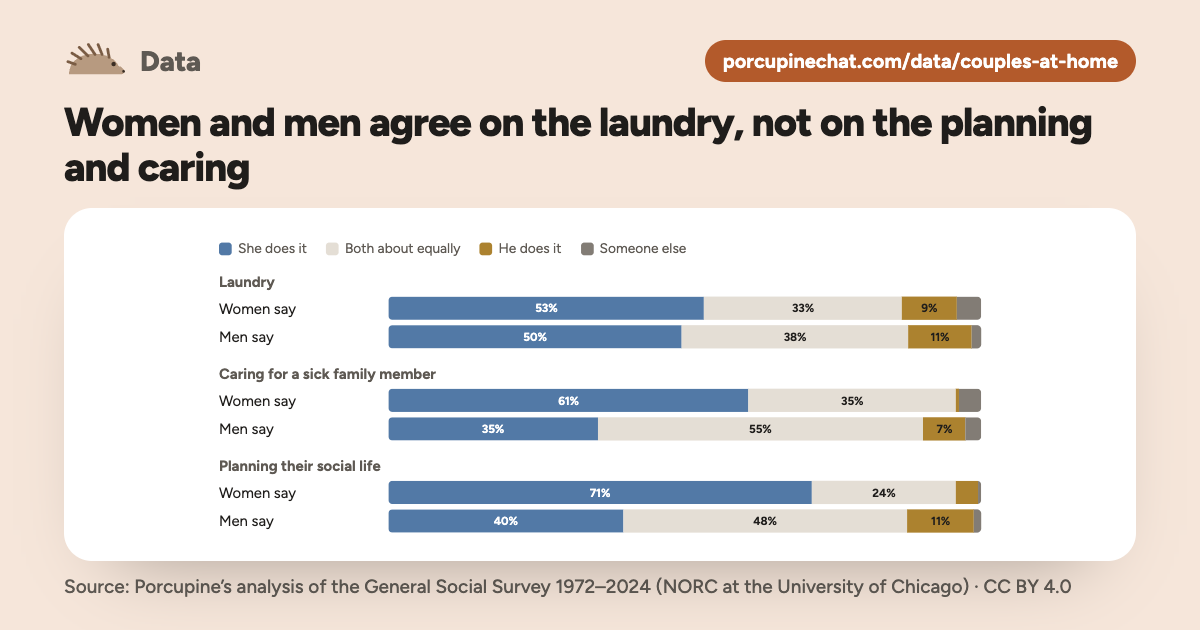
Women and men agree on the laundry, not on the planning and caring
Who does each one, as women and men who live with a partner tell it, in 2022.
Laundry
Cooking
Cleaning
Groceries
Caring for a sick family member
Planning their social life
“She does it” is a woman saying “I do” or a man saying “my partner does.” Planning was first asked in 2022.
Free to use, even commercially, under CC BY 4.0: credit Porcupine and link to this page.
Download the pictureChart: Porcupine, from the General Social Survey 1972–2024, NORC at the University of Chicago (CC BY 4.0). porcupinechat.com/data/couples-at-home
Angry at a spouse, most people talked to them; angry at a boss, most didn’t
The last time people were really angry, in 1996, the only year the survey asked.
Angry at a spouse or partner
Angry at a friend
Angry at a coworker
Angry at a boss
“Someone else” is anyone but the person they were angry at, like telling a friend about the boss. People could do both, so the two bars can add up to more than 100%.
Fewer couples put all their money in one pot
How couples who live together handle their money.
“One manages it” means one partner handles it all and gives the other a share.
More people say their job gets in the way of family than in 2002
People who work, saying it happens often or sometimes.
Fewer people are married, but marriages are as happy as in the 1990s
Married people who call their marriage “very happy”
Adults who are married
The other answers: “pretty happy” (about 1 in 3) and “not too happy” (about 3 in 100). The survey asks one person, not couples.
Couples who live together without marrying are just as happy
People who call their relationship “very happy.”
2012–18
2022–24
Each bar is its own group: 61% of married people, and 62% of people living with a partner they aren’t married to. The survey first asked people living together in 2012.
Before you bring up the housework
- Name the task, not the tally. Your partner may not see the gap you see. “Can you take over the dentist appointments?” gets further than “I do everything.” Describe, don’t diagnose
- Say the invisible work out loud. Planning and caring are where couples see it most differently, so list them when you talk about who does what. Us against the problem
- Agree on money, don’t assume. More couples keep some money apart now; how you split it is worth saying plainly. Fair to both
General ideas from the principles Porcupine is built on, not advice for your situation.
Ask for help at home, in your words first
Write it the way it comes out. I’ll show you if the quills are up, and a version with them down.
The Quills Check needs JavaScript. Please turn it on and reload the page.
Common questions
Do husbands and wives agree on who does the housework?
Not quite. In 2022, 54% of men who live with a spouse or partner said the housework is split about fairly, but only 40% of women said so, by Porcupine’s count of the General Social Survey; 54% of women said they do more than their fair share. It was the same in 2002 and 2012. They agree most on the laundry, and least on planning the couple’s social life: 48% of men say they share it about equally, and 24% of women say so.
Are marriages less happy than they used to be?
A little less than in the 1970s, and about the same since the 1990s: 62% of married Americans called their marriage very happy in the 1990s, 62% in the 2010s and 61% in 2022–24, while the share of adults who are married fell from 67% in the 1970s to 51%.
Are husbands happier in their marriages than wives?
Not clearly, these days. In the 2010s, 63% of husbands and 61% of wives called their marriage very happy, and in 2022–24, 63% and 58%; both gaps are within the survey’s margins.
Are couples who live together as happy as married couples?
Yes: in 2022–24, 62% of people living with a partner they aren’t married to called their relationship very happy, and 61% of married people said so of their marriage.
Are fewer young adults married?
Yes. In 2022–24, 27% of Americans under 35 were married, down from 53% in the 1970s, and another 17% lived with a partner they weren’t married to.
Do couples still share their money?
Most share at least some of it, but fewer pool all of it: 61% in 1994 and 52% in 2022. Couples who keep all their money separate went from 9% to 17%.
Guides for partners
- How to ask your partner for more help at homePartners
- How to plan a vacation with your partner when you want different thingsPartners
- How to tell your partner what you needPartners
- How to talk about money with your partner without fightingPartners
- How to tell your partner something’s bothering youPartners
- How to stop having the same argument over and overPartners
Find the words with Porcupine
PorcupineWho does what, how you split the money, what’s been bothering you: the talk goes better when you both feel heard. I can help you find the words.
Porcupine is coming soon. Sign up to be one of the first to try it.
We’ll email you when Porcupine opens and when we add new tools. Unsubscribe anytime. Privacy
More from the data
- Who Fills Your Day?Partners, kids, friends and family, at every age
- How much time do couples spend together?5 hr 10 min a day, and what they do with it
- How much time do people spend with friends?By age, who sees friends least, and how it feels
- Are we in a friendship recession?Which ages lost the most time with friends since 2003, and where it went
- How much of your time with your parents is behind you?Pick your age to see your share
- How much time do people spend with family on the holidays?Thanksgiving, Christmas and five more holidays, by the clock
- What do neighbors complain about, and when?New York City’s 311 complaints, by hour, week and season
- How often do people ask for a raise, or for help with money?Who asks, who gets a raise, and who gets help paying the bills
- How often do renters need repairs, or fall behind on rent?Repairs, rent and running late, for renters
- Do Americans still know their neighbors?Evenings with neighbors, friends and family since the 1970s
- When are people most alone, and who still calls?The hour the most people are alone, and who still calls
- How has the way we say sorry changed?Sorry, pardon and “sorry if,” in books since 1800
- When did therapy-speak go mainstream?Boundaries, ghosting, gaslighting: in books, on Wikipedia and in searches
- What people asked advice columns, then and nowCourting faded, family took its place: 28,539 letters, a hundred years apart
- Etiquette then and now: which of Emily Post’s rules on what to say still hold?Her 73 rules from 1922: we’d keep 50, and every one we’d change said to keep your feelings, wants or questions to yourself
How we counted
- The General Social Survey, run by NORC at the University of Chicago since 1972: about 1,500 to 4,500 adults each survey year. The housework and money questions were asked of about 500 to 1,400 people who live with a spouse or partner, in 1994, 2002, 2012 and 2022.
- Women and men here are different people, not the two halves of a couple: if both saw things the same way, their bars would match.
More on how we counted
- Shares are weighted to match the country, with 95% margins from the survey’s design. A difference is shown as a finding only when it’s bigger than its margins. Hover or tap a bar for its margin.
- The survey doesn’t ask a partner’s gender, so a few same-sex couples are in the housework counts.
- 2021 is left out: the survey was online only, mid-pandemic. Since 2022 it’s online and in person; people offered the web first and people offered an interview first gave the same answers (job and family: 45% and 43%), so 2022–24 sits beside the earlier years.
- Source: Porcupine’s analysis of the General Social Survey 1972–2024 (Davern, Bautista, Freese, Herd and Morgan; NORC at the University of Chicago, Release 3a), public. Our charts and numbers are free to reuse under CC BY 4.0.
Updated