Data › Therapy-speak
When did therapy-speak go mainstream?
Some of these words sat in therapy and self-help books for decades before everyone said them. Others, like situationship and weaponized incompetence, were born online. And since 2021, searches for many of them have grown while Wikipedia gets less of that interest.
- Since 2021Searches for attachment style, emotional labor and setting boundaries about doubled, while Wikipedia’s share fell.
- 2022Searches for gaslighting were highest, the year it was Merriam-Webster’s word of the year.
- Oct 2023“Therapy speak” got its own Wikipedia article, read more every year since.
Numbers last updated November 2026. We refresh them twice a year.
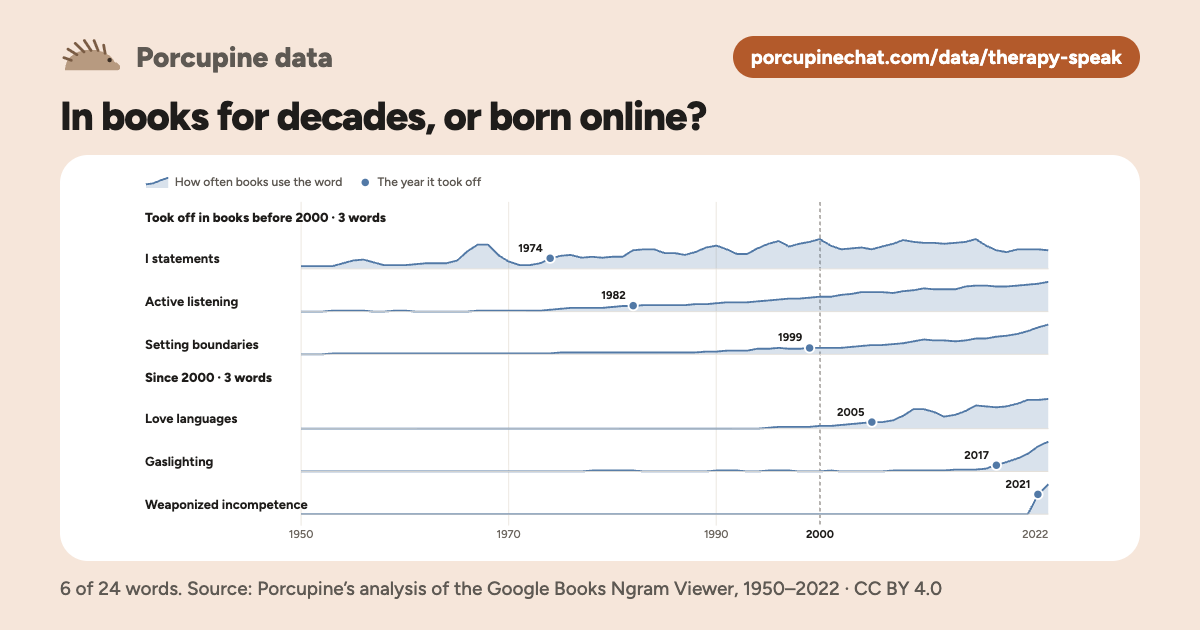
Some came from books, some were born online
- Before 2000: nine words, starting with I statements (1974).
- Since 2000: 15, the newest trauma dumping and weaponized incompetence (2021).
Source: Porcupine’s analysis of the Google Books Ngram Viewer, English books, 1950–2022.
How it’s counted
Each line is on its own scale, so it shows when a word grew, not how common it is, and each year is a three-year average. A word took off in the first year after which it never falls under a fifth of its highest level. Stonewalling, breadcrumbing and ghosting have other meanings in books (politics and the law, cooking, a double image on a screen), so their lines count those too, and ghosting has no took-off year. Books are printed a year or more after they’re written, so they show where a word came from more than when people started saying it.
Free to use, even commercially, under CC BY 4.0: credit Porcupine and link to this page.
Download the pictureChart: Porcupine, from the Google Books Ngram Viewer (CC BY 4.0). porcupinechat.com/data/therapy-speak
See the numbers
| Word | Counted in books as | 1960 | 1970 | 1980 | 1990 | 2000 | 2005 | 2010 | 2015 | 2019 | 2022 |
|---|---|---|---|---|---|---|---|---|---|---|---|
| Setting boundaries | “set boundaries”, “setting boundaries” | 0.0088 | 0.016 | 0.022 | 0.037 | 0.089 | 0.117 | 0.190 | 0.209 | 0.273 | 0.397 |
| Active listening | “active listening” | 0.012 | 0.010 | 0.087 | 0.151 | 0.265 | 0.346 | 0.418 | 0.504 | 0.489 | 0.530 |
| I statements | “I-statements”, “I-statement”, “I-message”, “I-messages” | 0.0061 | 0.0048 | 0.012 | 0.043 | 0.048 | 0.028 | 0.035 | 0.049 | 0.028 | 0.024 |
| Emotional labor | “emotional labor”, “emotional labour” | 0.0004 | 0.0006 | 0.0010 | 0.011 | 0.074 | 0.130 | 0.153 | 0.231 | 0.419 | 0.427 |
| Love languages | “love languages” | 0.0001 | 0.0001 | 0.0005 | 0.0004 | 0.0062 | 0.018 | 0.066 | 0.052 | 0.071 | 0.071 |
| Attachment style | “attachment style”, “attachment styles” | 0.0001 | 0.0006 | 0.0008 | 0.014 | 0.150 | 0.159 | 0.235 | 0.283 | 0.339 | 0.326 |
| People pleaser | “people pleaser”, “people-pleaser” | 0.0001 | 0.0017 | 0.0021 | 0.0055 | 0.0097 | 0.017 | 0.036 | 0.046 | 0.074 | 0.090 |
| Ghosting | “ghosting” | 0.044 | 0.029 | 0.041 | 0.043 | 0.073 | 0.096 | 0.105 | 0.130 | 0.169 | 0.220 |
| Situationship | “situationship” | – | – | – | – | – | – | 0.0003 | 0.0005 | 0.0070 | 0.0092 |
| Trauma dumping | “trauma dumping” | – | – | – | – | – | – | – | 0.0001 | – | 0.0005 |
| Gaslighting | “gaslighting” | 0.0017 | 0.0011 | 0.0047 | 0.0038 | 0.0042 | 0.0023 | 0.0061 | 0.013 | 0.094 | 0.271 |
| Narcissist | “narcissist” | 0.0061 | 0.011 | 0.031 | 0.036 | 0.067 | 0.120 | 0.225 | 0.227 | 0.436 | 0.577 |
| Love bombing | “love bombing”, “love-bombing” | – | – | 0.0013 | 0.0022 | 0.0023 | 0.0019 | 0.0028 | 0.0067 | 0.011 | 0.028 |
| Red flag | “red flags” | 0.142 | 0.133 | 0.090 | 0.128 | 0.264 | 0.377 | 0.600 | 0.563 | 0.678 | 0.765 |
| Toxic relationship | “toxic relationship” | 0.0002 | – | 0.0003 | 0.0005 | 0.0017 | 0.0025 | 0.012 | 0.020 | 0.050 | 0.086 |
| Emotional intelligence | “emotional intelligence” | 0.0006 | 0.0014 | 0.0012 | 0.0029 | 0.444 | 0.725 | 0.948 | 1.300 | 1.660 | 1.800 |
| Inner child | “inner child” | 0.0012 | 0.0097 | 0.0056 | 0.139 | 0.109 | 0.123 | 0.219 | 0.210 | 0.235 | 0.349 |
| Enmeshment | “enmeshment” | 0.0049 | 0.0077 | 0.023 | 0.043 | 0.048 | 0.052 | 0.065 | 0.076 | 0.074 | 0.082 |
| Stonewalling | “stonewalling” | 0.0041 | 0.0046 | 0.035 | 0.050 | 0.077 | 0.077 | 0.082 | 0.082 | 0.068 | 0.069 |
| Weaponized incompetence | “weaponized incompetence”, “weaponised incompetence” | – | – | – | – | – | – | – | – | – | 0.0005 |
| Breadcrumbing | “breadcrumbing” | 0.0005 | 0.0001 | – | 0.0001 | 0.0007 | 0.0003 | 0.0008 | 0.0004 | 0.0027 | 0.0032 |
| Emotionally unavailable | “emotionally unavailable” | – | 0.0006 | 0.0018 | 0.0061 | 0.011 | 0.014 | 0.029 | 0.033 | 0.041 | 0.045 |
| Toxic positivity | “toxic positivity” | – | – | – | – | – | 0.0001 | – | 0.0001 | 0.0014 | 0.033 |
| Conscious uncoupling | “conscious uncoupling” | – | – | – | – | – | 0.0001 | – | 0.0039 | 0.0041 | 0.0038 |
Uses per million words (one-word terms) or per million phrases of the same length, each year as counted, not averaged, with the spellings in each row added together. Case doesn’t matter.
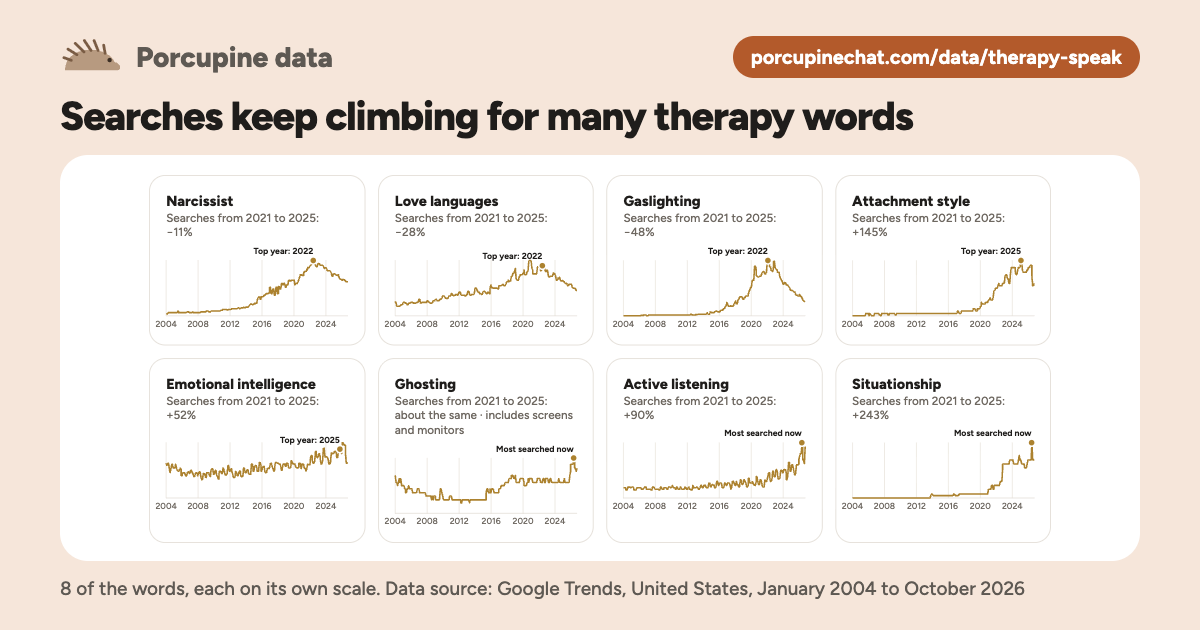
Searches keep climbing for many
- Up by half or more since 2021: ten words, most of all situationship (+243%).
- Past their peak (2019–2023): love languages, gaslighting, narcissist and three more.
Narcissist
Searches from 2021 to 2025: −11%
Love languages
Searches from 2021 to 2025: −28%
Gaslighting
Searches from 2021 to 2025: −48%
Attachment style
Searches from 2021 to 2025: +145%
Emotional intelligence
Searches from 2021 to 2025: +52%
Ghosting
Searches from 2021 to 2025: about the same · includes screens and monitors
Active listening
Searches from 2021 to 2025: +90%
Situationship
Searches from 2021 to 2025: +243%
Data source: Google Trends, United States, January 2004 to October 2026.
Free to use with the credit below. The search numbers are Google’s, so the credit names Google Trends, and they’re used under Google’s terms.
Download the pictureChart: Porcupine, from Google Trends data. porcupinechat.com/data/therapy-speak
How it’s counted
Each word’s share of all Google searches in the United States, month by month, the middle of each three months, on its own scale. Left out: red flag, since its searches catch other things (“red flag” is also a fire-weather warning). Trauma dumping and therapy speak are too rare in searches to draw. The newer words were searched in quotes, so the words have to come together. Rarer words move in steps, since Trends rounds to whole numbers. Several words jumped in February, April and June 2026 in every download, which these numbers can’t explain. Google Trends’ numbers are Google’s, used under its terms.
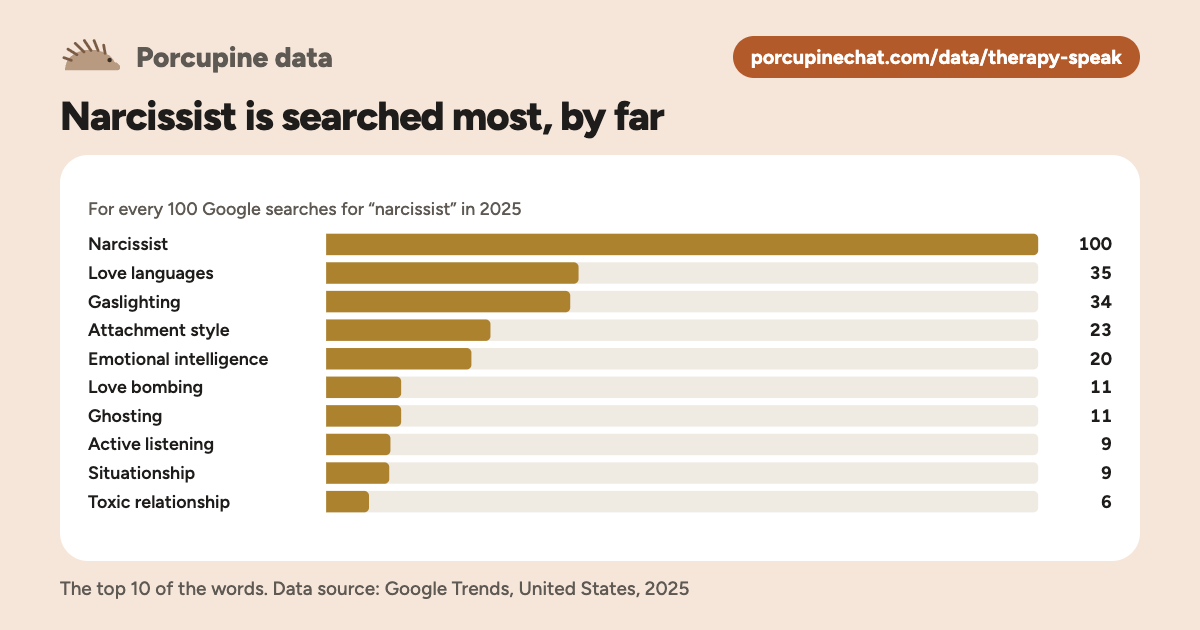
Narcissist is searched most, by far
- Next: love languages (35) and gaslighting (34), about a third as many.
- Most-searched everyday words: love languages (35), attachment style (23) and emotional intelligence (20).
For every 100 Google searches for “narcissist” in 2025, how many there were for each of the other words.
Data source: Google Trends, United States.
Free to use with the credit below. The search numbers are Google’s, so the credit names Google Trends, and they’re used under Google’s terms.
Download the pictureChart: Porcupine, from Google Trends data. porcupinechat.com/data/therapy-speak
How it’s counted
Google Trends gives each month’s share of all searches in the United States, on one scale for every word here, so the numbers compare how often each was searched. These are the averages for 2025, scaled so narcissist is 100.
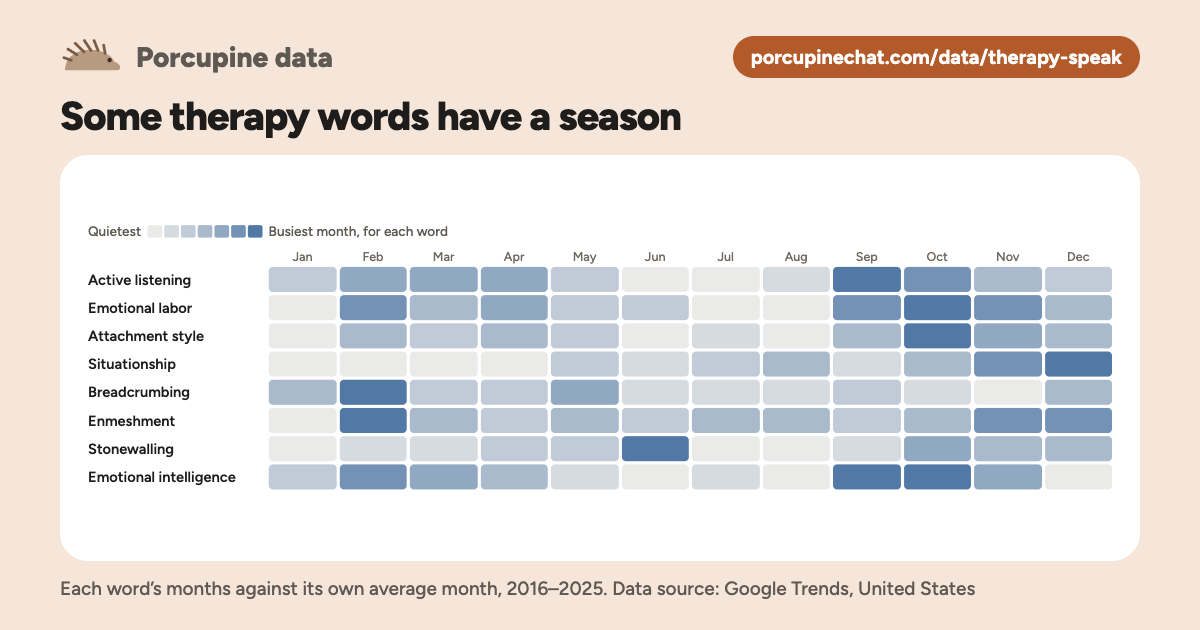
Some words have a season
- The school year: active listening, busiest in September and quietest in summer.
- December: situationship.
- February: breadcrumbing and love languages.
Data source: Google Trends, United States, 2016–2025.
Free to use with the credit below. The search numbers are Google’s, so the credit names Google Trends, and they’re used under Google’s terms.
Download the pictureChart: Porcupine, from Google Trends data. porcupinechat.com/data/therapy-speak
How it’s counted
Each word’s months from 2016 to 2025, compared with its own average month each year, then averaged over the years. Each word is shaded from its own quietest month (lightest) to its busiest (darkest), so the rows show when, not how much; the rows are in order of how much a word’s months differ, most first. Shown: words with at least 7 years of searches whose busiest and quietest months are at least 20 points apart. A word is named above only when its busiest month is at least 8 points above every month that isn’t next to it (a peak can spread over two neighboring months); a busiest month that only just leads, like setting boundaries’ December, isn’t named. Hover or tap a month for its number.
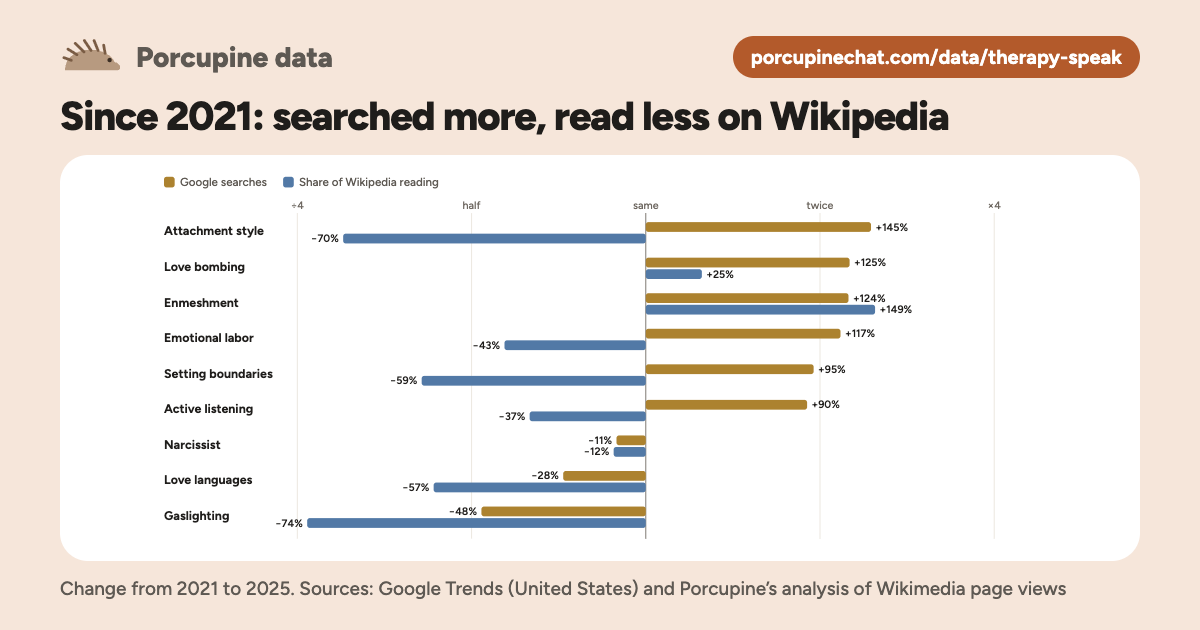
Since 2021: searched more, read less on Wikipedia
- Interest grew; Wikipedia got less of it. Searches up by half or more, Wikipedia down: attachment style, emotional labor, setting boundaries and two more.
- Down on both: narcissist, love languages and gaslighting.
- Up on both: love bombing and enmeshment.
How much each word’s Google searches, and its share of Wikipedia reading, changed from 2021 to 2025.
Sources: Google Trends (United States) and Porcupine’s analysis of Wikimedia page views.
Free to use with the credit below. The search numbers are Google’s, so the credit names Google Trends, and they’re used under Google’s terms.
Download the pictureChart: Porcupine, from Google Trends data and Wikimedia page views. porcupinechat.com/data/therapy-speak
How it’s counted
2025 against 2021, both after Wikipedia began labeling bots (before May 2020, some bots counted as readers). Wikipedia reading is each word’s share of all English Wikipedia reading (its article and every title that leads to it), so Wikipedia’s own ups and downs don’t count; a view is someone reading the page. Each step on the scale is twice or half. Only words with enough searches and a Wikipedia article in 2021: people pleaser, weaponized incompetence, emotionally unavailable and toxic relationship have no article of their own. The numbers can’t say where the interest went instead; search pages and AI tools now answer many questions without a click.
What each source can and can’t show
Books lag
A book is printed a year or more after it’s written, so books show where a word came from more than when people started saying it.
Page views aren’t searches
A view is someone reading the article. Search pages and AI tools now answer many questions without a click.
Searches are relative
Google Trends gives each month’s share of searches, scaled to 100 for the busiest, not a count of searches.
A word like “ghosting” is a guess about why someone went quiet. Saying what happened, and how it left you, gives them something to answer.
Use the words without starting a fight
- Say what happened, not what it’s called. “You haven’t answered since Friday” leaves room for an answer; “you’re ghosting me” is a verdict. Describe, don’t diagnose
- A boundary is what you’ll do, not a rule for them. Say what you need, and what you’ll do if it keeps happening. Ask, don’t pressure
- Listen before you name it. Ask what they meant before you decide which word fits. Understand before answering
General ideas from the principles Porcupine is built on, not advice for your situation.
Guides for the everyday words
- Set boundaries kindly and clearlySetting boundaries
- I statements, with examplesI statements
- Active listening, with examplesActive listening
- What to say when someone ghosts youGhosting
- How to ask your partner for more help at homeEmotional labor
- How to ask someone you’re dating where things are goingSituationship
- How to stay friends with your exConscious uncoupling
Common questions
What is therapy-speak?
Words from therapy and psychology used in everyday talk, like setting boundaries, gaslighting, trauma dumping or attachment style. Some came from therapists and self-help books; others, like situationship and weaponized incompetence, were coined online.
When did “setting boundaries” become common?
It took off in books around 1999, and searches for it went up 95% from 2021 to 2025.
When did gaslighting become popular?
Gaslighting took off in books only around 2017. Its Wikipedia page was read most in 2020, and Google searches for it were highest in 2022, the year Merriam-Webster named it the word of the year. Searches have fallen 48% since 2021.
Which therapy word is searched most?
Narcissist, by far: for every 100 Google searches for it in 2025, there were about 35 for love languages and 34 for gaslighting.
Find the words with Porcupine
PorcupineWords like these can say a lot in one go. I can help you say what you mean, plainly, so the other person can hear it.
Porcupine is coming soon. Sign up to be one of the first to try it.
We’ll email you when Porcupine opens and when we add new tools. Unsubscribe anytime. Privacy
Some of these words name real harm. If someone is hurting or frightening you, you don’t have to find the words for it on your own.
More from the data
- Who Fills Your Day?Partners, kids, friends and family, at every age
- How much time do couples spend together?5 hr 10 min a day, and what they do with it
- How much time do people spend with friends?By age, who sees friends least, and how it feels
- Are we in a friendship recession?Which ages lost the most time with friends since 2003, and where it went
- How much of your time with your parents is behind you?Pick your age to see your share
- How much time do people spend with family on the holidays?Thanksgiving, Christmas and five more holidays, by the clock
- What do neighbors complain about, and when?New York City’s 311 complaints, by hour, week and season
- How often do people ask for a raise, or for help with money?Who asks, who gets a raise, and who gets help paying the bills
- How often do renters need repairs, or fall behind on rent?Repairs, rent and running late, for renters
- Do Americans still know their neighbors?Evenings with neighbors, friends and family since the 1970s
- When are people most alone, and who still calls?The hour the most people are alone, and who still calls
- How has the way we say sorry changed?Sorry, pardon and “sorry if,” in books since 1800
- Do couples agree on who does more at home?Chores, money and marriage, as women and men each tell it
- What people asked advice columns, then and nowCourting faded, family took its place: 28,539 letters, a hundred years apart
- Etiquette then and now: which of Emily Post’s rules on what to say still hold?Her 73 rules from 1922: we’d keep 50, and every one we’d change said to keep your feelings, wants or questions to yourself
Sources: Porcupine’s analysis of the Google Books Ngram Viewer (English books, 1950–2022) and Wikimedia page views (English Wikipedia, July 2015 to October 2026, CC0): free to use under CC BY 4.0, crediting Porcupine and linking to this page. Search numbers: Google Trends, used under Google’s terms; credit Google Trends.
This page is Porcupine’s analysis of public data about words: when they appear in books, on Wikipedia and in searches. It isn’t a study of relationships, and a word showing up more doesn’t mean the thing it names happens more.
Updated