Quills Check › Conflict resolution
Free tool · Quills Check
Conflict resolution, in five steps
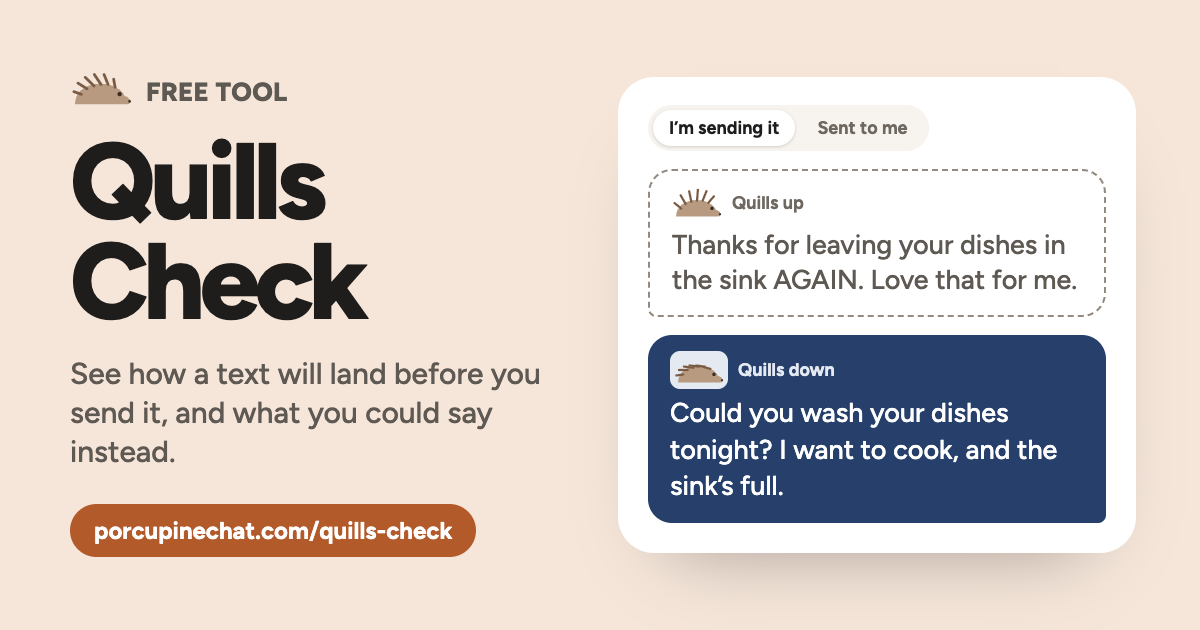
Paste what you want to say about the disagreement. See how it could land, and a version that keeps your point with the quills down.
The Quills Check needs JavaScript. Please turn it on and reload the page.
Work it out without anyone losing
Resolving a conflict doesn’t mean someone wins. It means you both understand what happened, and you both know what happens next. The same five steps work with a coworker, a partner or a roommate. Here they are on one disagreement: your partner made weekend plans with their friends without asking you.
Cool down first
If either of you is heated, take a break, and say when you’ll come back to it.
TryI’m too annoyed to talk about this well right now. Can we pick it up after dinner?
Cool down, then talk ›What one study found
In two lab studies of couples’ conflict, breaks, both ones the researchers imposed and longer ones partners chose for themselves, reduced aggression between partners.
Listen until they feel heard
Before your side, say back what you heard, and ask if you got it right.
TrySo you thought I’d be up for it, and it feels like I never want to see your friends. Is that right?
Active listening, with examples ›Say what happened, and what you need
Talk about what happened, not what kind of person they are, and how it landed for you.
TryWhen the plans got made before we talked, I felt left out of it. I’d like us to decide our weekends together.
I statements, with examples ›Make it you two against the problem
Look for what you both want, and a way that gets you both some of it, without giving up what you need.
TryWe both want time with your friends and some time to rest. What if we do brunch Saturday and keep Sunday free?
Us against the problem ›What one study found
A meta-analysis of negotiation studies found that people who cared about both sides’ outcomes argued less, problem-solved more and reached better joint agreements, as long as they also held firm on what they needed.
Agree on a next step, or agree to differ
End with one small, specific thing, or with knowing where you each stand. If part of it was yours, say so.
TrySo we check with each other before saying yes. Does that work for you?
How to apologize, with examples ›
Say it so it can get worked out
A first message sets the tone for the rest. Here’s the same point, quills up and quills down.
To a coworker · quills upYou just went ahead and sent it to the client without me. Typical.
What’s behind itThe proposal went out without your section. You’d like to see things before they go to a client.
Quills downThe proposal went to the client without my section. Next time, could we check with each other before anything goes out?
To a partner · quills upForget it. We’ll just do what your family wants, like always.
What’s behind itTheir family invited you both for Thanksgiving again. You’d like to split the holidays this year.
Quills downIt feels like we always end up with your family. Could we talk about splitting the holidays this year?
To a roommate · quills upSome of us actually have to sleep.
What’s behind itThe music kept you up past 1 on a work night. You’d like it quiet after 11 on weeknights.
Quills downThe music kept me up past 1 last night, and I had work this morning. Could we keep it down after 11 on weeknights?
Know your conflict style
When something’s wrong, some people say it right away, some go quiet, and some look for the middle. You may have seen five usual names: avoiding, accommodating, compromising, collaborating and competing. No style is the best one. Each works sometimes and trips sometimes.
What’s Your Conflict Style? Take the quiz ›The seven conflict styles ›Common questions
What are the steps of conflict resolution?
Cool down, listen until they feel heard, say what happened and what you need, work on the problem together, and agree on a next step. Lists number them differently, but they cover the same ground.
What are conflict resolution skills?
Staying calm, listening, saying what happened without blaming, owning your part, and solving the problem together. They’re the same at work and at home.
How do you resolve conflict at work?
Keep it about the work, not the person. Talk in private, say what happened and what it does to the work, listen to their side, and agree on one specific next step.
What if you can’t agree?
That can still be a good ending. Understanding where each of you stands counts, and some differences are lived with, not fixed.
What one study found
In seven studies of couples, including experiments, conflict went with lower relationship satisfaction only for people who didn’t feel understood by their partner. Feeling understood went with more conflicts getting resolved, but that didn’t explain its benefit.
Know someone who overthinks their texts?
Find the words with Porcupine
PorcupineWorking it out usually takes more than one message. In Porcupine, I’ll help with what they say back, and get you ready if it’s better said in person.
Porcupine is coming soon. Sign up to be one of the first to try it.
We’ll email you when Porcupine opens and when we add new tools. Unsubscribe anytime. Privacy
Say it better
- I statements, with examplesA message you’re sending
- How to apologize, with examplesAn apology you’re sending
- Active listening, with examplesA message you got
- Professional ways to say it, with examplesA work message you’re sending
Checking something specific?
- Is my text rude?A text you’re sending
- What does this text mean?A text you got
- Is this text passive-aggressive?A text you got
- Apology CheckerAn apology you’re sending
- What does a thumbs-up mean in a text?A text you got
- Is this text sarcastic?A text you got
- Is this text dry?A text you got
- Does this sound needy?A text you’re sending
- Is this text flirty?A text you got
Guides that go with it
- How to calm down an argument before it gets worseAny relationship
- How to stop having the same argument over and overPartners
- How to repair a working relationship after a conflictTeammates
- How to disagree with your boss respectfullyManagers and employees
- How to tell your partner something’s bothering youPartners
- How to make up with your sibling after a fightSiblings
Play Mixed Signals
A daily game: one short text, read a few ways. Guess what they meant, then see how everyone else read it. Play today’s
The Quills Check is general information about communication, not legal, financial or professional advice, and AI can get things wrong. Afraid of how someone might react? Put your safety first, and talk to someone you trust.