Quills Check › Conflict resolution › In a relationship
Conflict resolution in a relationship
Paste what you want to say to your partner. See how it could land, and a version that keeps your point with the quills down.
The Quills Check needs JavaScript. Please turn it on and reload the page.
Not who wins, but how you fight
Every couple disagrees. What matters is how: warmth and working on the problem together, or digs and getting defensive. Here are the five steps on one disagreement: your partner said they’d do the dishes, and they’ve been in the sink for two days.
What one study found
A meta-analysis of 64 studies of couples’ conflicts, from many research groups, found that problem solving and warmth during conflict went with higher relationship satisfaction, and hostility with lower.
Cool down first
If you’re heated, wait until you can say it without a dig, and say when you’ll come back to it.
TryI’m too frustrated to say this well right now. Can we talk in an hour?
Calm down an argumentListen until they feel heard
Hear their side before yours. They’ll find it easier to hear you once they feel understood.
TrySo work’s been swamping you, and the dishes felt like one more thing. Is that right?
Active listening, with examplesSay what happened, and what you need
Say it plainly, about what happened, not about who they are, and ask for what you need instead of hinting.
TryWhen the dishes sit for two days, it feels like it all lands on me. I need us to share it.
I statements, with examplesWhat one study found
In a year-long study of couples, direct requests for change felt less successful in the moment than indirect ones, but went with more actual change over the following year.
Make it you two against the problem
You’re on the same side. Look for a way that works for both of you.
TryWe both hate the pile. What if whoever cooks doesn’t wash, and we do a quick reset before bed?
Us against the problemAgree on a next step
Try something small, and pick a time to see how it’s going.
TryLet’s try it this week and see how it feels on Sunday. Okay?
Ask your partner for help at home
When it’s the same fight again
Some fights come back because they’re about a difference that doesn’t go away: one of you is tidier, one saves more, one needs more time alone. The goal there isn’t ending it for good. It’s understanding each other, and finding a way to live with it.
What one study found
In seven studies of couples, including experiments, conflict went with lower relationship satisfaction only for people who didn’t feel understood by their partner. Feeling understood went with more conflicts getting resolved, but that didn’t explain its benefit.
And if a fight ever leaves you afraid, that isn’t a disagreement to fix with better words. Put your safety first.
Say it so it can get worked out
How it starts shapes how it goes. Here’s the same point, quills up and quills down.
To a partner · quills upMust be nice to scroll your phone all through dinner.
What’s behind itYour partner was on their phone through dinner most nights this week. You miss talking, and you’d like dinner to be phone-free.
Quills downYou were on your phone through dinner most nights this week, and I missed talking with you. Could dinner be phone-free?
To a spouse · quills upSo I guess we’re just buying whatever you want now.
What’s behind itYour spouse bought a new TV without talking about it first. You’d like to talk before anything over $200.
Quills downThe new TV came as a surprise. Could we agree to talk before buying anything over $200?
Common questions
How do couples resolve conflict?
Cool down before you talk, listen until your partner feels heard, say what happened and what you need without blaming, look for a fix that works for both of you, and agree on something small to try.
Is it normal to fight in a relationship?
Yes. Every couple disagrees. What matters is how: warmth and working on it together go with happier couples, and digs and hostility with unhappier ones.
What if we keep having the same fight?
Some differences don’t go away. Aim to understand each other and find a way to live with it, rather than to win or settle it for good.
How do you resolve conflict in a marriage?
The same way as in any relationship: one issue at a time, at a calm moment, about what happened rather than who they are, ending with something you’ll both try.
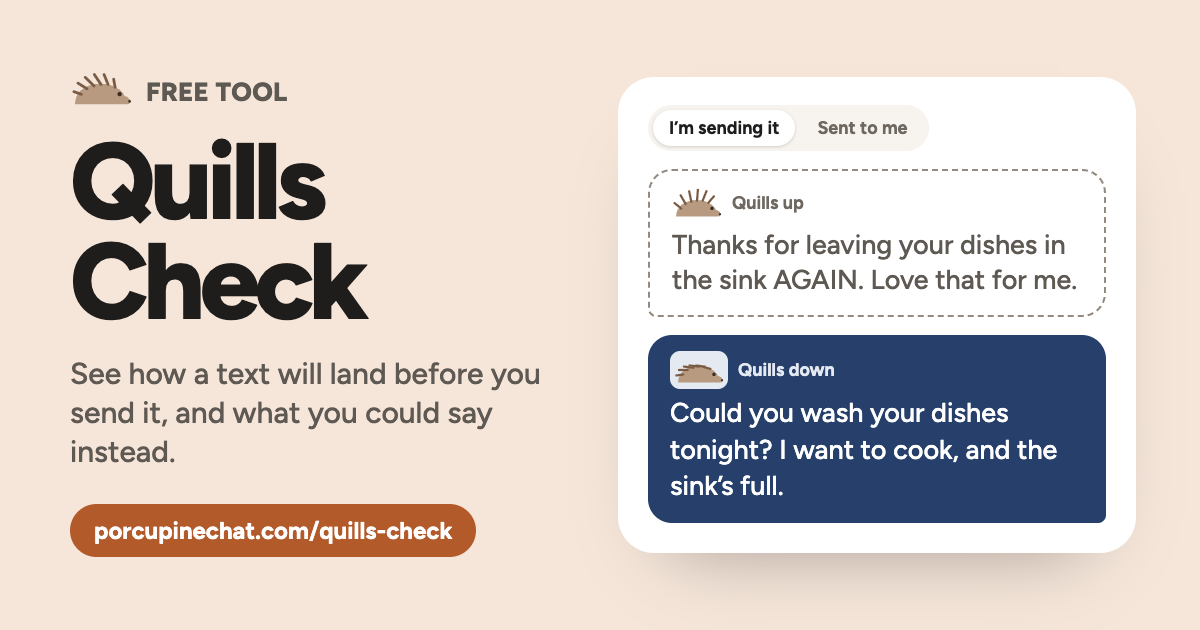
Know someone who overthinks their texts?
Find the words with Porcupine
PorcupineWorking it out usually takes more than one message. In Porcupine, a porcupine chat gives you both a coach, so each of you gets heard.
Porcupine is coming soon. Sign up to be one of the first to try it.
We’ll email you when Porcupine opens and when we add new tools. Unsubscribe anytime. Privacy
Say it better
- I statements, with examplesA message you’re sending
- How to apologize, with examplesAn apology you’re sending
- Active listening, with examplesA message you got
- How to validate someone’s feelings, with examplesA reply to how they feel
- Professional ways to say it, with examplesA work message you’re sending
- Conflict resolution, in five stepsA message about a disagreement
- What to say when someone ghosts youA text to someone who went quiet
Checking something specific?
- Is my text rude?A text you’re sending
- What does this text mean?A text you got
- Is this text passive-aggressive?A text you got
- Apology CheckerAn apology you’re sending
- What does a thumbs-up mean in a text?A text you got
- Is this text sarcastic?A text you got
- Is this text dry?A text you got
- Does this sound needy?A text you’re sending
- Is this text flirty?A text you got
- Text DecoderCommon texts, read a few ways
Guides that go with it
- How to tell your partner something’s bothering youPartners
- How to stop having the same argument over and overPartners
- How to calm down an argument before it gets worseAny relationship
- How to ask your partner for more help at homePartners
- How to talk about money with your partner without fightingPartners
- How to tell your partner what you needPartners
Play Mixed Signals
A daily game: one short text, read a few ways. Guess what they meant, then see how everyone else read it. Play today’s
The Quills Check is general information about communication, not legal, financial or professional advice, and AI can get things wrong. Afraid of how someone might react? Put your safety first, and talk to someone you trust.
Updated