Quills Check › Validating feelings
How to validate someone’s feelings, with examples
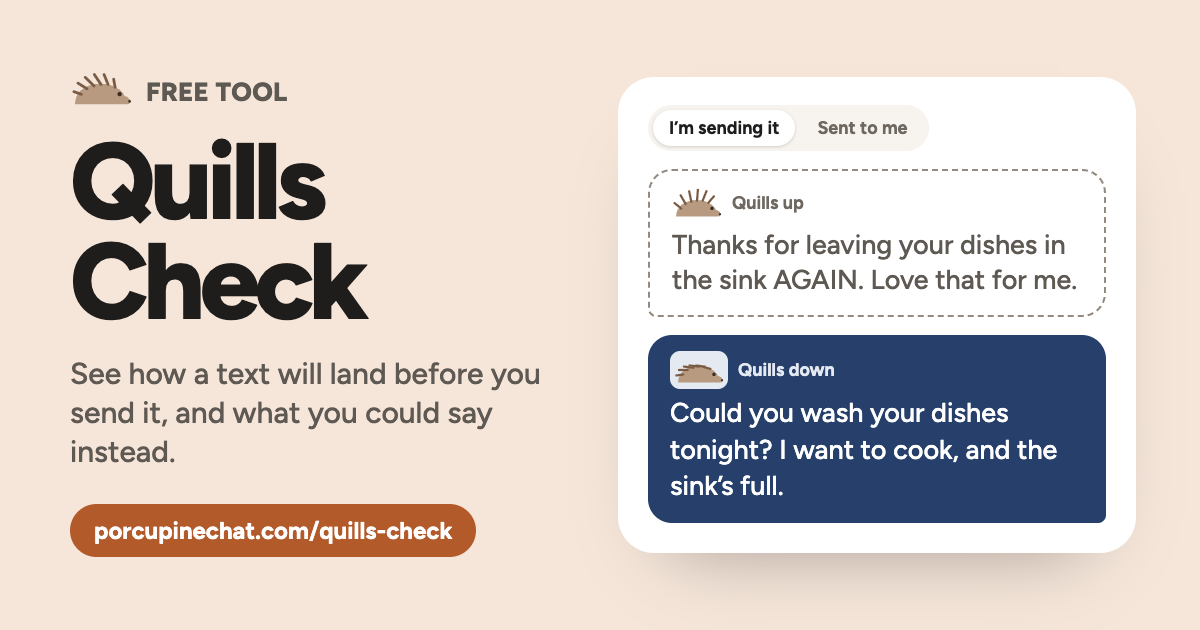
Paste what you want to say back. See if it could sound dismissive, and how to show you get it.
The Quills Check needs JavaScript. Please turn it on and reload the page.
Validating isn’t agreeing
Validating someone’s feelings means letting them know their feeling makes sense. You don’t have to agree with them, fix it or change your answer.
What one study found
In a lab experiment, people who got invalidating responses during a stressful task had more negative feelings, and a higher heart rate and skin conductance, than people who got validating responses.
What it sounds like
- Name what you see: “I can tell that stings.”
- Say why it makes sense: “Of course you’re upset. You were counting on it.”
- Share it, if you feel it too: “I’ll miss it too.”
- Then your side, if you have one, as its own sentence.
Brushing it aside, or validating it
What we say to help someone feel better can tell them the feeling is wrong. From Porcupine’s guides:
- Relax.
- I can tell that stings.Set a boundary with a friend
- You’re being dramatic.
- I can tell that worries you. I’m not going anywhere.Ask for space without hurting someone
- You’ll get over it.
- I can tell that hurts. I’m sorry it does.Tell your ex you don’t want to be friends
- It’s just one weekend.
- I know you were looking forward to it. We’ll miss it too.Decline an invitation from your in-laws
- You need to stop worrying about me.
- I know you worry because you love me.Set a boundary with your parents as an adult
- Don’t make this sad.
- I can tell this is a lot. I’m sad about it too.Tell a friend you’re moving away
- It’s not that big a deal.
- I know this puts you in a tough spot with the rent.Tell your roommate you’re moving out
- That’s just how it is.
- I know this is a stretch. What would make it more manageable?Tell your tenant the rent is going up
Validating without giving in
You can see how they feel and still say no. Say the feeling, then your answer. A “but” between them can sound like the first part didn’t count.
Your in-laws sayWe were really counting on having you all here.
Giving inUgh, fine, we’ll come.
Seeing it, and still noI know it’s disappointing. We still can’t this time. May would be lovely.
Your mom saysIt won’t feel like the holidays without you.
Shutting it downI already told you, I’m not coming. Drop it.
Seeing it, and still noI hear you, and I’ll miss it too. I’m still not coming this year.
Someone you went out with saysCan’t we just try one more date?
Giving inOkay, fine, one more date, I guess.
Seeing it, and still noI understand you’re disappointed. My answer is still the same.
Over text
A text has no face or voice to show you care, so say it in words. A quick “that sucks” or “at least…” can read as brushing it off.
A friend textsI didn’t get the job.
Brushing it offThat sucks. Something better will come along.
Validating itOh no, I’m sorry. You really wanted that one. Want to talk tonight?
Your roommate textsYou still haven’t paid your half of the deposit?? I asked a week ago.
Firing backWow. You’re unbelievable. Don’t text me again until you’ve calmed down.
Validating itI can tell you’re upset about the deposit. I want to sort it out, and I want to answer properly. Can we talk tonight?
Common questions
What does it mean to validate someone’s feelings?
Letting them know their feeling makes sense, given what happened or what it’s like for them. It’s about the feeling, not whether they’re right about the facts.
How do I validate someone’s feelings without agreeing with them?
Validate the feeling, not the facts. “I can see why that upset you” doesn’t say they’re right. Then say how you see it, in its own sentence.
What if their feeling doesn’t make sense to me?
Ask before you decide: “What part upset you most?” A feeling usually makes sense once you know what it’s about.
What are invalidating statements?
Words that tell someone their feeling is wrong, too big or not allowed, like “relax,” “you’re overreacting,” “it’s not a big deal” or “at least…”. They’re often meant kindly.
Is validating the same as active listening?
They go together. Active listening shows you heard what happened. Validating says the feeling makes sense.
Know someone who overthinks their texts?
Find the words with Porcupine
PorcupineIn Porcupine, I’ll notice when a reply might brush their feelings aside, and help you find words that show you get it.
Porcupine is coming soon. Sign up to be one of the first to try it.
We’ll email you when Porcupine opens and when we add new tools. Unsubscribe anytime. Privacy
Say it better
- I statements, with examplesA message you’re sending
- How to apologize, with examplesAn apology you’re sending
- Active listening, with examplesA message you got
- Professional ways to say it, with examplesA work message you’re sending
- Conflict resolution, in five stepsA message about a disagreement
- What to say when someone ghosts youA text to someone who went quiet
Checking something specific?
- Is my text rude?A text you’re sending
- What does this text mean?A text you got
- Is this text passive-aggressive?A text you got
- Apology CheckerAn apology you’re sending
- What does a thumbs-up mean in a text?A text you got
- Is this text sarcastic?A text you got
- Is this text dry?A text you got
- Does this sound needy?A text you’re sending
- Is this text flirty?A text you got
- Text DecoderCommon texts, read a few ways
Guides that go with it
- How to set a boundary with a friendFriends
- How to ask for space without hurting someoneAny relationship
- How to decline an invitation from your in-lawsIn-laws
- How to tell your family you’re not coming home for the holidaysAnyone in the family
- How to tell your ex you don’t want to be friendsExes
- How to calm down before replying to an angry textAny relationship
Play Mixed Signals
A daily game: one short text, read a few ways. Guess what they meant, then see how everyone else read it. Play today’s
The Quills Check is general information about communication, not legal, financial or professional advice, and AI can get things wrong. Afraid of how someone might react? Put your safety first, and talk to someone you trust.
Updated